One of the fun things about playing D&D is that there are so many wild and unheard-of monsters available in the Monster Manual. The Beholder, the Gelatinous Cube, the Displacer Beast – all of these are iconic and brilliant, and bring you right into this strange and magical world.
But sometimes, you want a classic. You want a monster that already lives rent-free in the minds of your players.
They will know the Werewolf instantly.
Werewolves are fantastic monsters to bring into your campaign because they bring everything to the table. You want a good fight? They’ve got you. You want complex social encounters? Absolutely. You want something that emerges from deep and terrifying human fears? Take your pick. The Werewolf has everything you need!
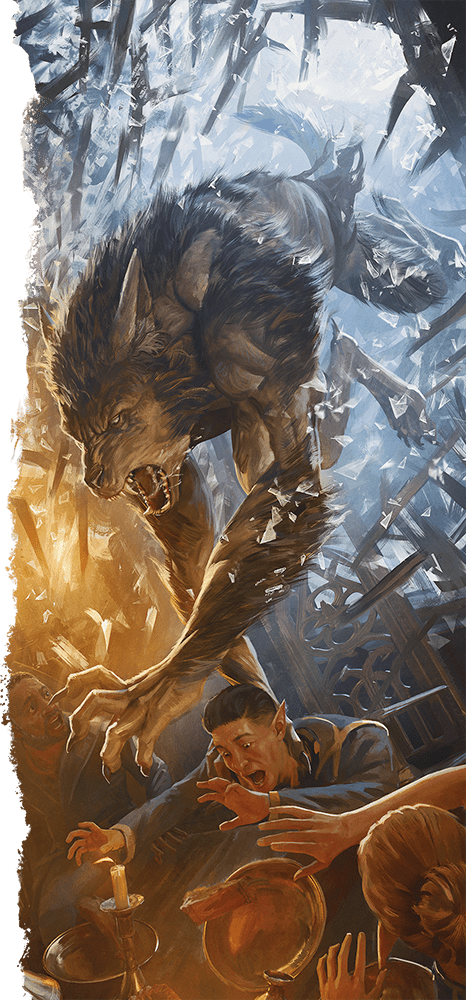
Let’s start with the basics – what does a Werewolf actually bring to combat? Introduce a pack of Werewolves into a fight, and your players may soon find themselves overwhelmed. Fighting together can give the Werewolves advantage on attacks, and their human/animal nature means that they can use human weapons, such as a longbow, as well as their deadly claws and fangs. They have many ways to inflict damage, all of them terrible.
And if your player should happen to be bitten….
Well, that’s where you should probably turn to the 2014 Monster Manual, because that is so much more interesting. Under the 2024 rules, a bitten player has to fail a Constitution save, then drop to zero HP, at which point they turn into a 10 HP werewolf under the DM’s control.
Depending on your table’s style, this may not be a very satisfying outcome. In my opinion, it’s one of a couple of changes that was made where the 2024 version is far less interesting.
You see, the 2014 rules also require a bitten player to make a CON save, but if they fail they are “cursed with werewolf lycanthropy.” Which is, as you well know, SO much more interesting.
There is nothing that can derail a campaign quite so much as a player turning into a Werewolf. And, for some parties, derailment is the whole point.
Now the Party has to track full moons. The search for an ancient artifact or evil wizard suddenly becomes a quest for a cure, and that’s assuming the player even wants a cure!
Lycanthropy in your campaign shifts so many power dynamics and plot points that it can send everything in a whole new direction. This is not an option for the faint of heart, though. If you’re not prepared for some improvisation, or the story you’re telling won’t survive a Werewolf player, then either don’t put them in your game, or make sure there’s someone nearby with Remove Curse who can help out.
There’s another aspect of the 2014 Werewolf that you also might want to adopt, since it both calls back to Werewolf lore and requires your players to plan for a Werewolf attack. This Werewolf was immune to bludgeoning, piercing, and slashing attacks from non-magical weapons that aren’t silvered. This means that if your Fighter hasn’t prepared properly, their blade is useless against the Werewolf, as is the Rogue’s dagger or the Ranger’s arrows.
This immunity will require your players to become more familiar with the lore of the Werewolf, possibly seeking out sages or a grizzled Werewolf expert with a jaunty eyepatch and eight fingers. Maybe all the arrows at the rangers’ outpost are silvered. Perhaps that little village they pass through has kids skipping rope to a chant about werewolves and silver. If one of the themes of your game is “knowledge is power,” having your players seek out Werewolf lore is a great first step.
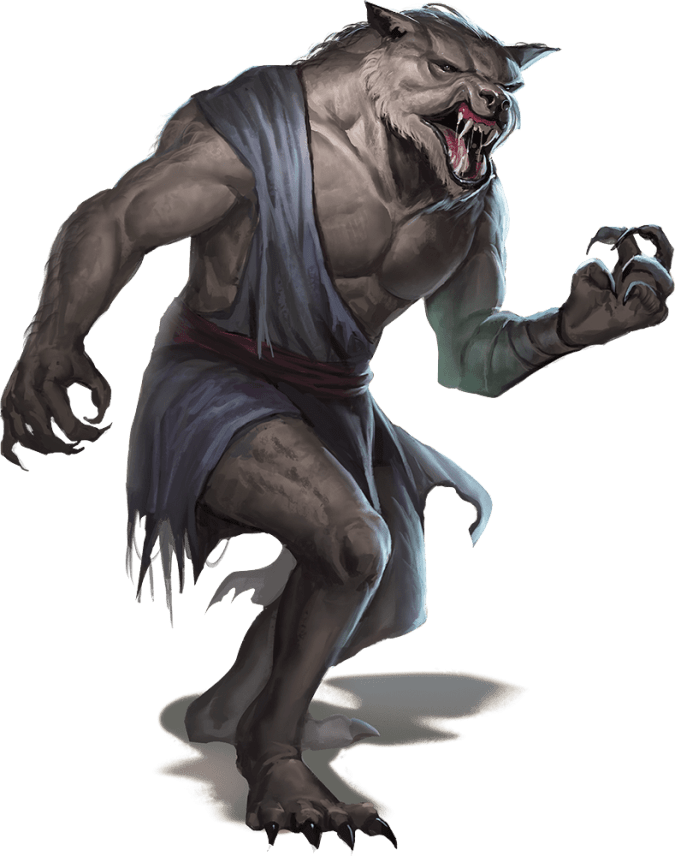
Fun fact: this immunity meant that 2014 model Werewolves cannot injure each other. Their teeth and claws are nasty, but they’re not silvered. Have fun with that.
There’s more to Werewolves than combat, though. They’re intelligent pack creatures, living in complex social groups with competing factions and plans. With that in mind, think about how they can serve your game in a social or political capacity. How you do so depends, of course, on how seriously you want to take the stat block’s note that their alignment is Chaotic Evil.
Ignoring that, you could have a faction of Werewolves that want to integrate themselves into proper society. They’re people, just like us, but with a special little problem they have to deal with. You might have support groups meeting on the night of the new moon, desperately affirming to each other (and themselves) that “The beast does not control me” over coffee and donuts.
Perhaps a public figure outs themself as a Werewolf and has to convince the city that they’re still who they always were, just, occasionally, fuzzier. Your players could seek out a way for them to prove their innocence after a savage murder occurs, or to find a cure to bring them back into public favor.
There could be a disgraced noble house, cursed through their bloodline with lycanthropy. They’ve spent generations in isolation, shunned by others, and their last descendant has hired your party to either cure them, or, if they cannot, destroy them.
If you want to play evil Werewolves, of course, there’s nothing stopping you. A pack of Werewolf bandits would be a great problem for your party to try and solve, or Werewolf insurrectionists who have teamed up with some Druids to fight off the inexorable encroachment of “civilization” into their territory. They may claim to have noble intent, but those dead lumberjacks and miners had families, dammit!
Ultimately, though, Werewolves represent a kind of corruption and loss of control. being a Werewolf has always come with the horror of not knowing what you did when you “wolfed out” for the night. Did you roam the woods, howling and mad? Did you attack a flock of sheep? Did you murder someone in the throes of wild need? Without the memory of those moments, a person is really two people who know nothing of each other, but whose destinies are intertwined.
Being a Werewolf means facing the existential horror that you are, at heart, an animal. You have impulses and instincts that lurk behind your conscious mind, and, under the right circumstances, all the glittering finery of civilized humanity could fall away in a flurry of fur and fangs. In a D&D campaign about transformation and control, the Werewolf is a keystone creature, and examining those who fight the curse versus those who accept it can allow you to explore how we come to grips with the parts of the world that are not only beyond our control, but attempt to control us.
Some D&D games need high-concept monsters that vary from table to table, DM to DM. Bring a Werewolf into your game, though, and you’ll be building on centuries of folklore and tradition, striking a chord of fear in your players that makes them wonder: what kind of monster sleeps within them, waiting to break free?
 Encounter Every Enemy
Pingback: It’s Just a Chicken: The Cockatrice Ecosystem | Encounter Every Enemy