Your Party is making their way from one adventure to another, as they often are, when they come across the carcass of a large elk. It’s been rent and shredded, half-devoured. As they inspect it, looking to see if it is perhaps A Clue, they are surprised by a great rush of wings, and a cry that sounds like an eagle trying to roar. From above comes a creature that looks like it was put together by committee – the forepart is that of a majestic eagle, the rear is that of a powerful horse. It alights, bristling with anger, ferocity, and power, ready to defend its prey against any interlopers.
The Hippogriff is one of those great creatures that belongs to the classic genre of Blended Monsters. Take bits from various normal animals, put them together and you have a Hippogriff, or a Griffin, or a Sphynx. I’m not quite sure what drove people to create these creatures back in ancient antiquity, but I’m glad they did. To my mind, it suggests a belief that the natural world is weirder than we could possibly understand, and while modern science has taken that thought in different, more empirical directions, I kind of miss the days when we could just slap a couple of creatures together and call it a day.
As a natural predator, the Hippogriff occupies a niche that is pretty crowded in D&D – the opportunistic flying hunter. It’s skilled in the air, with the ability to fly without provoking opportunity attacks, and it’s reasonably fast on the ground. But if you just use it as something to fight against, then you’re wasting the potential of this grand and strange beast.
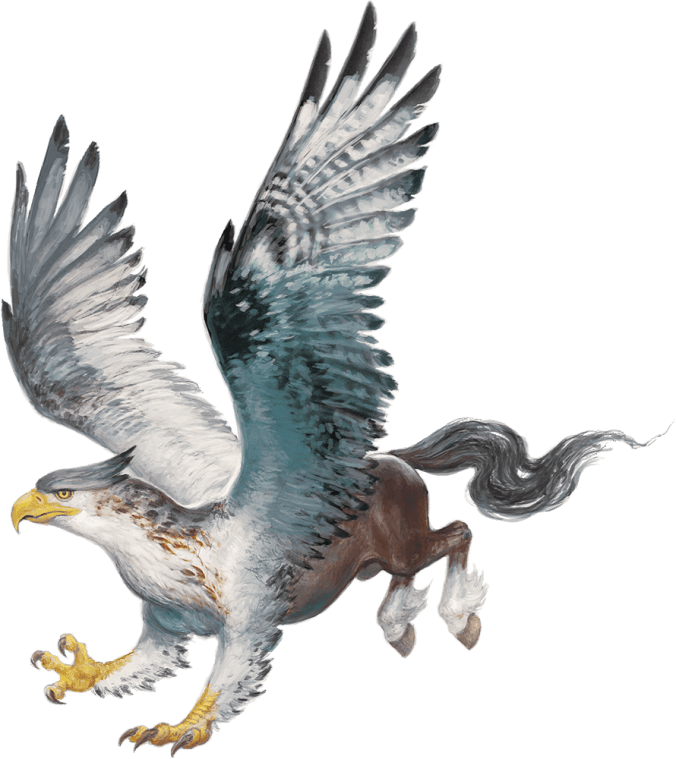
At its heart, the Hippogriff – and other blended monsters like it – are a study in contrasts. Its two components are as unalike as you can imagine. One is a solitary flying predator, all beak and talons, swooping down from the greatest heights to devour any unlucky creature that pokes its head out. The other half is a gregarious herbivore, dangerous in its own right, but never really looking for a fight.
How can these two things coexist? What is the push-and-pull of a creature that is so different in its parts?
Well, that’s a question human society has been trying to deal with for ages. If you’re planning to do a story that examines how conflicting ideas or values can find a way to work together, perhaps becoming more powerful in their partnership, then a Hippogriff is an excellent place to start.
There’s an ancient noble house that has been training Hippogriffs for generations. Their beasts are given to the most noble knights and lords in the land, and their methods and results are unmatched. Until now. Something has gone wrong with the latest cohort of foals – they’re unstable, violent, and dangerous. Is this some kind of magical interference, or are they simply reverting to what they always were – wild animals rather than symbols? Whatever your party discovers, it will change the course of this noble house forever.
If the Hippogriff is a contradiction made flesh, then who might choose to ride one? A knight having a Hippogriff mount is an interesting proposition itself. A knight is meant to be a symbol of law and civilization – a code, a crown, and clean lines of order. So why choose such a mount that is half contradiction?
Well, sure – it can fly is probably a great reason. But more importantly, what does it tell us about this knight, or this order of knights, perhaps, that their adventures must begin with the conquering of an impossible beast. Perhaps this is their last step before finally receiving their knighthood – to find and tame a Hippogriff, bringing order to the unorderly. And there might just be an ambitious young knight who will turn to your party for help.
Bonus points if that knight is really not ready for this quest.
You could use the Hippogriff to make things personal for your players as well. It’s a blending of things that were not meant to go together. Are any of your players multiclassed? Maybe the needs of one of their classes conflicts somehow with the other, creating tension within that character. Their back story might indicate some incompatible parts as well – the rural kid who traveled to the Big City to learn magic, or the Noble who is far happier slumming it with the rogues and pickpockets than trading gossip in court. Your party may itself be a blending of classes, species, or backstories that don’t quite fit perfectly – feel free to lean on the Hippogriff as a symbol of those clashing, unequal parts.
Finally, in our world, the Hippogriff has been a symbol of the impossible. It is said to be the offspring of a mare and a creature that already shouldn’t exist: a Griffin. The probability of a Hippogriff being born is vanishingly small, and encountering one might be a once-in-a-lifetime experience if you’re lucky. This may hold true in your campaign as well (unless you’re running with those Knights I mentioned earlier). You could bring out the Hippogriff as a way to accomplish an impossible task. The Cloud Giant’s castle is miles above the earth. The ancient lich is in a soaring tower that has no doors at the bottom. The burial ground of the undead king is at the top of a sheer cliff face, impossibly high up.
When your players look at a challenge and think, “That just can’t be done,” that might be the time for the Hippogriff to make its appearance.
In a D&D campaign, the challenges might be difficult, and the odds may seem insurmountable. The feuding needs of culture and personality might make a quest seem like it just can’t be done.
But if the Hippogriff is living proof: impossible doesn’t mean unachievable.
 Encounter Every Enemy