Your players are exploring a tomb inside an ancient hillock. After prying open the door, they are led through a strange, awkwardly-proportioned series of rooms and corridors. Some of them are blocked off, others seem to curve in odd ways from one room to the next. Your more perceptive players notice that there are odd gaps where chamber becomes hallway, but there are no secret passages or hidden caches to be found. Your history expert begins to think this doesn’t look like any tomb they’ve heard of.
This place reeks of strangeness. Enough to put even veteran adventurers on edge.
Eventually their explorations lead to a larger chamber, tilted at an awkward angle. It has one wall made entirely of dull crystal, cracked at the edges. There’s a chair in the center of the room, but no ancient king or revered hero sits there in eternal rest. The arms of the chair have small, gemlike buttons and gilded levers, glowing with arcane light dimmed by centuries of dust. Your spellcaster casts Comprehend Languages to read the labels on the buttons, and finds one marked, ACTIVATE.
And so, of course they do.
The room lurches and shifts, dust sifting down from the ceiling. They feel the floor under them rise as it orients itself to the horizontal again, and they can hear the rumbling of thousands of tons of earth and stone outside rolling away, as though the button had triggered an earthquake.
The crystal wall illuminates. Flickers. Words appear, and the wizard reads aloud:
UNIT DESIGNATION: THUELLAN, STORM OF THE MOUNTAINS.
STATUS: ACTIVE
MISSION PARAMETERS: UNCHANGED
DESTROY
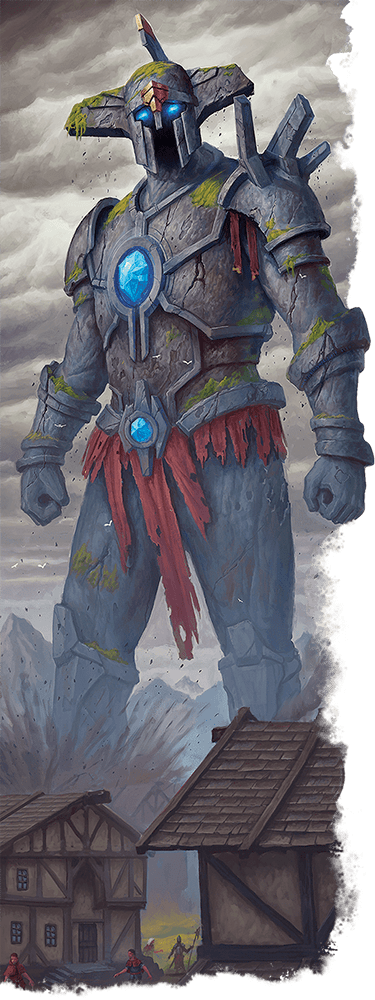
Your players now find themselves in a mountain-that-walks, a figure so large it blots out the sun. With each lurching step, it moves closer to its unknown target, and that target is closer to destruction.
Your players have found a Colossus.
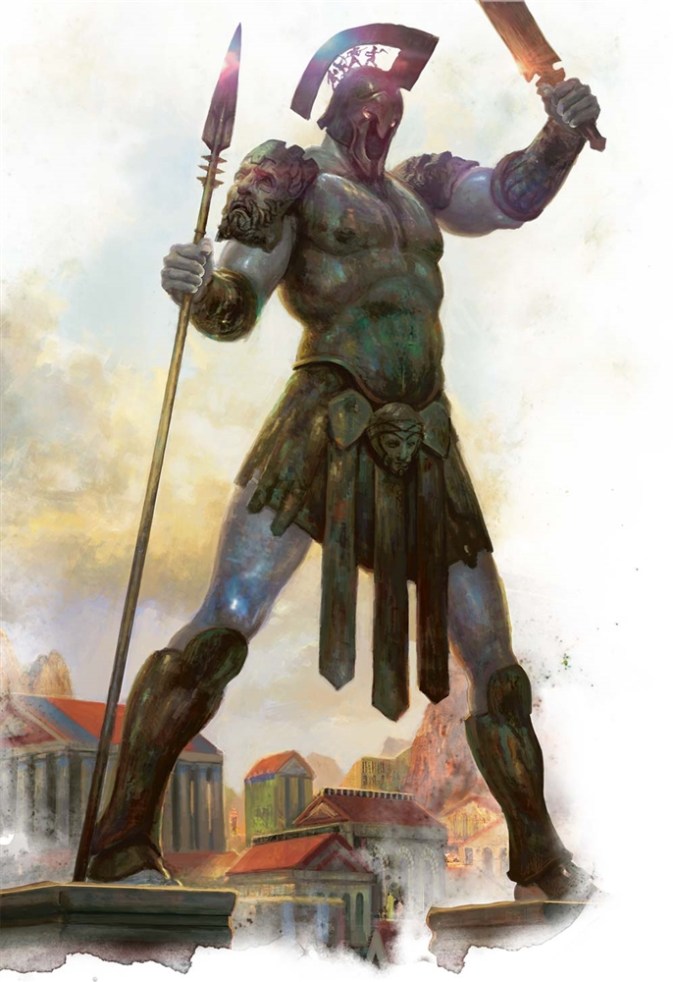
So let’s talk about what, exactly, your players have found here. Colossi in D&D are rare and amazing things. The great war machines of Eberron, the Walking Statues of Waterdeep – they all evoke a mystery in whoever sees them, and it usually comes in two parts.
The first, depending on your disposition, would be Who made these things? A colossus could be an excellent chance for you to establish some of the Deep Lore of your world. Ancient civilizations that once battled not with paltry swords or siege engines, but with giants that bestrode the land, mountains shaking with every footstep. Why did they make them? And — more importantly — why did they stop? What unimaginable catastrophe forced them to abandon these great constructs?
Perhaps it was something as mundane as an economic collapse. Massive walking statues can’t be easy to build or maintain, and an arms race between enemy nations can soon outstrip their ability to pay for them. Perhaps these machines made for terrible war were too expensive for the war they were destined to fight. The money ran out, the nations collapsed. Too much money spent on superweapons instead of food and housing and education.
There might be a lesson in this, if that’s the kind of game you like.
Perhaps they were stopped by an arcane virus. Some plucky wizard, long, long ago discovered how the Colossi used magic to communicate and coordinate their efforts. They crafted a unique spell, designed to insinuate itself into those communications and send a permanent shutdown signal. With these weapons shut down, there was finally a real chance for peace in your world.
And, if you want, perhaps a less noble-minded spellcaster has re-discovered this arcane virus in their explorations and is using it to dominate the community of wizards in the present day. Your party’s exploration of an ancient Colossus might be the key to stopping them.
The other question you might ask about a Colossus would be, How do we fight it?
If that moment arises, you have so many options available to you. For one thing, the Colossus isn’t on the battlefield – it is the battlefield. In order to stop it, your players will have to get inside, because just standing around and whacking it with swords isn’t going to do very much. It has an ungodly number of hit points, is resistant to magic, an if any of your players thinks they can just Polymorph it into a snail or something, they can guess again – the Colossus will not be changed.
This isn’t in the stat block, by the way, but here’s something you can add to it: a Damage Threshold, a trait common in a lot of structures and really sturdy objects in D&D. If an attack or effect doesn’t do at least a certain amount of damage, say 30 HP, it does nothing. Your players will realize pretty quickly that this thing can’t be stopped by brute force alone.
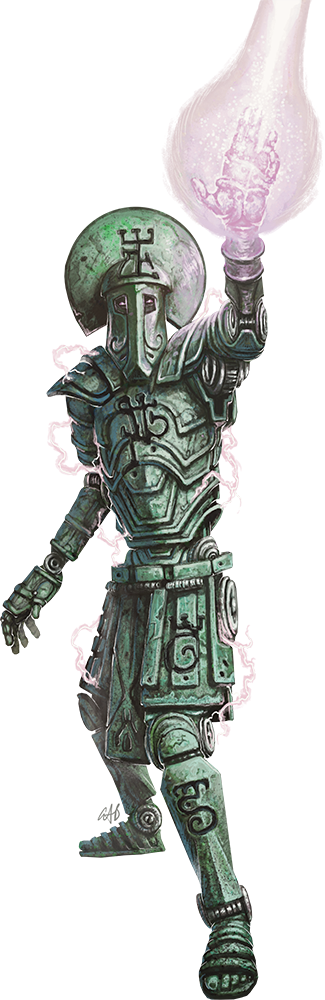
And if they try, they’ll run the risk of being Slammed by the great machine, shot by its Radiant Ray, or – and this is my favorite – reduced to dust by its Divine Beam, a disintegration ray that can reduce everything it touches to a fine mist.
Getting inside the Colossus should clearly be the safer option. At least until they meet all the cleverly re-skinned Modrons you have patrolling its halls, looking out for invaders….
What if stopping the Colossus isn’t just a matter of hacking and slashing? The animating force of the Colossus might be a sentient soul, a creature that they can talk to and negotiate with. Perhaps it was bound in service long ago, and wants nothing to do with the mission of destruction. If your players can figure out how to release it, they can stop the Colossus and save a life.
Unless it refuses to stop. It believes in its mission wholeheartedly, and the new goal is to convince it, somehow, that it is wrong. Its war is millennia gone, and now it’s just killing innocents. This ancient spirit may have to come to grips with the knowledge that its time is over and its mission has failed.
Which should, in my opinion, lead to the inevitable self-destruct sequence which will also, in all likelihood, take out the city.
Good luck with that.
What’s more, this could just be the start of your campaign. The rest of it could be all about who activated this thing, and what their intentions are. Is this an ancient Colossus brought back to life? Has someone discovered the secret to making a new one, and if so, how did they keep it secret until this point? Are there powerful people trying to re-start a forgotten war, ignorant of why the war ended in the first place?
Finally, if you’re a truly generous DM, you could set up a scenario like the one we opened with. Your players have to stop a Colossus that is bent on destruction. The clock is ticking as they scramble to uncover its mission and its history. And if they succeed? Well – there’s no reward quite like a new home base that could, under the right circumstances, become an engine of unbelievable destruction.
That’s how truly great D&D stories are made.
 Encounter Every Enemy
Pingback: Monthly Monster Mashup 10: Colossus + Swarm of Rats | Encounter Every Enemy
Pingback: Shambling Mound: The Immune System of the Dungeon | Encounter Every Enemy