The terrifying thing, I think, about a Swarm of Rats isn’t that it’s rats.
It’s the sound.
A little skittering on the brick or concrete floor of the sewer tunnels. Soft at first, as one of them ventures out to see what’s out there. And then more and more – like raindrops on the roof. Incessant. Driving. But not random, like rain.
There’s a rhythm to it. A flow, as the swarm moves, rushes towards you. The clicking of hundreds of tiny nails almost overpower the eager squeaking noises coming from behind a thousand teeth as they surge towards the poor, lost giant that they intend to devour, leaving nothing but bone and memory.
Swarms as a creature type in D&D carry a certain kind of terror. Part of it is that they’re undefined. You don’t know exactly how many creatures are in a Swarm, just that they’re crawling all over you, moving around in such a way that counting them seems impossible.
Additionally, swarms can do something that few other creatures can do: it can occupy another creature’s space. It can move with that creature, biting as it goes.
That’s about as far as the Monster Manual takes it, but there’s no reason you can’t take it further.
The Swarm of Rats might not be intelligent, but they’re well-coordinated. They can perhaps use the Players themselves as a type of cover from injury – if one Player tries to hit a Swarm that’s in the same space as another Player, feel free to lovingly transfer that damage to the poor sap who’s already covered in rats.
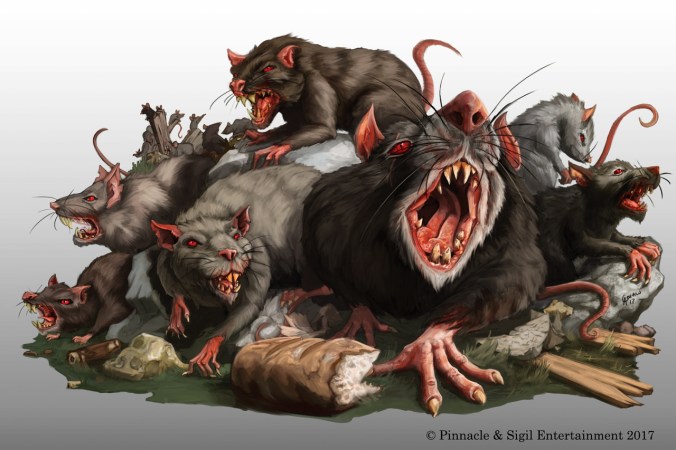
They can slip under clothes, into open packs, and exploit wounds. Maybe they can make it harder to pick up dropped gear, or steal things from a backpack before a Player notices. They can squeeze into places your Players can’t, making them harder to track down and kill. They can climb the walls, coming at the Players from literally any direction.
It’s very easy for Players to underestimate a Swarm of Rats, but a good DM absolutely shouldn’t.
For one thing, you can use a Swarm of Rats to reward player movement. They get up on boxes and crates, set the floor on fire, or use other means of terrain control, so now it’s not just a fight, it’s a desperate attempt to change the battlefield to your advantage. The inverse of this is that you might use the Rats to move the Players, directing them towards the particular passage you want them to visit, or away from one you don’t.
Think of your Swarms like a weather pattern, rather than discrete creatures. In one part of the encounter, they’re ahead of your Party, cutting them off from safety or resources. In another, they’re behind, nipping on your Party’s heels and waiting for them to stand still for just a little too long. And when they’re too badly hurt, they split off, or surge, or flee to recover and regroup.
With a little creative thinking, misdirection, and some very stress-inducing music at the table, you’ll make your Players regret coming into the sewers today, no matter what they thought they would find down there.
Of course, it doesn’t always have to be sewers.
A small village near the city is known for its grain production. They out-harvest everyone in the region, and produce some of the best breads, flour, and other products around. They’ve become incredibly prosperous, attracting scholars from all over the continent who want to study their agricultural practices.
But once a month, everyone in the village locks themselves inside their homes, leaving a gift of grain out by their door. Usually, this grain is gone by morning.
Not this time.
This time, the Rats are still hungry.
Or perhaps the Rats gather in the forest, slinking through the underbrush and building nests under fallen logs. They bother no one, and live a reasonable, ratty life.
Recently, though, the Rats have discovered a new hole that has opened up in the ground, jagged and sulphureous. The Rats have started to gather there, listening to what lives far below. Something with a mind like broken glass and a voice that only the tiniest creatures can hear.
It’s teaching them things. New patterns. New ideas. Turning them into not just woodland creatures, but a single force that can operate at the direction of a strange and angry mind.
This is their forest now, and woe betide any luckless Adventuring Party that finds their way in.
Ultimately, it’s important to remember that a swarm isn’t a monster.
It’s a reminder: sometimes, in D&D as in life, danger doesn’t come in one big problem.
Sometimes it comes in a hundred, skittering small ones, all moving in the same direction.
Right at you.
 Encounter Every Enemy
Pingback: Monthly Monster Mashup 10: Colossus + Swarm of Rats | Encounter Every Enemy