Most monsters in the Manual have a predictable relationship with the living. Either they’re trying to eat you or trying not to be eaten by you.
But there is one monster in the Manual who isn’t really interested in your players.
It’s interested in their stuff.
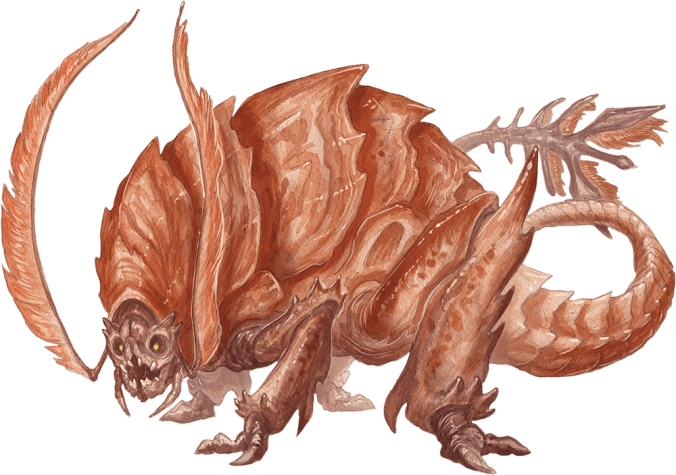
Picture this: your Party is roaming through the Underdark, navigating by the lights of bioluminescent fungus or fiery mushrooms. Then they hear the dry clicking of chitin on stone, the shift of hard scales. They might think they’re Ankhegs or perhaps a Carrion Crawler, but it is not until tiny rust marks begin to flake off the Fighter’s sword that they realize it’s something much more terrible.
It’s a Rust Monster.
And Rust Monsters don’t take blood. They take confidence.
What makes a Rust Monster scary isn’t the attacks it can do. At CR 1/2, they’re not lethal—33 HP, a 5-damage bite. A level-2 party shouldn’t break a sweat. Physically.
The thing with physical injury in D&D, of course, is that every player knows that a Long Rest will cure just about anything. Knocked down to 1 HP by a Beholder? Hey – if you can get back to camp, you’ll wake up fresh as a daisy the next morning.
Players know injury is temporary. Gear loss? That’s a dent in the soul.
This means that an encounter with a Rust Monster will bring a different kind of fear than almost any other monster encounter, with different emotional stakes for the players. They know that the destruction of armor or a sword or other equipment will come with permanent consequence, and that’ll create a whole new level of tension.
Watch your players’ faces as you describe the metallic sizzling of their blade rusting. Chef’s kiss. Best thing ever.
So when you’re running a Rust Monster, you of course want to prioritize whoever has the most metal on them, which will almost certainly be a martial player. Not predators. More like ambulatory garbage disposals following scent alone, and they’ll start taking apart every piece of steel they can find. This will force your other players to intercede, maybe looking for ways to draw the Rust Monsters away and reduce the chance that your Fighter will fail five DEX saves in a row.
You can amplify this with challenging terrain – narrow paths, cluttered ruins, any kind of space where retreat is difficult and potentially dangerous. How fast can you get through these monsters, and how much of your stuff are you going to lose?
You can also think about who to pair them with. They go really well with creatures that don’t use metal, of course, as well as other creatures that dissolve and eat away at things. This means putting Rust Monsters with various oozes or elementals that corrode or disrupt matter—earth elementals in rust-rich caverns, or mephits made of acidic fumes. These might create a really interesting encounter where everything is trying to not just eat the Players, but to unmake them.
There’s also some creative twists you can play with. For example, your players might come across a cavern littered with rusted blades and corroded armor, growing into a pile of rusted jagged metal. In the center, like a queen ant, sits the Rust Monster Queen, fat with trace metals and surrounded by her kin. And if, by some strange means, your Party’s McGuffin is in her nest, well, you can wish your party luck and start working on your next merchant NPC.
Give her a 10-ft Corrosion Aura: any nonmagical metal that starts its turn within range must save or take a place on the ‘oh god not my heirloom sword’ track.
Or try this – your Party has to deal with a pack of Kobolds, maybe in search of clues to a dragon’s lair. But the Kobolds are clever creatures. Before all the traps and winding warrens, they have several caged Rust Monsters. They flank the entrances, waiting for someone with some nice juicy metal to come by. Have enough of these, and your Players will be in their undershorts before the combat even begins. It’s the perfect kobold trap: cheap, vicious, and humiliating. The trifecta.
And while the Rust Monsters might not think of this, you certainly will: there are some fighters with beautifully crafted blades, armor that has been passed down for generations, a shield that carried them through countless battles.
Target them first. Just sayin’.
If you don’t want your players to stop coming to your games, of course, you can do a few things to minimize crisis. Telegraph the danger with rusted equipment near the Rust Monsters’ territory. Put a weeping fighter in a shop buying cheap plate because his gorgeous ancestral armor is now artisanal orange powder.
You could also set up alternative solutions for your players, like using scrap metal to redirect it and move it where the Party wants it to go.
If you want to test your players’ courage, throw a dragon at them. If you want to test their wits, put them in front of a Hag.
But if you want to test their resolve – give them a Rust Monster. Nothing reveals a party’s soul like the sound of a sword turning to dust.
 Encounter Every Enemy