Most creatures in the Monster Manual are dangerous because they want to be. They might be clever or territorial, hungry or greedy, magical or mundane. Or they might just have a policy of “kill all that moves.”
The Ankylosaurus is dangerous because it doesn’t care you exist. It’s not a creature that plots or hunts. It probably doesn’t even get annoyed. It’s a walking siege engine that might just so happen to want to occupy the space your Party is in right now. And in that moment, your Party goes from being a plucky band of adventurers to a physics problem.
This is a slow, cheerful bulldozer with legs – not a problem to solve.
And that might actually be more terrifying.
A lot of people, when you talk about dinosaurs, think of the predators. The T-Rex, Velociraptors, that one weird one with feathers that looks like a taxidermy accident. You ask about herbivores and they think, “Oh – it eats plants, so it must be harmless.”
Oh, bless their hearts.
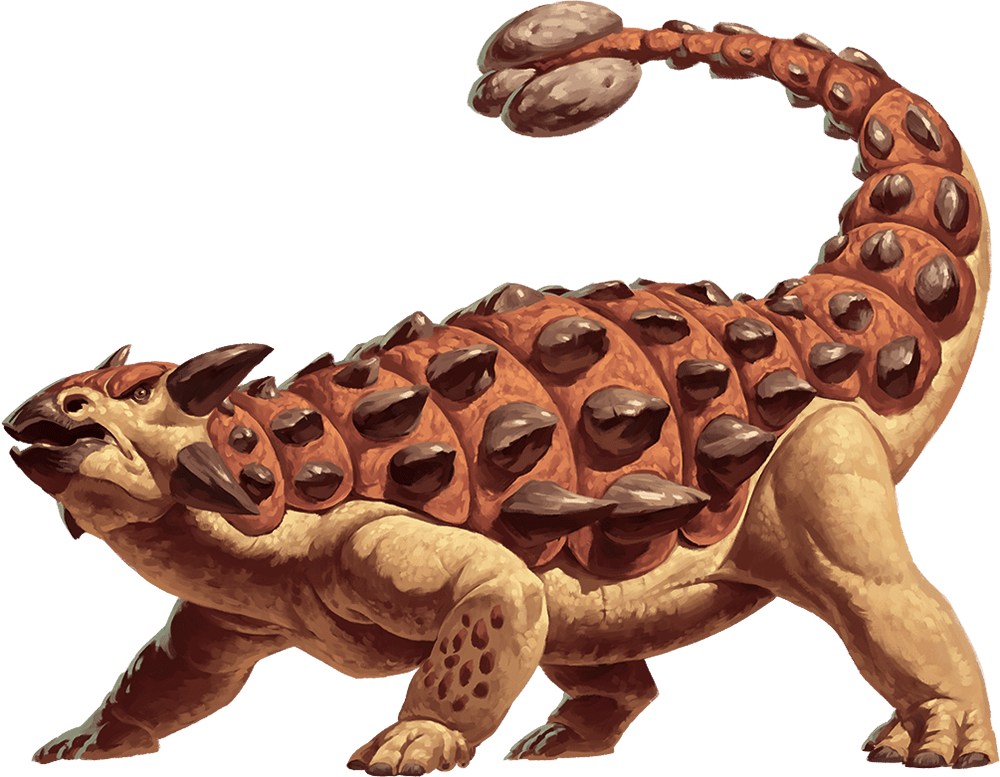
This creature is covered with rock-hard scales the size of dinner plates, built like a fortified wagon, and armed with a tail club that essentially says: What if a wrecking ball had opinions? That tail can one-shot a low-level character if you roll well enough, and can even give more advanced characters a moment of deep pause to reconsider their life choices.
The Ankylosaurus doesn’t really fight in the way that other creatures do. It just decides where it wants to be, and then proceeds to utterly demolish everything between where it is and where it is going. It simply moves, and anything that gets too close gets a 50-pound tail club to the face. Not because it’s angry or hostile, but because it is a 4-ton land turtle with a built-in “no thank you” mechanism.
And when that tail hits, someone is going to have a bad day. The Ankylosaurus gets to swing twice, and a successful hit not only does damage but will knock most creatures prone. If it was lucky enough to whack one of your Players on the first hit, the second will almost certainly be worse.
So when you put an Ankylosaurus encounter in front of your players, run it like a hazard of geography. The Cleric tries to flank it? TAIL. The Rogue hides behind a rock? Rock becomes gravel. The Wizard backs up? The Ankylosaurus just rotates a few degrees and turns the Wizard into landscape.
This is really the fun part of this creature – your Players don’t have to fight it. The Ankylosaurus just wants a few simple things: berries, shade, mud, maybe a nice place to lie down. And it wants these things with zero awareness of adventurers, wagons, goblin camps, fences, or buildings.
This can lead to wonderful moments like when your Players encounter a house with a dinosaur-shaped hole going through it. Goblins fleeing a camp that looks like it’s been hit by God’s rolling pin. Your Ranger running for their life, screaming, “IT’S COMING RIGHT FOR US!” as this amiable landslide just keeps moving.
You have so many ways to incorporate this into your adventure if you want to. For example, your Players are moving through a narrow canyon on their way from Evil Temple to Haunted Lair. Blocking the way is this massive creature, taking a little nap. Your Druid will quietly explain that waking it would be… unwise.
Your Players might be on an escort mission, helping a merchant get from Waterdeep to Neverwinter. Your Players will, of course, be on the lookout for bandits and raiders and menaces. But what if the wagons smell nice, and this massive lumbering thing decides to investigate?
Bonus points if the merchant is transporting incredibly fragile things, like small ceramic angel figurines or wedding cakes.
If the setting is right, you could even change a whole combat scenario with one of these. Picture it: your Players are battling a goblin camp, trying to get the upper hand even as they try to cut your Players down. Suddenly, and with seemingly no situational awareness, God’s own spiky bowling ball just lumbers through the battlefield, completely changing the face of combat because there’s a really tasty plant right over there, and it’s hungry.
So when the session is over and your Players are doling out the healing potions, or trying to remember if they know anyone who can raise the dead, you can lean back and ask, “So. What did we learn?“
What they learned – hopefully – is that a creature does not have to be evil to be dangerous. Sometimes the world has weight, and when that weight shifts, it rarely cares about the squishy adventurers that get caught underfoot.
Not every problem is personal. Not every threat is intentional.
Some things are just… bigger than you.
In those cases, maybe the best thing you can do is not to fight it, but to convince it to move in literally any other direction.
 Encounter Every Enemy