It is a fine thing to do one’s duty.
Legends and stories abound of people who have done their duty – to their country, their family, themselves – and how noble this dedication might be. Even when doing your duty leads to disaster, we still love these stories because we want to believe that it’s possible to devote yourself to something bigger than you. To have purpose in a world that sometimes seems purposeless and random.
But what happens when you outlive that duty? When the obligation you signed up for no longer exists, and the responsibility that guided you is lifted from your shoulders?
It would be a hard transition, but I think most of us would find a way to move on. Find something else to dedicate ourselves to or work towards. We change when change comes upon us. But for some, the change never comes.
This is the Gorgon’s curse.
Gorgons are constructs that have their roots in unimaginable hubris. Wizards of old combined the bones of a bull, the blood of a Medusa, and the brain of a Basilisk and sealed it all inside a shell of enchanted iron. And then, having accomplished this absolutely unholy feat of arcane creation, they told it to guard the house and then forgot about it.
And don’t get me wrong: Gorgons are absolutely tops at things like guarding the house. If anything out of the ordinary comes around, it will likely be turned to stone. And then gored. And then decisively trampled.
As part of their construction, the Gorgon exhales terrible arcane gas that can petrify those who get caught in it. This is a noxious exhalation born from the forced marriage of basilisk brain and medusa blood.
It doesn’t breathe this gas strategically. It’s not angling for maximum effect. It breathes because the arcane energy inside its iron lungs is a constant, grinding agony, a magical spasm trying to escape the unholy thing it has become.
Knowing this mindless obedience is essential for setting up a good Gorgon encounter, and providing that knowledge is essential to your Players’ success. They may think they can trick it or just charge at it, but that would be deadly.
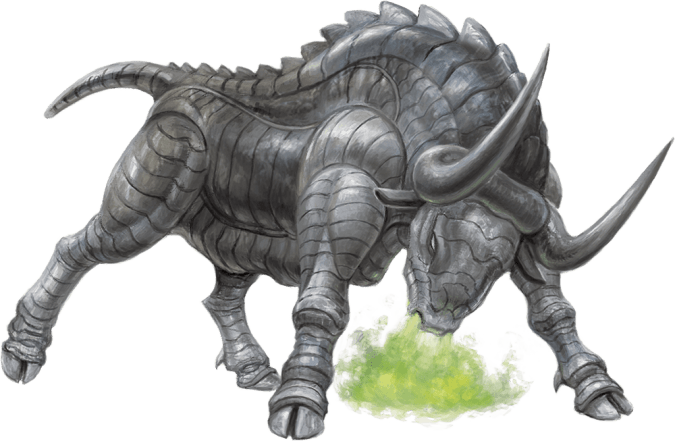
Maybe what it’s guarding is still there, or maybe it isn’t. The vast treasury could be empty. The arcane library burned. The temple overtaken by nature. Whatever the Gorgon is guarding is irrelevant. The Gorgon only understands the simple, clear command it was given long ago: If it moves, stop it.
For the DM, the Gorgon is deceptively simple to run. There is no cunning strategy, only relentless commitment. You simply plot the shortest, most brutal straight line toward the nearest intrusion. Your Players, if they’re smart, will doubtless try to kite the Gorgon somehow so that it can be dealt with from afar by ranged attacks, so make sure the landscape is filled with obstacles and choke points to block line of sight and get stuck.
This encounter design actually serves another, more insidious purpose.
The Monster Manual suggests that each Gorgon has a Command Key – a circumstance under which it will not attack, presumably to allow its master or creature to pass. This could be singing a specific song or wearing a particular mask or even offering it a drink of some kind to slake its thirst.
You can build this information into the leadup to this encounter, as well as this very important caveat: “Should someone provide the command key, the monster ignores that intruder so long as the intruder remains in its sight. But if the intruder ventures out of sight and then returns without again presenting the command key, the gorgon attacks.” (emphasis mine)
What this means is that the moment the Gorgon loses line of sight on a player – if they turn a corner or pass behind a pillar or, even more fun, hide behind your big beefy Paladin – they have to present the Command Key all over again. Now the scenario is not just about how to placate the Gorgon, but how to make sure it stays placated long enough for the party to get to what it’s looking for.
There is a Gorgon variant available in the Manual, if you want – the Brazen Gorgon. It lacks the Petrifying Breath, but has exchanged it for the ability to capture creatures within itself and carry them around with it, keeping them out of the fight until the Gorgon is defeated or the creature escapes.
And, of course, there’s no reason you can’t use both, creating a truly punishing encounter where some PCs are locked down while others are desperately trying to avoid petrification.

Choose your cruelty wisely.
Knowing the protocols of the Gorgon allows you to make any number of quests just that much harder. Let’s say one of your PCs has inherited a Keep. Good for them, except that the Keep is guarded by a Gorgon, and no one knows what the Command Key is. Your Players need to either destroy it (the boring option), re-discover the Command Key, or find a way to set a new Command Key, arguably the most fun of the three options, as it can trigger a whole new set of quests just by itself.
Whether it guards a ruined temple or an abandoned diamond mine or just the dilapidated keep of a wizard who forgot to turn off his security system, a Gorgon offers your Players a unique challenge, and perhaps an important lesson:
It is a fine thing to do one’s duty. But it is also a fine thing to be able to lay that duty down when it no longer serves.
The Gorgon can’t make that choice, but your Players can.
 Encounter Every Enemy