We all know what a Knight is. A hero in armor, often riding a powerful steed, whose job it is to protect their kingdom and all those within it. The Knight is a master of warcraft, able to face an enemy with lance or sword or bow as necessary, and will devote their life to taking down whatever threat is in its way.
That’s how we think of Knights: great heroes.
But the true power of a Knight comes not from their martial prowess. It’s not about the shining armor or the gleaming blade.
The true power of the Knight comes from their willingness to put their master’s will above all other considerations.
In order for a Knight to exist, generally speaking, they must have someone to knight them. They need a Sovereign or a Ruler or a King or a Queen. Being a Knight means being in a state of service to another, more powerful will.
And sure, there’s a certain romance to that. Knowing that you are a part of a larger cause is an attractive proposition, and if the ruler you follow is righteous and just, then being their Knight – being an extension of their will – is a very attractive proposition.
But what if they’re not?

What if, by sacrificing their conscience to an authority, the Knight is actually one of the most dangerous people your Players will meet in a D&D game?
The 2024 Monster Manual provides us with two Knights for our games, one considerably more dangerous than the other.
The Knight is a CR3 fighter well-tuned for martial encounters. They have two attacks with an Greatsword and/or a Heavy Crossbow (a feat of logistics best ignored in-game) and are able to parry an attack that might otherwise do damage to them. They’re your troop commanders, often leading squads of other fighters in the field, attended by squires and other people to make sure their armor is shiny and their sword is sharp.
In your world, they’re a step above your average foot soldier. The ruler they serve might send them to negotiate a deal or put down a rebellion. They are, in essence, the practical pillar upon which their ruler’s power rests. If their ruler is a good person, the Knight will enforce justice and fairness in the realm, making sure the goodness of their master is maintained. They may want to work with your Party to ferret out injustice or to help put down a rebellion.
If their master is a wicked person, however, the Knight becomes the armored bully, wielding power not because it is right, but because they can. Shaking down farmers and peasants, assaulting travelers on the road, carrying out impulsive acts of cruelty because in this moment, they are the law, and there is no one to tell them no.
Except, maybe, your Party. If they are so inclined. And what can be more fun than taking down a corrupt realm, one Knight at a time?
The Questing Knight is the NPC version of a Paladin. They come in at an impressive CR 12 and have an array of abilities beyond simply whacking things with a sword until they fall down.
I mean, they can if they want. But there’s so much more that they can do.
They get three attacks with a Greatsword and/or Longbow, dealing not only the physical damage but also Radiant damage with every hit – potentially doing about 100 points of damage in one round. On top of that, they can cast spells – they have Daylight, Dispel Evil and Good, Greater Restoration, and Phantom Steed in their repertoire. All solid spells that can make a Questing Knight an invaluable ally.
Much like the regular Knights, it’s expected that the Questing Knight will travel with an entourage. They’ll bring their friends and servants, lesser fighters and ambitious Knights to fight by their side. And with the power of their belief, their unshakable righteousness, the Questing Knight makes their friends stronger – immune to being Charmed or Frightened.
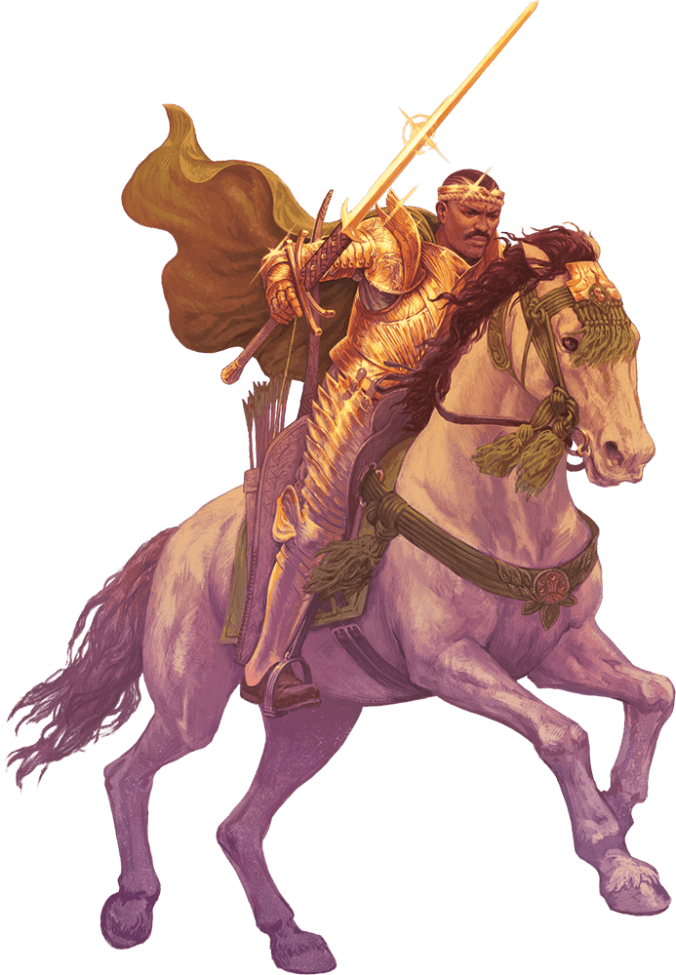
A person like the Questing Knight may have transcended the service of something as paltry as a mortal ruler. They, like the Paladins they emulate, serve an Idea, a Vow, or a Cause, and that fanatical devotion makes them truly terrifying. Their devotion is absolute and non-negotiable, and whatever goal they have set their mind to is the only concern they have.
This unstoppable force is a great way to complicate your Players’ schemes. Perhaps they’re trying to retrieve a holy relic in your Party’s possession. Or the Dragon that your Party decided to spare? It is destined to be slain by the Questing Knight.
Figure out what your Party is doing, build a Questing Knight in opposition to it, and watch the sparks fly. Have the Knight dog their every footstep, pursuing them from town to town because they violated some principal held precious only by this very, very powerful person who has decided they need to pay for it.
With either Knight, if your Party is powerful enough, they’ll probably defeat it.
But that’s not the real challenge of the story. The real challenge is figuring out where the Knight’s loyalty lies, and how that loyalty ended up putting them at odds with the Party. To whom – or to what – did that Knight owe fealty, and what happens now that the Knight is defeated?
The ruler whom they served is still there.
The cause they followed is known to others.
It won’t be long before another fanatic in shining armor astride a silver steed comes looking for your Party.
If they want to know peace, defeating the Knight is only the first step in a very long chain of events that will test their understanding of right and wrong, and where they lie on that murky, difficult spectrum.
 Encounter Every Enemy
Pingback: The Impossible Beast: Hippogriffs and the Power of Contradiction | Encounter Every Enemy