The Underdark is not a place for the faint of heart.
There are the Drow, of course, and there are creatures that burrow through the earth and that overwhelm the mind, but those kinds of creatures are understandable. They have familiar minds and needs. They can be tricked or bargained with or even, in rare cases, befriended.
But the large, vaguely humanoid thing lumbering towards your party down a narrow crevasse in the shadowed dark is not a thinking thing. It moves on a very basic impulse: find-and-eat. This is not up for negotiation. If there is anything else that it wants, it is not comprehensible to a human mind.
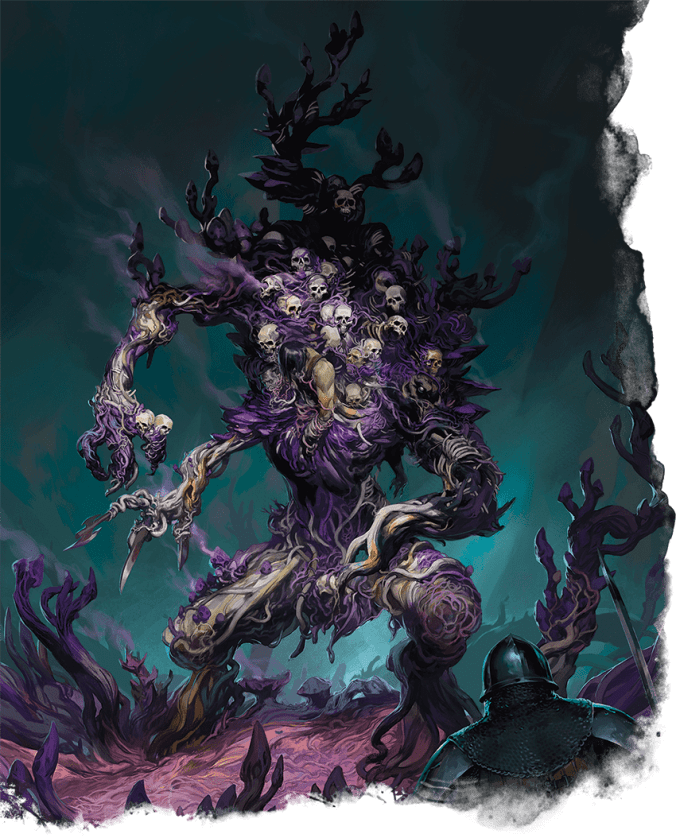
The Violet Fungus Necrohulk is one of several Fungi in the 2024 Monster Manual, and it is terrifying in its strange, alien way. A creature reminiscent of the fungal zombies in The Last of Us, it is fairly fast, strong, and poisons everything it touches. On top of that, should a creature be so unlucky as to fall into its grasp, the creature can become Grafted to it, stuck in place and less able to resist the Necrohulk’s poisonous exhalations.
If that creature should be so unlucky as to die in the Necrohulk’s clutches, they become fully absorbed within it, and the terrible fungal creature regains the health it needs to absorb someone else.
The great thing about the fungi in D&D is that they don’t have to be confined to the Underdark – anyplace that never sees the sun is a perfectly good place for these weird and incomprehensible things to grow. An old forest, a forgotten dungeon – even the basement of your Party’s favorite tavern might find itself the home of these things. And the Monster Manual give you a good variety of fungi – from the irritating to the downright deadly – to play with.
The Shrieker Fungus might seem to be the most innocuous of the Fungi. It doesn’t hunt or move, and doesn’t even have an attack to wield. What they can do, however, is contained in their name – if they’re disturbed or exposed to sunlight, they emit a terrible noise that can be heard up to 300 feet away for a full minute.
So no matter how sneaky your Party is being, if they don’t notice these things – or know what they are – everything and everyone nearby will know they’re there.
For Shriekers in isolation, that can put a damper on the Party’s exploration, certainly. But there’s no doubt that certain people who know Shriekers can put them to good use – encircling an encampment, perhaps, or deliberately allowed to root along paths that an enemy might take to travel quietly through the world. Imagine the look on your Players’ faces when their well-planned stealth mission comes to an abrupt halt because the now-familiar Shrieker mushrooms are everywhere they look. Perhaps, if everyone rolls high enough on their Stealth roll they can get through. But that’s unlikely.
I’m looking at you, Paladin.
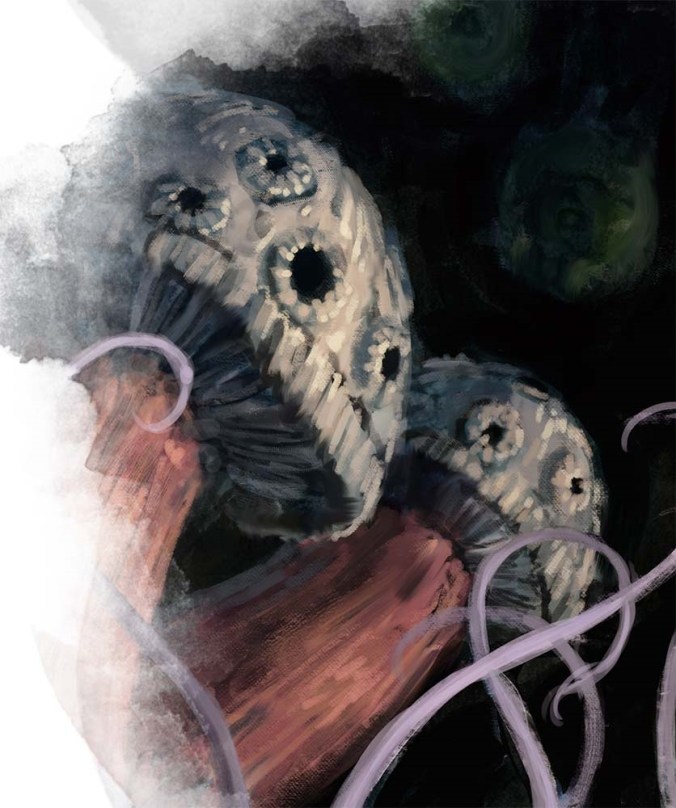
For all their noise, though, the Shrieker can’t actually hurt anyone. The same cannot be said for the Gas Spore Fungus. These spherical, floating gas balls bob through the air, tendrils wafting about in an attempt to find something to devour. Those tendrils can do a little damage, but can also poison a creature, making them susceptible to more damage later.
Now, most Parties would probably make the obvious move – kill that thing.
That might very well be the worst decision they could make.
While it is true that the Gas Spore Fungus is easy to kill – it has an AC of 8 and only 13 HP – it explodes upon death and releases a cloud of spores. Every creature within twenty feet of that Fungus will have to succeed on a Constitution save. Not a difficult one, only a DC 10, but failure means almost certain death. Not only does the creature take damage, but they are Poisoned for up to 24 hours. Unless that condition is removed – through means magical or mundane – the creature will die, sprouting tiny new Gas Spore Fungi to float away and wreak havoc on others.
This is how the Fungi truly begin to become terrifying. They’re not just an annoyance anymore – they’re mindlessly propagating. Infecting those who come too close. Your Players might find themselves in a cavern littered with the bones of unlucky travelers, spores drifting slowly through the air as the huge, poisonous puffballs descend from a high ceiling to feed and reproduce.
Of course, all that rotting flesh grows another vile Fungus – the Violet Fungus. Of the Fungi here, this is perhaps the most straightforward – it attacks any living thing that gets within ten feet. It can move, albeit slowly, and it’s fairly easy to kill. With only 18 HP and an AC of 5, it would be almost impossible not to kill one of these.
Which is why you shouldn’t use just one. These are sprouting from the remains of creatures dead so long that even their bones have been devoured, and a whole crop of Violet Fungus, slowly making their way towards your Party’s encampment, would give you a great zombie scenario to terrify your players with.

Which brings us back to where we began. Perhaps some of those poisoned dead did not just decompose peacefully. Perhaps some of them, wrapped in an amalgamation of various spores and tendrils, were reanimated by the very things that killed them. The Necrohulk isn’t just one dead adventurer – it’s an agglomeration of them. Spines and skulls, meat and bone, all lashed together mindlessly to form something more horrible than the Fungi that killed it.
Fungi in D&D offer a great opportunity for the DM to play with ecosystems, something that is not always easy to do. The Fungi don’t coordinate consciously – they’re not intelligent enough to do that – but their very existence creates coordination. The Shriekers might attract victims for the Gas Spores or the Violet Fungus to devour. The Gas Spores and Violet Fungus provide the corpses necessary for a Necrohulk to arise.
And your Adventurers? They’re just food. Today’s heroes, tomorrow’s Necrohulk shambling through the dark looking for the next meal.
The fungus is patient. It can wait.
 Encounter Every Enemy