Once a month or so, we’ll do a Random Monster Mashup! This could take many forms – maybe see what happens when the monsters fight or team up, think about what kinds of circumstances might result in this situation, and even, if we’re feeling really creative, think about what happens if we stick these two monsters in a teleporter together and hit “SEND.”
This month, I am reminded of one of my favorite Terry Pratchett books, Small Gods.
If you’re not familiar with it, you should absolutely read it. The basic concept is that the Great God Om (HOLY HORNS) wanted to go to the Discworld and stir up some holy trouble. You know, come down as a great bull, trample the wicked, show the non-believers who’s boss, that sort of thing.
The problem is, Om actually has far fewer believers than He thought He did.
Just one, in fact.
And so, when Om comes to the Disc, he does so in the form of a half-blind tortoise, and it is up to his sole believer to protect him and show him what it really means to be a Great God.
The idea of trying to find a way to put an Empyerean and a Seahorse together in the same adventure took some thinking, but once I remembered Small Gods, it seemed like the most entertaining and potentially thought-provoking combinations I’ve been able to do yet.
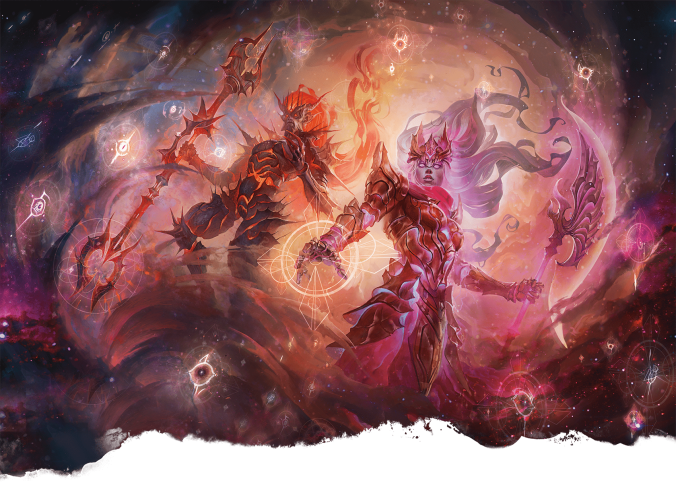
To refresh your memory, Empyreans are the children and servants of gods. They are massively powerful celestial beings with the ability to command the powers of divinity to reshape the world. What they do can set the course of history and lay low the destinies of whole civilizations.
Seahorses…. have nothing. No attacks, only 1 HP. I mean, it can swim away without taking opportunity attacks, so I guess that’s something, but still.
You might think there’s no way these two should show up in the same adventure.
But what about this: Somewhere in the great celestial planes, an arrogant young Empyrean has finally gotten on the last nerve of its divine parent. Too much plotting and scheming, too many “independent projects” like cavorting with milkmaids and stableboys, or just plain not doing their part in keeping the Cosmos in working order.
To teach this young god humility, their parent curses them to become the smallest, most fragile creature they can think of.
This new Seahorse, one amongst millions, has all the awareness, intelligence, and personality it used to have, but now it is utterly powerless. And if it should die in this form, without having learned the lesson its parent wanted to teach it, then the universe will have one less cosmic being to worry about.
With that in mind, there are so many ways you can craft this into an adventure for your Players.
The Prophecy Quest begins with an Oracle. A divine seer gets a vision from their Deity telling them that a great power has been humbled. However, it is imperative that this not-so-simple creature survive its ordeal. After all, this transformation is a lesson, not a punishment, and if the wee little Empyrean gets caught up in a trawling net or devoured by a tuna, then the lesson cannot be learned. Following the oracle’s guidance, your Players have to find this specific seahorse and keep it alive while it learns what it is meant to understand. Perhaps they need to witness a mortal’s kindness despite having nothing to gain. Or experience what it’s like to be truly powerless.

Of course, to make it more fun, make sure the Seaperyan can still talk to your players. There’s nothing like a delicate wisp of a fish lecturing people about how the cosmos is ordered and demanding that they treat it with the respect it deserves.
You still have some decisions to make – what does humility look like to the child of a god? What if this arrogant, divine fish simply refuses to learn its lesson? “Yes, I’m a fish, but I’m a divine fish, mortal, and you’d do well to remember that!”
How will you know when it’s learned its lesson, and what will happen when it does?
The Messenger, on the other hand, is a slight variation on the Humbled Godling. In this case, the Seahorse is exactly what it is, but it has been chosen – for reasons that make sense to a divine being – to be the mouthpiece of an Empyrean.
Something has happened to the Multiverse. The Empyreans cannot seem to cross over to the Material Plane anymore, but they have to get a message out. And somewhere, where your Players thought they were having a fun Beach Episode, a tiny Seahorse approaches them, clears its tiny throat, and tells them that their assistance is required by the highest masters of the Universe.
Now they must protect this tiny thing from the world as it leads them through their quest to re-open the barrier between the Celestial planes and the Material. Between simple accidents, hungry sea life, and one very determined NPC who insists that they need a preserved Seahorse for their potion-making, your Players will follow this tiny, wispy-voiced thing through the world to do the work they have been set upon.
The True Form could be a way of subverting your players’ expectation of what a “divine being” might look like. On the Material Plane, where the Empyreans show up to impress mortals, they are towering, beautiful, pinnacles of physical and cosmic power that can awe whole kingdoms. This, of course, is because that’s what mortals expect.
But when they bring your Party to their own plane, the Empyrean’s true form is revealed: a Seahorse.
And when your Players are baffled and trying to hold back their giggles, this Seahorse explains – rather indignantly and in that tiny voice again – that this is what true power looks like on this plane.
Knowing most D&D Players, they will absolutely not take this seriously. Fish puns, horse puns, occasionally trying to trap it in jars – they’re probably going to manage to make this creature really annoyed. And won’t they be surprised when this utter wisp of a fish hits them with the Empyrean’s Divine Ray and shaves 35 HP off the most irritating one (AKA The Bard). Whatever the Empyrean brought them here for, they may well all die out of sheer celestial pissed-offedness before the quest even begins.
Sometimes it can be great fun to play with extremes in these games. Size and scale and power differences can all matter, and there’s always a way to upend your Players’ expectations about what they mean to each other. With the Seahorse and the Empyrean, you have many ways to accomplish this, all of them fun.
And if you’re lucky, your Players – like the Great God Om – will have learned something important along the way.
 Encounter Every Enemy
Pingback: Monthly Monster Mashup 10: Colossus + Swarm of Rats | Encounter Every Enemy