The Giant Lizard is one of those anomalies of the Monster Manual that don’t immediately reveal to you why they are there.
If I had to hazard a guess, it’s because some adventure writer Way Back in the Day imagined some Drow or mysterious raiders riding giant lizards, and so that meant the game designer had to give a deep sigh, ask Are you sure? and then whip up a stat block for it. Because the game has pack animals already, with mules and horses, and it has terrifying reptiles already, with creatures like dinosaurs and… oh, wait, what are they called again…?
Oh yes. Dragons.
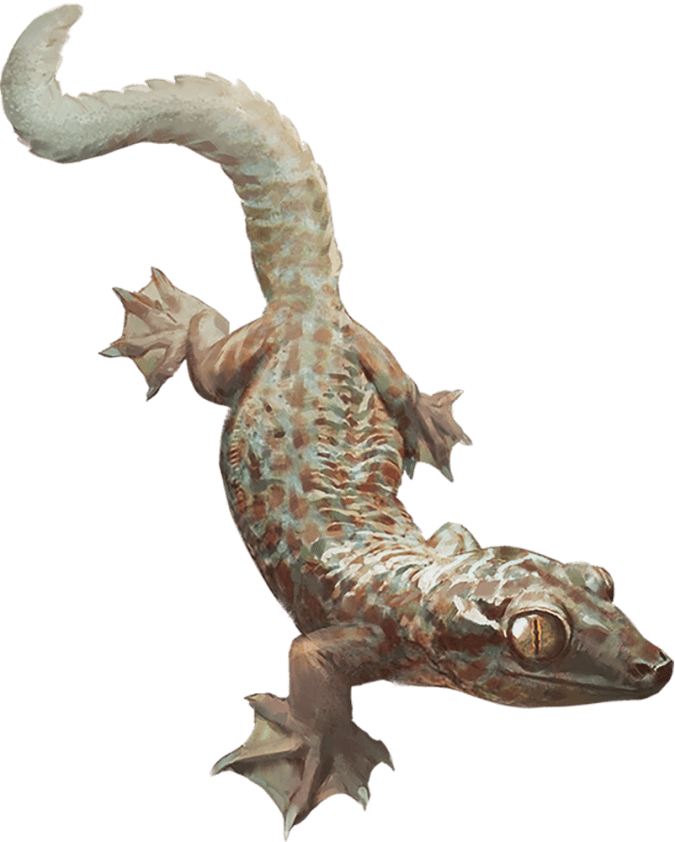
Nevertheless, the Giant Lizard has survived in D&D for nearly 50 years, so we need to show them the respect that they’re due as the strange, useful, inspirational creatures that they are.
First, let’s look at them as what they were made for: utility creatures.
When you think about it, the advantages of Giant Lizards over horses are clear and undeniable. For one, they have Spider Climb, which is why you would see a subterranean culture like the Drow make good use of them. Suddenly, your journey isn’t confined to two-dimensional travel, but to three, giving riders choices in how they approach their goals.
With this as a given, some really interesting worldbuilding ideas come to mind. For one, how does a rider stay perched on one of these things when it can move up walls and walk around on the ceiling? I can imagine riders have to develop some pretty intricate saddle-and-harness approaches for their Giant Lizards, and if you assume that those designs are specific to certain cultures or clans, then you can use them as clues for your players to follow. Those raiders that tried to invade your camp? A good Investigation roll might show that their harnesses have a distinctive triple-knot design, marking them as coming from the Grasslands Clan. Or a successful Nature check after slaying a few wandering scouts might reveal that their riding tack is leather made from the skin of high-altitude carrion birds – which would place them as coming from the Great Mesas. And what about those charms sewn into the reins? A good Religion check tells your Players that these warriors follow a goddess of the Infinite Depths, which would place those Drow as coming from a part of the Underdark that is in open rebellion against Menzoberranzan.
Now these Giant Lizards aren’t just mounts, they’re clues that you can use to point your players in the right direction.
It also tells us something about the people who have domesticated them. After all, in nature, these things would be fairly high on the food chain. One bite can kill a Commoner outright if the dice cooperate. So someone saw them as more than a natural hazard. Now instead of them just being spot number twelve on your Random Encounter table, they could be anywhere. Goblin shock troops clinging to walls, swamp raiders, desert nomads, all seeing the utility in these creatures to not only get them where they need to go, but to provide an advantage over other, more horse-centric peoples.
And, of course, you can ask yourself: who raises them? Who trains them and makes sure they do what you want? Are they common enough so there can be everyday “utility” lizards in this world, or are they too rare for that, meaning that any Giant Lizard you come across that carries a rider might be a threat? How much will it cost your Players to purchase them – because you know they will, and how badly will they be grifted by the Lizard Trader who insists that, “No, you definitely need the specially-prepared, high-protein lizard snacks that my cousin makes. What, you want your Lizard to be eating just whatever it finds? Garbage off the streets? What kind of owner would that make you? Only five gold for fifty snacks, and that’s cutting my own throat.”
Now, with all that taken care of, you discover that the Giant Lizard is the beating heart of an entire culture. They might live in places inaccessible to other folks – deep in swamps, high in the mountains, places where mere horses might balk or even be unable to travel, but the sturdy, dependable Giant Lizard can get to. In the same way that domesticating horses led to massive and permanent shifts in how the ancient people of our world moved and fought and lived, the Giant Lizards can play an equally pivotal role in yours.
Of course, all this talk about saddles and cultures still doesn’t answer the fundamental question: what about the Dragons? Why use these dumb geckos when there are actual dragons out there?
A fair point. I’ll grant you that.
Giant Lizards are the anti-Dragon. I mean, take away a Dragon’s intelligence and magic powers, and what is it? A Giant Lizard. No vast wings, no monologuing, no ancient prophecies – just muscle and hunger. But here’s the thing: a Dragon exists because the story needs it to. A Giant Lizard exists because the world needs it to. And because your Players are predisposed to think that Everything Matters, you can use the Giant Lizard to play with their expectations.
Imagine it: a scrape of claws on stone, a reptilian shape in the twilight, the hiss just before an attack… That can really spook your players if you do it right. Even moreso if you remember that these guys, like a Dragon, can attack from above if the terrain is set up right and most Players forget to look up. Really build the suspense of being tracked and stalked by something scaly and terrifying, and when the moment comes….
Oh. It’s a lizard. Okay.
Which is when the actual Dragon shows up and gets very angry at your Players for beating up on its younger, somewhat slower cousins.
In the end, the Giant Lizard belongs in your campaign because, like many other Beasts in the Manual, it helps you create a living, interesting world. These are creatures who don’t care about your Players. They don’t demand a story in the way a Dragon or a Mind Flayer or a Beholder does. If your world only contains things that demand attention, it stops feeling real.
In a game full of monsters that symbolize something like greed, corruption, madness, entropy — this one symbolizes continuity. It was here before your heroes and it will be here after.
The Giant Lizards just… exist. They are the blank space in the narrative.
And the blank space is where a good Dungeon Master can find the most opportunity.
 Encounter Every Enemy