There is something lurking in the swamp.
The locals won’t go near it. Hunters and explorers have tried and gone missing.
The local children speak of The Swampy Man and dare each other to go past the spot where the ground goes from simply muddy to wet.
On stormy nights, it is said that the Swampy Man hunts for people to devour, breaking their bones to feed his roots.
The Players at your table may know it by its proper name – the Shambling Mound – but the people in your world will speak of it in hushed whispers because it is not simply a monster. It is an avatar of Nature, coming to reclaim what the civilized world has stolen from it.
The Shambling Mound is a wonderful creature to put in any adventure where your Players have to deal with nature. Whether it’s an overgrown swamp, an ancient forest, or even a dungeon that is being taken over slowly, you can have a Shambling Mound there to bar the way forward. When they run into one, there’s not much more they can do but fight it – it doesn’t have enough of a mind to ask questions or be bargained with.
It is hungry in the way that Nature is hungry, and it wishes to do nothing more than consume.
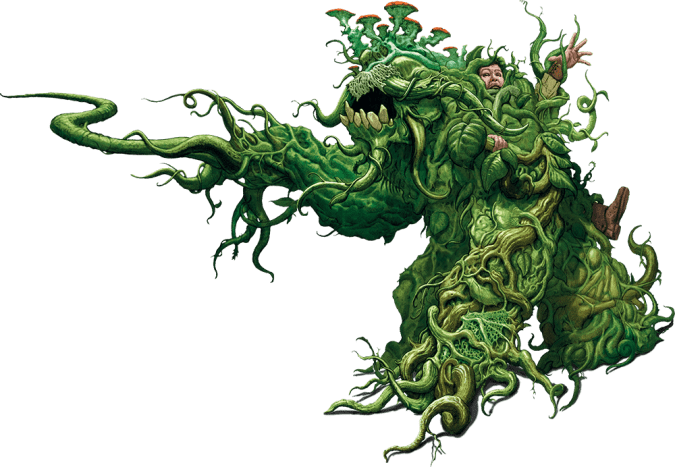
And, like nature, it has some pretty interesting tricks up its tendrils. One is its ability to Engulf. The Mound can grapple a creature nearby and pull it into itself, blinding and restraining it. What’s more, the poor creature trapped inside the Mound will take 3d6 lightning damage per round as the Mound attempts to kill it and absorb its nutrients.
Lightning is actually a very important aspect of the Shambling Mound. Its Charged Tendril attack (new in the 2024 Monster Manual) will do lightning damage when it hits, and if the Mound takes any lightning damage, it is instead healed for the equivalent amount.
This last fact may come as a wonderful surprise to players who’ve never met a Shambling Mound before, so if you have a Player who is excited to be a lightning-heavy spellcaster, you might put a Mound in their place. Heck, if you know they’re going to meet one, there’s no reason why your Players shouldn’t find a conveniently-placed Wand of Lightning Bolts a few areas before where the Mound lurks.
Let them learn that some solutions actually cause more problems. That alone can be the thesis statement to a whole campaign, especially where nature is concerned.
Perhaps your Players are exploring a vast underground dungeon, a labyrinthine complex built by a mad sorcerer-king thousands of years ago. Since then, nature has been reclaiming the dungeon, bent and twisted by ancient magics, and the lower you go, the less constructed it is. It’s no longer bricks and mortar, but rather shattered stone held in place by mud and roots and vines.
In this place, the Shambling Mound can be more than just an obstacle to progress. It is the immune system of the dungeon. Mounds wander its halls, looking for anything that might prevent the dungeon’s reclamation – prevent it from becoming a true Colossus, perhaps.
A Shambling Mound the size of a mountain, slouching towards Waterdeep, its time come at last. Unless your Players can stop it.
Of course, the Mound doesn’t have to be apocalyptic. On a much smaller scale, it can serve many purposes. Perhaps it is a warning about something that has gone terribly wrong in the swamp. Bodies have been dumped there by a local crime syndicate over the years, all slowly decaying in the same foul pit. And then – a storm. A well-placed lightning bolt, and the moss and algae and plant matter that had been consuming all this death and horror comes to life, seeking out revenge for an injustice it cannot remember.
For a different approach, perhaps a Mound has been domesticated somehow. There might be a swamp community that has figured out how to keep it in line – maybe their local Wise Woman has a particular gift for Shocking Grasp, “feeding” the Mound when it does the right thing for the community. And so they have a walking compost heap, an implacable protector, and perhaps, on occasion, it carries firewood for the local elders. Imagine your Players coming into this mangrove village, seeing the local children riding on the shoulders of Mister Squishy like it’s a massive, moist birthday pony.
And imagine its rage if those children are threatened.
You might also have a particularly clever Wizard who uses the Mound as a guard dog. They’ve implanted a small artefact in the Mound that does lightning damage – not enough to heal it all the way, but enough to really annoy your players – every round that it’s in combat.
They could even surround their lair with lightning charges that do a certain amount of damage within a 30-foot radius. Then, they make sure their lair is populated with Shambling Mounds, Flesh Golems, Black Puddings and other creatures for whom lightning damage is a gentle summer rain while your Players are trying not to get fried.
The versatility of the Shambling Mound means that it can fit into almost any adventure, and if you were looking to explore themes connected to the natural world, they’re a perfect fit.
If we stopped maintaining our civilization, Nature would engulf us pretty quickly. And that is because Nature doesn’t really care about us. It simply is, like the Mound. There is a cycle of life, decay, and rebirth that the Shambling Mound embodies, and it is reflective of the cycles of Nature itself. A Druid or Ranger character brought up in the wild might have a very different opinion on the Mound than a city-born Wizard because they understand the world differently.
In a campaign where your Players are up against Nature Unleashed, you can use the Mound to remind them that sometimes, the ecosystem is just doing what it does. You don’t defeat Nature. You just delay it for a while.
And when it emerges victorious, the Shambling Mound will be there to see its triumph.
 Encounter Every Enemy
Pingback: Dryads: The Guardians of the Green | Encounter Every Enemy
Pingback: Giant Boar: Unseen, Unstoppable, Unforgiving | Encounter Every Enemy