It’s been understood for a while that sharks are vastly over-feared denizens of the sea. Unlike the great beasts of Jaws or Deep Blue Sea, most sharks are harmless to humans most of the time. They don’t hunt us down out of revenge or hatred, and kill far fewer people each year than falling coconuts. Seriously. I looked it up.
This means that the Reef Shark’s inclusion in the Monster Manual requires us to think creatively about this beast, much as we have with other real-life animals that are not, in themselves, terribly scary.
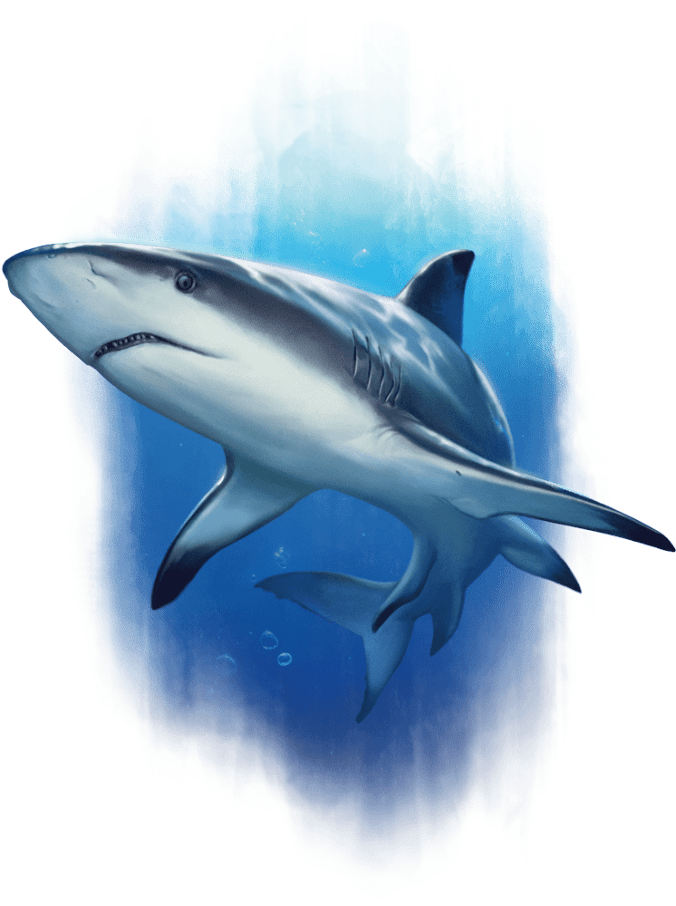
So what do we do with the Reef Shark in our games? Mechanically, it’s not terribly interesting. It has pack tactics, which means that you should always have a whole bunch of them in one combat, and they can do enough damage with one bite to potentially take a Level 1 character down to zero HP.
If you’re running a seafaring adventure and your Players fall overboard during a storm, swarming them with Reef Sharks can be a lot of fun.
For you. Not for them.
But that’s only if your Players are in the water. Outside the water, these Sharks aren’t going to be much of a threat, on account of not being able to breathe.
So what do these sharks bring to your world if combat isn’t really an option you’re choosing to explore with them?
Think about what these creatures do for the environment in which they live. For one thing, they are apex predators in their particular ecosystem. They keep reef systems interesting for the creatures that live there, prevent overpopulation, all the kinds of things any apex predator would do.
Let’s imagine Jaws – a seaside town suffers a terrible shark attack. Rare, but traumatic, and it might be perfectly understandable that they want these sharks Dealt With. What would be the consequences of a party of Adventurers wading in there and culling the shark population?
Well, there’ll be a lot more individual survivors from their prey, of course. More fish get to live, including those that might be wounded or weakened. But with more fish comes more hunger, and they devour the food the fish need in order to live. And now you have an unbalanced ecosystem where the fish are dying by the millions, and this town is no longer the economic draw that it used to be. Suddenly there’s this gap in the kingdom’s economy, seafood becomes more of a luxury good, and people with the ability to send more boats into better waters have greater power, assuming there isn’t a Dragon Turtle to deal with.
On top of that, the loss of coral reefs can do physical damage to coastlines, meaning waves hit harder and storm surges move further inland. While it may be a lot to put this all on the backs of some poor reef sharks, it is worth thinking about the interconnectedness of your world’s ecosystems.
That’s fascinating if you’re running a game for marine biologists, but what about the game you’re running for your murderhobo friends who want to really get in there and swing swords and spells around?
On a thematic level, this is a way to explore that idea that everything is connected. Nothing your Players do should be without effect in your world. They may kill some bandits, sure, but those bandits were connected to the world, and removing them will have repercussions, for good or ill. If your Players have a hard time with consequences, you might be able to introduce an ecological analogy like this in order to make them pause and consider the effect their actions have.
Of course, this is D&D, so we shouldn’t just stop at ecological catastrophes and social analogies. Let’s say that the Sharks are the guardians of the reef, but only because the reef itself is a cage, holding in some terrible, abyssal creatures that should not be allowed to come to the surface. It could be a vast and terrible Kraken, imprisoned eons ago by an angry sea god whom it tried to supplant. Maybe it’s an entire population of undead Merrow, never dying, always hungry, held in place by a coral prison grown by merfolk wizards.
Either way, with the sharks gone, the balance is upended, and the threat that has long been contained has a chance to emerge again.
The locals start bringing in hauls of things that never could have been fish. The waters turn black and red, and the tides themselves begin to fail, making the oceans even more unpredictable. Monsters rise from the waves to attack sleepy seaside villages, and the only people who know why are the old storytellers who’ve been telling tale of The Reef Prison to every child they cared for over the last sixty years.
The seas are dying, and your Players are going to have to figure out why.
You could also think about these beasts in terms of their relationships to the underwater civilizations that populate your world. If your Players are adventuring all the way into undersea kingdoms, the Reef Sharks could be the replacements for canines in that strange, dark world.
Perhaps a Merfolk Noble keeps packs of Reef Sharks as their hunting packs. Every month on the spring tide, this Noble and their lackeys go out on hunting expeditions, looking for hapless sailors or swimmers to bring down with their pack of terrifying Reef Sharks. No one dares confront them, knowing the consequences for trying to face down nobility, but your Players certainly aren’t going to worry too much about that.
You might decide that people keep these sharks as pets, perhaps showing them off. If your Players enjoy weird side quests, maybe they have to help a young Merchild look for Snuggles, their pet shark who swam away and the big Shark Show is TOMORROW!! Think about Lost Shark posters up on the walls of pearlescent buildings, people swimming with their sharks and collecting their waste in crystal containers so they don’t pollute the waters, perhaps breeding sharks into the kinds of wild variations that we see with dogs today.
What would be the French Poodle equivalent of the Reef Shark? I shudder to think about it.
Or perhaps, more seriously, as part of your Players’ maritime adventure, they need an NPC guide to help them cross treacherous waters and lightless depths. You could introduce a Triton Ranger or Druid into the game with a pair of Reef Shark animal companions, always vigilant, always ready to team up on any threat. Your Players will not only have to gain that NPC’s trust, but also that of their dangerous friends.
The Reef Shark isn’t going to threaten the world or upend a kingdom. It’s not going to lead to a TPK or bring about some kind of grand emotional catharsis amongst your Players. The Reef Shark will never be the main villain. It’s part of the color commentary, the environmental detail, the reminder that your world has ecosystems beyond “things that want to kill you.”
And honestly? Your world needs more of that.
 Encounter Every Enemy
Pingback: Seahorses and the Art of Creative Desperation | Encounter Every Enemy
Pingback: Not a Beach Episode: Merfolk in your D&D Campaign | Encounter Every Enemy