There’s something irresistible about tigers. In reality, they’re relentless, powerful predators, bestriding their jungle territory as though it were made for them. In fiction, they are dangerous, predatory, and a little bit sexy. I mean, there’s a reason Frosted Flakes are so popular, and I doubt it’s the taste.
I… may have said too much.
Like the other Beasts we have talked about here, it’s much more interesting to talk about the Tiger in terms of what it means for our worlds rather than what its stat block says it can do. Which isn’t a whole lot, honestly. It’s a CR1 creature, and has the Rend ability, which is an interesting mechanical choice – a Large or smaller creature that gets hit will not only take damage, but go Prone. If the Tiger had a second attack in its arsenal, or if Tigers fought in packs, this could be very dangerous. It doesn’t, though, and they don’t. As long as a character has the presence of mind to stand up again, the Tiger doesn’t gain any advantage.
So let’s leave combat behind and see what meaning we can make with Tigers in our D&D games.
One way to introduce a Tiger into the campaign is to bring it in as a territorial hazard. Tigers are extremely protective of their territory, which can span hundreds of square miles, and the thing to remember is that if your Players wander into Tiger territory, the Tiger isn’t being malicious or hateful when it attacks them.
It’s being right.
The question is, do your Players know that this is a Tiger’s territory? Do they get warnings from nearby villages not to venture into the deep jungle, from whence no man returns? They should, and if they do, then they have a wonderful trek ahead of them.
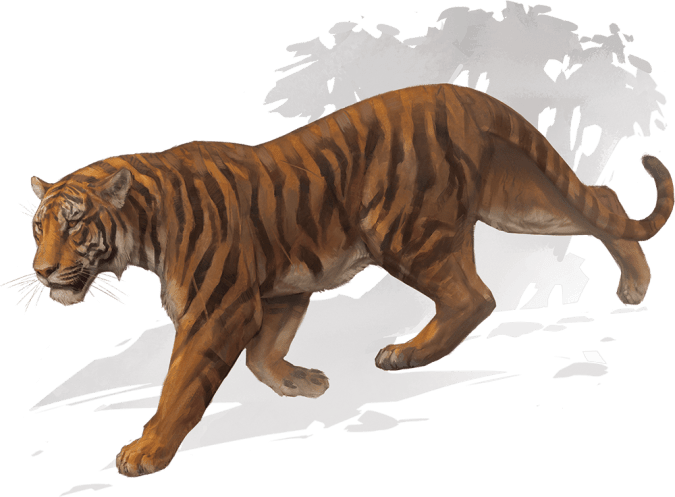
You see, Tigers are not stupid beasts. Their stat block gives them a Wisdom of 12, which is enough for them to start making inferences about the movements of people. Even out here in Real Life, Tigers that become threats to people do so by observing patterns and choosing their targets carefully. They evade hunters with relative ease, knowing that they know their territory far better than these terrified apes do. The Tiger becomes more than a problem – it becomes a pattern that the hunters, or your Party, has to break.
And so, any trip through a Tiger’s territory should be one of constant threat. Shadows in the undergrowth. A flicker of orange, just out of your sight. A low growl that seems to come from everywhere all at once. It becomes a contest between your Party and the Tiger: who can work out the patterns of the other first?
When it does finally attack, you can drag that moment out as long as you want. The birds stop singing. A creak from the trees above. The smell of wet fur and rage, all in that moment before a landslide of teeth and claws launches itself onto the most vulnerable member of your Party. Which, if they have been in the Jungle for a while, could be any of them. In the excellent adventure Tomb of Annihilation, characters can suffer from any number of illnesses that will drain their strength. My personal favorite is the Throat Leeches, which are exactly as awful as they sound. You can also look to the 2014 Dungeon Master’s Guide for disease ideas, like Cackle Fever or Sight Rot.
Either way, by the time the Tiger finds your Players, it won’t have to weaken your Party because Nature has done it for them.
The Tiger isn’t going to fight fair because, let’s face it, nothing in nature does. The Tiger doesn’t hunt the Party. It hunts the mistake.
But aside from being a jungle threat, what significance can you give to Tigers in your world?
Tigers can be said to represent Nature without negotiation. A beautiful creature that owns its realm, but which can inflict terrible and remorseless violence upon it. This means that any interaction you have with a Tiger is going to be representative of interactions with Nature itself.
A wealthy Noble wants to add a Tiger to their menagerie, already overflowing with exotic and beautiful creatures. He is willing to pay your Party an absurd amount of gold to bring one back to him, alive and unharmed. Is this something that your Players are willing to do? Even overlooking the danger of it, do they think it’s right for a person of great wealth to be able to buy the natural world in this way? Your Bard might think it’s a wonderful way to flaunt power and influence, but your Ranger or Druid might disagree. And what happens if the Party says no? Does this Noble have other, less scrupulous adventurers that they can use? This isn’t a hunt your Party should be able to walk away from easily.
What if the Tiger you’re hunting isn’t just some random cat? There’s a village in the jungle that has been, for years, paying tribute to the Tiger in whose territory they live. With respect and regularity, they provide the Tiger with food and other kindnesses, both out of a genuine devotion to this powerful cat and out of the knowledge that if they don’t give it a goat every now and then, it may well come for them. Even better – they’ve been doing this for ages. Not the same Tiger, of course, but generations of Tigers and Villagers have evolved together. The Tigers that have died are enshrined, and the birth of a new Tiger is reason for celebration. One of the best festivals in this village is the day they give the Tiger a name.
Which it knows, of course, but will never acknowledge.
Now, here come your Adventurers, promised gold and other rewards if only they take away the one thing that gives this entire village meaning.
What do they do with that?
There’s even a place for Tigers in your game without the actual Tiger showing up. Much like we talked about in the Triceratops entry, it is easy to make the Tiger into a symbolic animal.
A great general might use the Tiger as a symbol of their authority and power, working it into their insignia, making sure Tiger pelts are a prominent feature of their decor. Your Adventurers need to prove that they understand power as the General understands it if they are to gain their aid.
A secret clan of Monks might have adopted the Tiger for its stealth and ferocity, naming their most secret moves after the great beast. Knowledge of how to perform the Shadow Tiger Attack might be the entire reason your Monk character has become an Adventurer in the first place, and they can learn it – if they can get to the temple alive.
A Bard has gained great fame by using Disguise Self to perform as a humanoid Tiger Person. The disguise serves two purposes: it sets them apart from all the other up-and-coming Bards out there, and it allows for a certain amount of anonymity. And that anonymity is what the Bard is really after, as they weave careful plots and plans within a kingdom to enrich and empower themselves.
Or they might be a Rakshasa pretending to be a Bard pretending to be a Tiger Person. Which is even better.
Having a Tiger in your adventure is making a statement. Your players may wield magic swords and powerful spells, but Nature doesn’t care about that. If they let their guard down, the last thing they’ll know will be two eyes, gleaming in the darkness, and a growl that reminds them whose world this really is.
 Encounter Every Enemy