One of the easiest things about fighting most monsters in D&D is that they are unambiguously there. Sure, some will have resistances or immunities that you have to work out, and the more impressive ones will have Legendary aspects that need to be accounted for, but most monsters aren’t just going to stop existing for a while during the battle.
Well, most monsters aren’t the Phase Spider.
The Phase Spider has an ability called Ethereal Jaunt, a Bonus Action which allows it to teleport to or from the Ethereal Plane. What this means in combat is that it can Bite a character (which comes with some interesting effects if they hit 0 HP) and then just… vanish. Unlike the Giant Wolf Spiders, which travel in packs and hunt their prey, the Phase Spider is an ambush predator. It waits until your guard is down, drops from the ceiling, bites, and vanishes. Then it re-positions itself somewhere out of sight, pops back to the Material Plane, and uses that +7 in Stealth to get ready to do it all again.
Used properly, the Phase Spider should either terrify your players or frustrate them into flipping the table.
There are so many ways that you can use this ability to your advantage, and not just in combat.
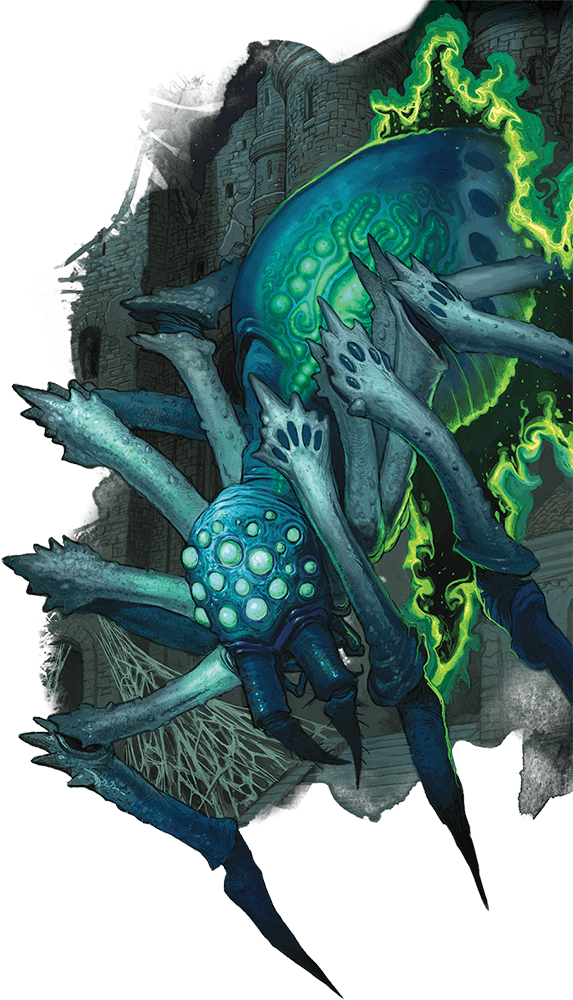
Your Players have been journeying from adventure to adventure, and recently, something has felt… off. Some of your players have started to feel like something is watching them, but there’s never anything there. This is best done if you pick one player and tell them this while everyone else is up getting snacks. Occasionally ask them to make a Perception Check – one that never quite succeeds, but which has a good chance of ramping up that feeling of being stalked.
And then, perhaps after a fight from which they are already tired and depleted, the Phase Spider emerges from the shadows, pumps the already-weakened character full of its poison, and then vanishes. In the ensuing confusion, it pops back to take its meal, and your Player has to make a new character.
The truly terrifying thing about Phase Spiders is not just that they exist a half-step away from reality, but that there’s a whole ecosystem behind that thin, ethereal screen. From that vantage point, they can watch the Party and study its strengths and weaknesses. They have a whole territory that is inaccessible to most Players, and can use that to their advantage.
The seemingly random attacks that the Spiders are making aren’t random at all. They’re carefully controlled routes that only the Spiders can follow. And if your Players can’t figure out what the Spiders are doing, they’re going to have to run away or die.
This can be especially frustrating for players who rely on controlling the battlefield. My current Party has a Druid who makes excellent use of spells like Spike Growth or Entangle. On most creatures, these are great spells, making it much harder for an enemy to move around.
But for a Phase Spider, these are barely annoyances. Rough Terrain doesn’t mean much when that terrain doesn’t exist for you.
As with so many monsters, the combat opportunities are just one reason why we pick the monsters we do. The other is for the stories that we can tell. And with monsters that are kind-of-here and kind-of-not, there are some really interesting adventures that we can build around Phase Spiders.
One of them would be an area of planar instability. Where the planes are thin, things get through, and one of the earliest symptoms of that would be the appearance of Phase Spiders. The Ethereal Plane, according to the Dungeon Master’s Guide, surrounds and envelops the Inner Planes – planes of fire and water, elemental chaos, as well as the Feywild and the Shadowfell. If the Ethereal Plane is somehow losing its coherence, these other planes could start leaking into each other, and that’s not good for anyone.
So, on your Planar Adventure, as your Players try to figure out how to keep the various planes from imploding into one semi-infinite undifferentiated lump of existence, Phase Spiders can be a way to signal to them that they are near a weakness or a fault in the planes. An extremely irritating signal, but the more of these you throw at your Players, the better they’ll be at fighting them.
Another option is offered by this line from the Monster Manual: “Phase spiders are more intelligent than mundane spiders, but most are cowards. They usually flee if they’re outnumbered by creatures capable of seeing them on the Ethereal Plane or pursuing them there. They make exceptions for ghosts and similar spirits, which phase spiders gain sustenance from and pursue as favored prey.” (emphasis mine)
A spirit medium comes to your Players begging for their help. Her Spirit Guide has vanished. Other ghosts and spectral entities which they used to communicate with are either missing or terrified. Something is hunting ghosts, and not in that fun 80s way with a funky theme song and a nuclear backpack.
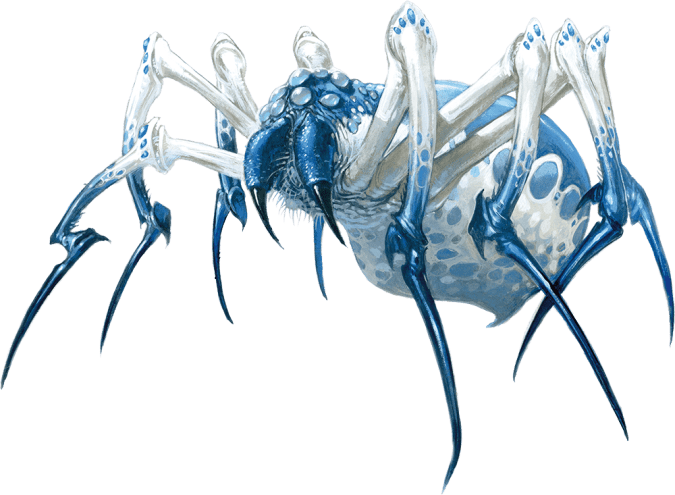
You can increase the tension with this by giving important information to a Ghost – information that will be lost forever if the Phase Spider gets its mandibles into them. Or perhaps the ancestral spirits of one of your Players start to visit them in the night, begging for help as they’re picked off, one by one. What does your Player owe to their forebears, and will they risk their lives for those who are already dead?
Of course, someone with ready access to the spirits that the Spiders hunger for would be your classic Evil Necromancer. In exchange for some of the spirits that they keep in order to fuel their unholy arcane plans, they use the Phase Spiders as guard creatures. Now, as your Party journeys through the Necromancer’s haunted mausoleum, they not only have to contend with zombies and skeletons and other reanimated horrors, but they are constantly being stalked by a pack of Phase Spiders that can attack from any direction, at any time.
There’s something about using Phase Spiders that, to me, kind of tests the DM-Player contract. You see, a proper DM cannot lie to their players. NPCs might lie, sure, but not the DM. If I say that there’s no monsters in the room, and the Players go in to suddenly find monsters, they would be within their rights to stop the game and ask me what I think I’m doing.
The Phase Spiders, though, allow you to do just that. The room that looks empty to every successful Perception check could be wall-to-wall Spiders in an instant, and there would be no way for your Players to be ready for that. There’s no lying involved, and no breaking of the rules. Just spiders. Everywhere.
I think this, more than the difficulty in fighting them, is what annoys Players the most. It’s the feeling that the DM is concealing something that, with any other monster, should be clear. That they are not operating with all the information they need – not because they rolled poorly or because they didn’t talk to the right NPC, but because the mechanics of the monster allow the DM to, in essence, lie.
So use Phase Spiders carefully. Signpost their existence when you can. The DM can create situations with these creatures where the players are missing information in a way that feels like betrayal, even when it isn’t.
Drive your Players mad, but make sure you do so fairly. No matter how tempting the Spiders might make it to do otherwise.
 Encounter Every Enemy