Your Players are making their way through the Shadowfell – a dark, sorrowful, unforgiving place that is made up of the despair and misery of all living things. Just being there is hard enough, to say nothing of the strange, twisted horrors that exist in that place.
They approach a cave, misty and cold.
From within that cave, they hear a growl. Maybe even a voice. And a large, dark figure shambles out to meet them.
Long, sinewy neck. Translucent webbed wings. Scales that shimmer like oil on water.
Their first thought would be Dragon! But this thing… it doesn’t move like a Dragon. It flickers, glitches. Seems to not be there right before it very much is there.
And when it speaks? Whereas most Dragons invoke terror, this is a voice of sorrow. Sorrow at having lost what it had been, at having been twisted. Corrupted. Made wrong.
Facing a Shadow Dragon is a whole other kind of encounter, and your Players may have to make hard decisions once the encounter has started.
The Shadow Dragons are, mechanically, just as terrifying as the other Dragons in the Monster Manual, but in their own awful way. For example, as long as they’re in dim light or darkness – which, to be fair, they should always be – they’re resistant to most types of damage and can Hide as a bonus action. They also have a Shadow Breath that can not only immediately kill a character, but raise them as a Shadow minion to fight against their former allies.
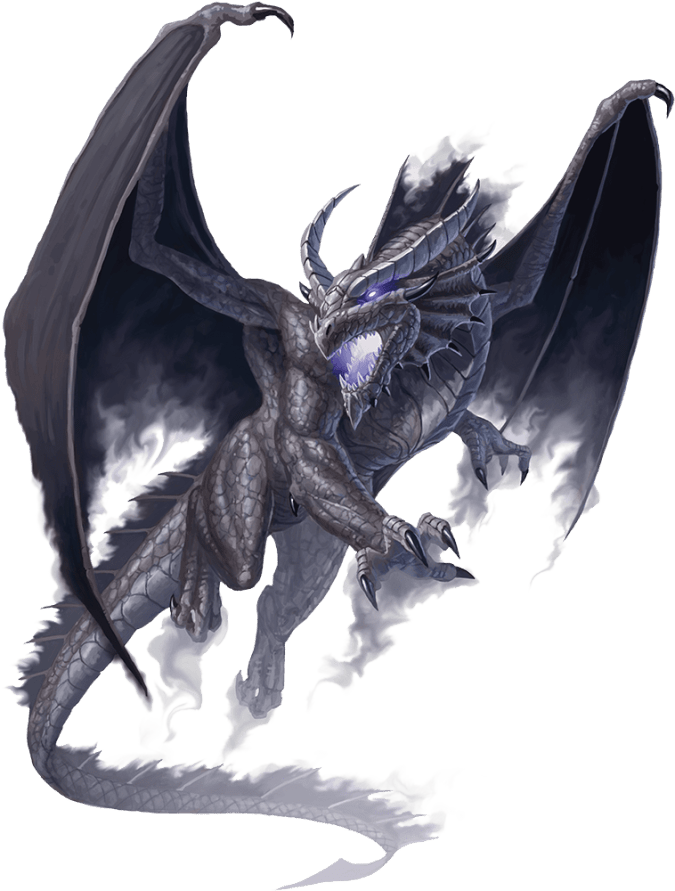
All this means that combat with a Shadow Dragon is a fight against the shadows themselves. It can vanish in a moment and then unleash deadly shadow at your Players from the darkness itself. A wave of black energy that does not roar – it whispers as it kills. Then it retreats into shadow not for tactical advantage, but because that’s all it knows how to do anymore – withdraw, lash out, withdraw again.
It cultivates death in a way that other Dragons don’t. They want to kill your Party because they’re angry or greedy or just plain hateful. The Shadow Dragon wants to kill your Party because Death is the only thing it understands anymore. Whatever it was before it became this dark and twisted thing, it’s forgotten all that now.
And that’s an important point: many Shadow Dragons didn’t start their existence that way. They started as normal Dragons – Chromatic or Metallic – and then they were changed. Perhaps they are seduced by the power of the Shadowfell, lured to its darkness by promise of greater strength or knowledge or treasure. But once that dim place gets a hold of you, your fate is sealed. What was once a Great Wyrm changes, becoming something darker and lesser, and the Dragon is powerless to stop it.
That alone can give you plenty to work with if you want to place a Shadow Dragon at the heart of your adventure.
What does it mean that a creature of such elemental power and pride has become a twisted shadow of itself? Do they mourn their transformation, perhaps, seeking out what it once was in a strange, half-mad reverie destroying as it goes. Or does it resent the weak thing that it once was? Perhaps it hunts down its old hoard and treasures, enemies and allies in order to destroy all the evidence of what it once was. Because that’s what sorrow does – it makes you sabotage the things that once brought you joy.
Or maybe the Dragon isn’t the real problem here. Shadow Dragons are corrupted by the Shadowfell, so what if this corruption spreads? What if the Dragon isn’t the encounter – it’s Patient Zero?
The trees have shadows that flicker. The wildlife moves… wrong. Druids coming out of the wilderness they love because they can’t stand to see what it is becoming.
Your Players are fighting more than a monster. They’re fighting an epidemic, and they don’t know if killing the Dragon will stop the spread of corruption or free it to spread. This is a great opportunity for a far-ranging adventure with some serious moral choices embedded in it.
And what is a Dragon without its element, anyway? A Red Dragon is fire made flesh. A Silver Dragon is winter walking. What happens when this essential element is stripped away and replaced with absence? Where once potent poisons or self-contained storms churned, there is now only void. Can you even call them dragons anymore? Or are they a terrible memory wearing the corpse of what was once a noble and terrifying creature? Think about how this might affect the way they interact with the world, lashing out from sorrow and despair, hoping to take the world down the same dark road that it walked.
And I think it is that sense of despair that should be at the heart of any Shadow Dragon story. Because despair isn’t just a Dragon thing – it’s a people thing. So let’s get into what this creature is really about.
We all get sad sometimes. Depressed. We spiral in on ourselves, fixating on our failures and our inadequacies, and when people try to help us out – we push them away. Because they don’t understand. Or because it’s too hard. Or because, deep in our hearts, we feel like we deserve this suffering. Like we weren’t strong enough to resist it, and so living in it is our just punishment.
That is the Shadow Dragon. It is despair made flesh. It is all those thoughts that keep you awake at 3 AM or that creep in around the edges of your mind when you’re trying to just live your life.
In the real world, fighting that kind of depression is hard. It takes time and effort, work that only you can do.
But in D&D? In D&D you get to kill it. You get to face the thing that whispers you’re not enough, that you’ll never escape what you’ve become – and you get to prove it wrong. The Shadow Dragon dies, and you walk out of that cave alive.
Sometimes you need that victory, even if it’s pretend. Especially if it’s pretend.
 Encounter Every Enemy