Once a month or so, we’ll do a Random Monster Mashup! This could take many forms – maybe see what happens when the monsters fight or team up, think about what kinds of circumstances might result in this situation, and even, if we’re feeling really creative, think about what happens if we stick these two monsters in a teleporter together and hit “SEND.”
One of the reasons we play D&D, as I and others have noted, is because it’s a power fantasy. It’s a chance for us to be stronger or smarter than everyone around us, solve insoluble problems, and defeat challenges that even the high and mighty cannot overcome.
In so doing, our characters become unique in the world, standing out against all the common folk.
But your Players are so few, and the common folk are so many. What are they to do when they have no one to rely upon but themselves?
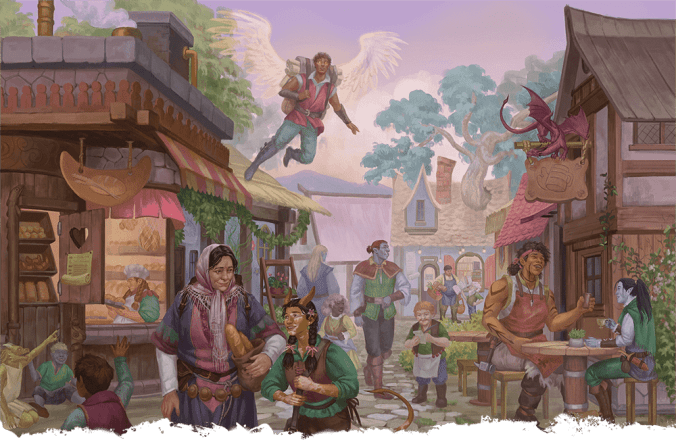
The Monthly Monster Randomizer has thrown this question at us by putting together the Commoner and Ogres, and that dynamic opens up some really interesting ideas for story hooks in your adventuring world.
First, the difference between Commoners and Ogres should be very clear: Ogres coming into a village or town are potentially an extinction-level event. For the Commoners, this isn’t an encounter that’ll be done in three or four rounds and forgotten – this is something that will end family lines, upend power structures, and potentially turn the village into a ghost town.
Let’s remind ourselves of the stats here.
A single Commoner has – at most – 8 Hit Points and can do up to 4 points of damage with their “club” (or whatever improvised weapon they have to hand).
An Ogre can have up to 104 Hit Points and will do – at a minimum – 6 points of damage with their Greatclub or Javelin.
What this means is that a single hit from an Ogre will almost certainly kill any single Commoner.
From the point of view of a D&D Commoner, the approach of an Ogre is basically a Godzilla movie. Trying to fight it would be futile – even if Johnny the Farmhand were able to get a hit on the Ogre before being turned into red paste, the town would need dozens of lucky farmhands like Johnny before they could take down an Ogre in a fair fight.
But then… who says it has to be a fair fight? While the Ogres have size and strength, the Commoners have numbers and brains. Commoners are distinctly more intelligent and wise than an Ogre, and are all mutually interested in not seeing this creature ruin their homes, which means they’re more likely to come up with a cooperative plan to take this lumbering creature down. Smart Commoners will immediately realized that they’re outclassed hand-to-hand, and start working together to take them down. In addition, in the 2024 Monster Manual, Commoners get one skill proficiency of the DM’s choice, so it’s possible that they have some sneaky, charming, or slightly more athletic people living amongst them.
Your Party has now stumbled into one of the great storytelling tropes, the most well-known example of which is…. GalaxyQuest.
No, wait – A Bug’s Life.
Or was it Army of Darkness?
Whether it’s The Three Amigos, The Magnificent Seven, or The Seven Samurai, the story follows a now-familiar storyline: a small village, unable to fend for itself, is under siege by a stronger, more vicious enemy, and they need the aid of experienced, powerful people if their village is going to survive. Your players now have a chance to not just defend the villagers, but to train them. Find the ones with useful skills and come up with where they fit in the plan. Send the sneaky ones to scout out the Ogres’ location, the charmers to make sure everyone is doing what they should, and the athletic ones to dig the pit traps or set up the big swinging logs.
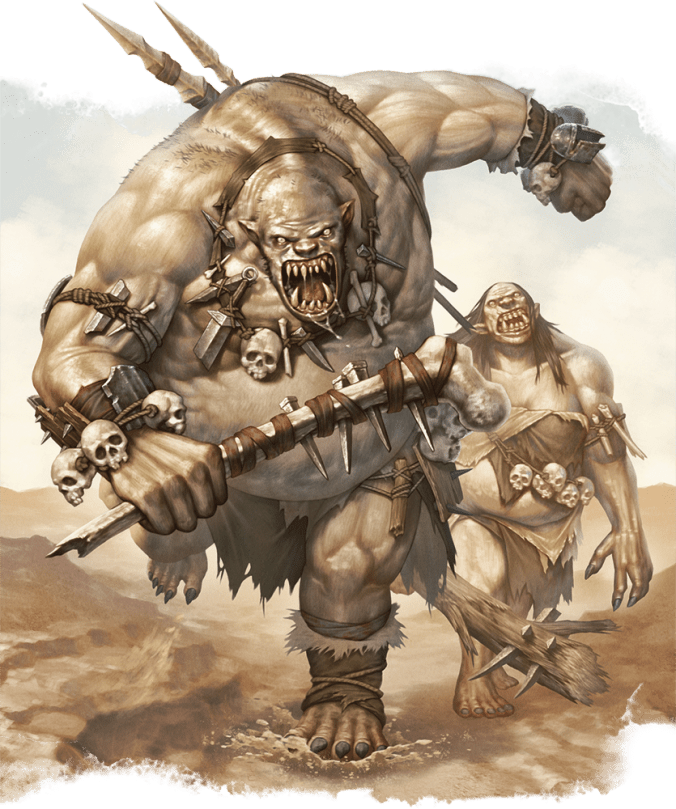
Picture this: A small clan of Ogres has made their home in a cave near this little farming village. The smarter of the Ogres comes up with a plan: demand “payment” from the village in the form of a cow every full and half moon. As long as the payment is made, the Ogres will leave the village alone.
Until there are no more cows. Until the Ogres start demanding alternative forms of payment. If not a cow, then maybe a couple of sheep. No sheep? Fine. The prettiest villager will do.
This is when your Players show up. The next lunar deadline is coming up, and the village is resolute that they’re not going to send Johnny the Farmhand (who, to be fair, is very pretty) to the Ogres to be eaten. This is where they draw their line, even though they know it could mean their doom.
Of course, you could make the village divided on this, especially if Johnny the Farmhand has been getting, shall we say, involved with Billy, the apprentice of the Blacksmith, and Billy’s family is deeply unhappy. There might be a few people who are happy to see Johnny fed to the Ogres, which is, of course, terrible.
However it plays out, your Players will now need to figure out how to save the Village, and the villagers are willing to help.
Of course, this scenario works best with low-level Parties. If they’re high enough, your Players will just find the Ogres and throw Fireballs and Greataxes at them until they’re finished which is, while effective, not nearly as much fun as gathering the Commoners together. You may want to telegraph the power of the Ogres with ruined buildings and a hasty, very closed-casket funeral through which you can show not only the threat they pose, but also why the Villagers might be angry enough to want to be part of taking the Ogres down.
You can put as many twists on this idea as you want. What if, for example, the Ogres never really were a problem?
Maybe those bastards from Riverbend Village have been encroaching on the orchards of Streamcrook Village for far too long, and the elders of Streamcrook see a solution in this clan of Ogres that has made a home nearby. So they put out a call for some plucky adventurers to move the Ogres elsewhere. “We don’t want to kill them,” they say. “They’re just big, stupid things – don’t know any better, really. Just nudge them along. Preferably downstream.”
Will your Players be able to catch on to what’s happening? Will they move the problem over to the next village? Or, if your Players are more morally gray, will they realize what they’ve got on their hands and strike a deal with the Ogres? Pretend to drive them out, send them to the next village, then conveniently show up to “help” these poor, hapless villagers.
For a price.
Whether your players choose to be the selfless protectors of the Seven Samurai or the opportunistic mercenaries of a border feud, the Commoner vs. Ogre mashup reminds us of a fundamental truth of the D&D world: power is relative.
To your level 5 Paladin, an Ogre is a Tuesday afternoon. To the farmer whose home is in its path, that same Ogre is an act of God. By forcing your players to look at the world through the eyes of those with only 4 Hit Points to their name, you shift the game from a tactical skirmish into a story about what it means to be a hero.
In the end, the commoners don’t need the players to be stronger than an Ogre—they need the players to remind them that they aren’t just red paste in waiting. They need a reason to stand their ground. And sometimes, the most powerful thing a hero can do isn’t swinging a sword, but giving a village the courage to pick up their pitchforks and realize that, together, they are the biggest monster on the map.

