Most people don’t play D&D for the economics of it.
I’ve seen good minds drive themselves mad trying to figure out the real-world value of a Gold Piece or how the economy of the Forgotten Realms works when a bottle of wine (2 silver pieces) somehow costs less than a bottle (2 gold pieces). Most DMs just hand-wave things like this away or seek out the resources created to try and solve this whole problem.
That doesn’t mean that you have to ignore economics entirely, however. If you’re interested in making fundamental market forces a player in your game (I’m looking at you, Brennan Lee Mulligan), then look no further than the great Landlord of the Deep: The Dragon Turtle.
Let’s get the mechanics out of the way first. This is a proper Dragon, absolutely able to hold its own against its more lizardlike kin. It has an impressive bite, a tail attack, and steam breath that can cook your Players like lobsters. It also has a ton of hit points, which means battling one of these guys is going to be a full-session encounter. Even more so if you go back to the 2014 Monster Manual, which gives us a lot more to work with.
Honestly, keep those old Monster Manuals around, folks – there’s gold in there.
Just fighting a Dragon Turtle isn’t all that interesting, though.
What’s more interesting is living with a Dragon Turtle, and that is something that the coastal settlements of your world may have to deal with. And the implications of having a Dragon Turtle in your seas are immense.
As far as Dragons go, Dragon Turtles aren’t quite as showy and flamboyant as their metallic or chromatic kin. They have no real ambitions to rule the world or right wrongs. In fact, the Dragon Turtle’s official alignment is Neutral, rare amongst dragons. Odds are, unless you go picking a fight with one, it’ll be perfectly happy to never deal with your Players.
One quality that the Dragon Turtle does share with other Dragons is that it has a love of treasure. It may sink ships that are laden with gold and silver and drag them down to its lair. On top of that, a clever Dragon Turtle may in fact demand tribute from ships, allowing passage if they pay for safety.
And that’s where the economics come in.
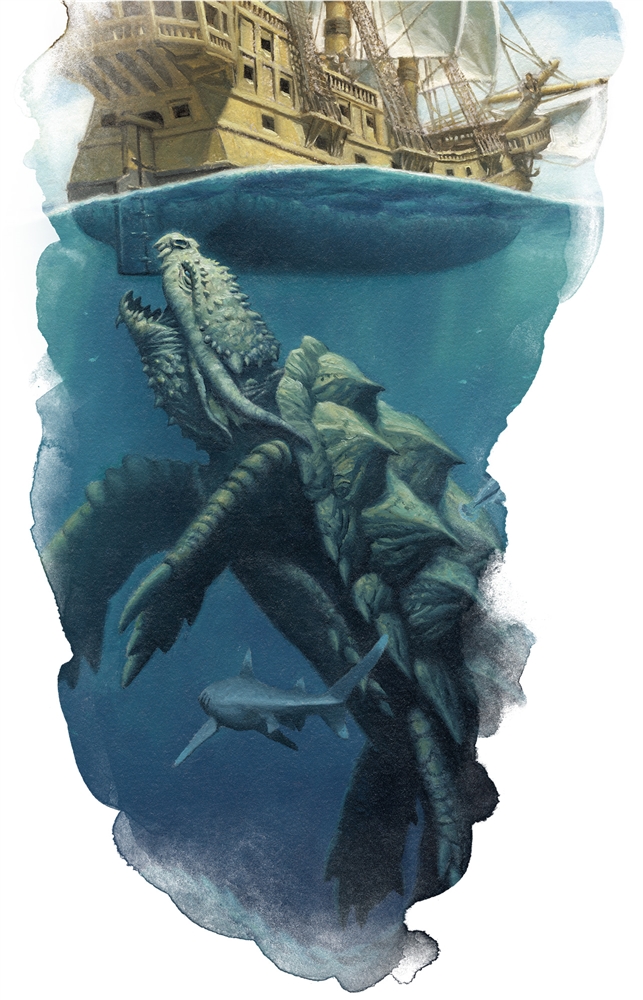
Imagine, if you will, a shipping lane that is dominated by a Dragon Turtle. It has the power to sink merchant ships, and will happily do so unless it is properly compensated. So shipping companies start to factor this into their shipping fees, which impacts the prices that merchants pay for goods, which impacts what your Players will pay when they find out that the Potion of Healing that usually costs 50 gold elsewhere will run them 80 gold here.
Do people like the Turtle? No, not really. It’s one more issue to factor into their plans, and an unpredictable one at that. Last season it demanded 500 gold per ship, but this season it’s gone up to 600. Anyone who does business in these idyllic coastal towns has to have a Dragon line item in whatever the D&D equivalent of an Excel sheet is. Food, trade goods, seafaring insurance – all of those have to be more expensive if we consider the Dragon Turtle thanks to ever-changing Dragon Compliance Fees from the Turtle Risk Assessment Office.
There may even be specialists whose job is to figure out the mood of the Dragon Turtle at any given moment. There are actual Wizards with divination spells at hand, casting Augury or Commune to discern the best approach to the Dragon Turtle, working with Chambers of Commerce to best advise shipping companies on their plans. And then there are the charlatans who camp out at the docks, sleeves rolled up, big charts on display, promising an inside track into the mind of the great beast, if only you can pay for it.
Since the Turtle is an intelligent creature, and can be bargained with, perhaps some of your more charismatic captains are able to wrangle lower fees from it. Now one or two captains are getting all the choice shipping contracts, amassing wealth of their own, while the less charming ones in the docks have to pay full price to traverse the local seas.
Given the sheer size of the Turtle, there may even be people living on its shell. Perhaps there is a Turtle Cult, who negotiate on its behalf or who defend from those who would do it harm. It’s to their benefit to keep the tributes coming because what enriches the Turtle can enrich them as well.
Ultimately, the Dragon Turtle is amassing gold, which it loves, at the expense of this little seaside city. It’s using the people of this region to enrich itself simply because it has the strength and leverage to take it and because they can’t live without the Turtle granting them passage.
You see where this is going.
Your Players might think this is a great problem to solve. Kill the Dragon Turtle, take a load off of everyone’s minds. Maybe get a reward in the end for freeing everyone from this gold-hungry tyrant.
But what if the Dragon Turtle is the keeper of the peace here? Ask the locals, and they might say, “Sure the Turtle costs extra, but you should have seen the piracy we used to have to deal with.” Or they may say that the Turtle costs more, but it keeps people honest – the wreck of the last smuggling vessel that the Turtle destroyed is on display at the docks to remind people of how things used to be. And no one can remember the last time a Kraken swam in these seas.
Eventually, people just stop questioning it. The Dragon Turtle becomes less of a monster and more of a market force. Killing it isn’t heroism anymore.
It’s economic destabilization.
And this is where your story can find itself. Perhaps the shipping companies have banded together, threatening to withhold tribute because it’s gotten too expensive. That angers the Dragon Turtle, which is now tearing into their infrastructure, and your Players have to decide whether to talk the Merchants into making a deal or taking out the Turtle entirely.
What if there’s another city, a little ways down the coast, that has come to its own arrangement with the Turtle? In exchange for levying higher prices on a rival, they’ll give the Turtle special treasures or privileges that only they can provide. Now the city without connections is suffering – not because their goods or services are worse, but because they don’t have the necessary relationship with the Turtle to succeed. Are your Players willing to interfere in the deals that these cities make in order to level the playing field?
Or you might have a Navy, proud and strong, that wants to slay the Turtle so that it can have access to shipping lanes to prosecute their war. They have the numbers and the cannons, and could probably take the Turtle down. But should they? Is the war that they’re engaging in more important than the economic success of coastal towns?
And let’s say the Dragon Turtle is slain – who or what replaces it? Does that Navy leave a garrison to maintain stability while people adjust to a turtle-less world? Do the local Merchants form a collective that takes turns, hoping everyone will do their part? Do the Pirates come back, taking more than the Turtle ever did?
Or maybe this is the moment that Kraken has been waiting for all this time, and now you’ve swapped a gold-hungry living island for a malevolent, lightning-hurling telepath.
An adventure with a Dragon Turtle can offer so much to your table, beyond simply a long dragged-out fight. It can shape your entire world in complex and difficult ways, which in turn can give your Players more options for how they engage with the world. And if they just so happen to see parallels with the real world?
Well, you will have made Mr. Mulligan proud.
The fact is, in the many worlds of D&D, some monsters hoard treasure.
Some become the reason treasure moves at all.
 Encounter Every Enemy