There is something to be said for being able to take a step back and see the world from a distance. Things looks smaller. Simpler, perhaps, than if you were in the thick of things, and maybe you realize that not every problem needs you to solve it. Maybe you can just… let things happen.
Giant Eagles are grand celestials that live in the highest parts of the world and see it from the perspective of the divine. Agents of the gods, they observe events. They try to see the whole of things before deciding on whether anyone needs to intervene, and use their wisdom to make the best choices.
They do not act as shuttle services for a bunch of grubby Adventurers trying to return jewelry.
One of the most interesting things you can offer your Players in a game is a change in perspective. Most Players are laser-focused on the mission: get the Snow Opal of Baroness Winter. Find the Ancient Temple Beneath the Seas. Slay the Arachnolock of Lolth before she turns everyone into spiders. All of those are clear, achievable goals. Unless they fail their saving throws, in which case, enjoy being a spider.
With creatures like the Giant Eagle, much like with the Guardian Naga, your Players will have to acknowledge that there is a world beyond their mission, and the Eagles will only aid them if they can be convinced that their aid is necessary.
Picture this: Your Players climb to the highest peaks, prepared to ask the Eagles for aid. They explain that the ruler of the valley, Baron Skullsworn, is preparing for war and exploiting his people to death, and getting there is of paramount importance.
The Eagle turns its head to them and says, “There have been fourteen rulers of that valley since my mother hatched.” And leaves it at that.
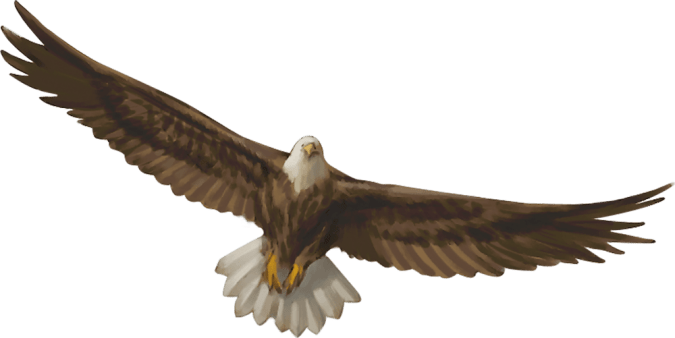
And… yeah. From the distant perspective of an ancient celestial being, what Baron Skullsworn is doing will pass eventually. He’ll die, a new ruler will come, either good or evil or otherwise, and life will go on. What good does it do to intervene in the way civilization naturally progresses? All of this has happened before, and it’ll all happen again, as J.M. Barrie would put it.
Alternatively, you might have the Eagle give them a Trolley Problem answer: if they help you take out Baron Skullsworn, that valley might be saved. However, it would create a power vacuum that will almost certainly lead to a civil war that will harm far more people. And did you not know that his exiled sons are ready to swoop in and tear apart the carcass of their father’s holdings? It might be best to just let things play out.
By this point, as the DM, your job is pretty much done. You’ve laid out the situation and the consequences from the perspective of one who sees the whole. It’s up to your Players to decide what to do about it. And if this absolutely has to involve the Eagles, they’ll need to be very convincing.
This sets the Giant Eagles apart from, say, the Bronze Dragons. The Dragons are interventionists—they see a problem and are determined to solve it with all of their friends. The Eagles, on the other hand, see the problem, but the world is so full of problems, so what’s one more? They spend human lifetimes watching, and they see the way people are. Short-lived, spending so much energy battling over pieces of land or perceived slights that don’t really matter in the long run because we’ll all be dead and there will be new squabbles and fights after us.
To gain the aid of a Giant Eagle, you need to convince them that this particular problem matters. Not just to a few people or to a kingdom, but to the world in the long run.
It might actually be hard to build an adventure around this, a creature that doesn’t really care if the Players achieve their goal. So this means that you should only put Giant Eagles in adventures where they can actually accomplish something. The Baron Skullsworn example is a good one. Why should the Eagles care which human rules? Ah, but if Baron Skullsworn is pulling power from an infernal contract? If he’s promised to establish a permanent planar gate to the Hells in exchange for the souls of his people and the power to rule them? Well, that might be something big enough to attract a Giant Eagle’s attention and get them to do something.
One other thing that might move their feathered hearts might be problems of freedom. These creatures, who make the whole sky their home, might just have a role to play in stories where others are kept in cages. Do you need to deliver the proof of an exiled prince’s legacy before he is executed? Is the Party urgently in need of a way to liberate an enslaved population? Illithids are mind-controlling a Queen and her ministers? These might be enough to get through the Eagle’s natural neutrality and into a place where they might be willing to help.
Now you have a Giant Eagle ally on your Players’ side, and they can act as much more than mere transportation. They have access to the Celestial plane, remember, which could potentially give your Players a line to some higher powers if necessary—great if you have a Cleric in your Party—and can run interference with any sky-based problems on the way. Their combat abilities aren’t outstanding, which is fine. Giant Eagles aren’t big on engagement anyway, so their ability to Rend, while flashy with that extra radiant damage, probably isn’t going to turn the tide in a fight.
However, their presence certainly can. I think that having a Giant Eagle show up with your Party should automatically grant advantage to their Persuasion rolls to get the crowd on their side, or their Intimidation rolls to get the bad guy to give up on their plot for power. You could even have eagle symbolism show up in whatever the post-adventure culture looks like. If you evern manage to bring your Players back to the land they saved, they might find eagles adorning all sorts of things, from flags to ale flagons.
What all this sets us up for is a moral dilemma that your Players may not be expecting. Adventurers don’t usually look at the big picture because generally, they don’t have to. The march of history doesn’t matter to them because there is a problem that needs solving now. From their point of view, the Eagles’ detachment isn’t carefully-chosen neutrality. It’s a choice, and they are choosing not to act. And sure, it may be true that in the long run, everything kind of works itself out, but the people who are being exploited or enslaved or conquered don’t have a long run to look forward to. The Giant Eagle asks your Players to consider the consequences of their actions, while your Players ask the Giant Eagle to consider suffering.
But here’s the uncomfortable truth hiding behind that celestial wisdom: neutrality has never been neutral for the people being crushed. The Eagle gets to watch from above, patient across centuries, untouched by any single ruler’s cruelty. The peasant in Baron Skullsworn’s valley doesn’t have that luxury. They have one lifetime, and it’s happening now. When your Players finally understand that the Eagle’s ‘balance’ looks a lot like privilege from high enough up, that’s when the real adventure begins. Suddenly it’s about more than fighting monsters, but rather deciding what they believe justice actually requires.

