Once a month we’ll do a Random Monster Mashup! This could take many forms – maybe see what happens when the monsters fight or team up, think about what kinds of circumstances might result in this situation, and even, if we’re feeling really creative, think about what happens if we stick these two monsters in a teleporter together and hit “SEND.”
This month, we have a fascinating combination: the Guardian Naga and the Shambling Mound. One exists to preserve the history of holy places. The other is a mindless devourer.
As narrative tensions go, this is actually a really interesting one, and you could turn a pretty straightforward adventure scenario into an examination of purpose and permanence and what it means to hold on to something for far too long.
Picture this: Your Players find the Ancient Temple of the Serpent God Miccapetlacalcoatl, buried under centuries of old growth jungle. When they get to its heart, they find not a treasure but a great, serpentine creature in distress, who is overjoyed to see Adventurers. “They’re destroying everything,” the Naga says. “Please – rid my temple of them and I’ll reward you with knowledge lost for generations!”
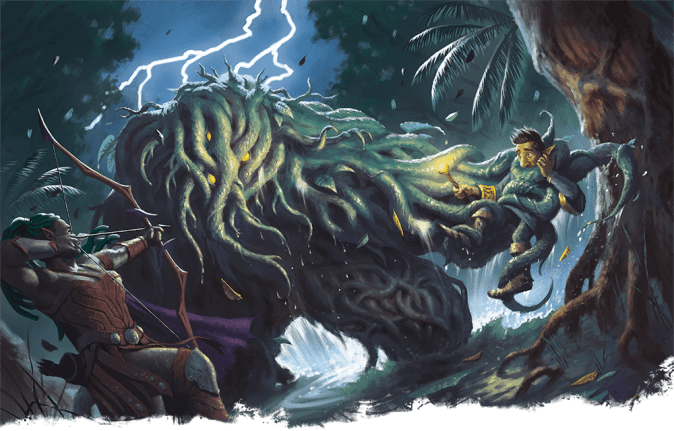
Shambling Mounds have invaded, and they’re sweeping up everything that this Naga has promised to preserve. The Mound is pulling the jungle in with it, allowing root systems and lichen and corrosive fungal networks to seek out the cracks and fissures in the ancient stones. If left alone, the whole edifice, perhaps the last temple to this lost serpent god left in the world, could come down. For the Naga, there is little it can do. The Naga deals in knowledge and lore and history. The Mound is just… biology. It can’t be reasoned with or implored to. But your Adventurers? They love killing things and getting rewarded for it, of course, so why wouldn’t they start crawling through the temple and slaying every bit of moving greenery they can?
It is now a battle between preservation and reclamation. A race between a creature that has held on to this place for eons and the forces of nature that want to take it back.
But what if it isn’t that simple? What if the temple isn’t really worthy of preservation? As your Players travel through the temple, they might find out that the Serpent God’s followers died out ages ago. It doesn’t have anyone to pray to it and, depending on your views on Ontological Theosophy, may not even exist anymore. The Naga may be trying to preserve a temple for no one, and, if that is true, perhaps the Shambling Mounds should reclaim it.
They may even go back to question the Naga about its purpose:
Why do we need to destroy these things?
“Because they’re destroying my temple!”
Okay, but what’s in the temple?
“I guard the temple!”
Yes, but what for?
Perhaps the Naga guards the temple because that what it was commanded to do, long ago when there was something worth guarding. If you want to twist the knife, you may even have the Naga, for the first time in its very, very long memory, open the chambers it was commanded to guard and find…. Nothing. The sacred weapons and armor of the God-King Itzam-Ye turned to dust centuries ago. The great, gold-threaded tapestries that depict the ascension of Queen Centehue the Radiant are mere rags, devoured by time. Only the Naga is left.
The Naga has preserved this temple for no one but itself, and that may be the problem that your Players have to solve. They will have to decide whether this knowledge needs to be preserved, or if it is okay to simply let it go once it has outlived its usefulness.
What seemed like a simple, straightforward slash-and-burn then becomes a heartbreaking moral choice. Do they keep an empty temple intact simply to fulfill a duty that ended long ago, or do they let nature take its course and reclaim it into the earth? There may be no real reward here other than a crushing realization that sometimes, even in D&D, there are no easy choices, and that sometimes, letting go is the best thing to do.
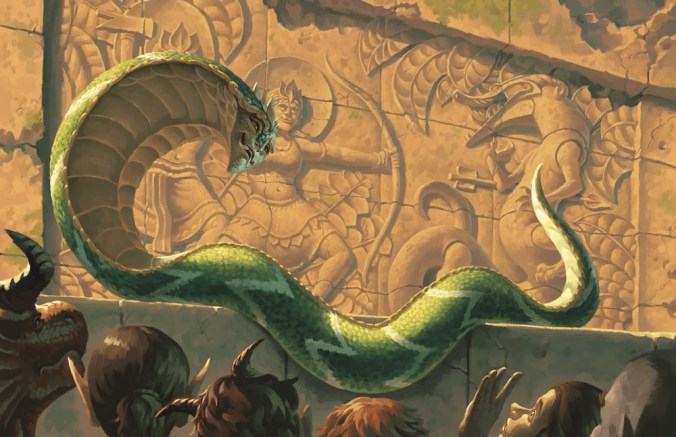
But what if we want to take this to the other extreme? Rather than a Guardian Naga that is fighting against the devouring forces of nature, what if the Naga is the devourer?
What if we combine these creatures to create the Guardian Mound, a slithering, celestial mass of serpents that devours knowledge as it moves. It is drawn to museums, libraries, universities – any places where esoteric knowledge and deep lore can be found, and when it passes? That knowledge is just gone. It leaves blank pages, smooth stones, and minds that have been stripped clean of what they were once so proud to know?
Homebrewing monsters is not my strong suit, so if you want to take a stab at it, leave your stat block in the comments. But here are some thoughts:
- It regenerates. If destroyed, the Guardian Naga returns to life, and if hit with lightning, the Shambling Mound becomes healthier. So perhaps the Guardian Mound should benefit from Psychic damage, gaining hit points as mental energies are sent its way.
- It engulfs. A normal Mound will swallow someone and start to eat them. The Guardian Mound might not do physical damage, but perhaps might eat away at their Wisdom or Intelligence scores temporarily. Until the next long rest, perhaps. Let’s call it DC 15 against whichever score the Mound is trying to absorb.
- It casts spells. The Guardian Naga has some good spells in its roster, but the Guardian Mound might have Detect Thoughts or Modify Memory or Befuddlement to use on those who threaten it.
Whatever the Mound ends up being in a mechanical sense, the more important thing is that it still forces your Players to choose what can be sacrificed and what needs to be saved. Do they try to lure it away from the priceless books on civil engineering by dangling a full collection of texts on the nature and composition of household dust, painstakingly written by a long-dead Halfling scholar? Is useful knowledge more important than a passion project?
Put these two monsters together and suddenly preservation comes with a choice. Temples crumble. Books decay. Memories disappear. Heck, whole civilizations can vanish from human memory. We can’t save everything, and sooner or later we have to deal with that, whether it’s a fantasy kingdom or the world outside the game. And when that time comes, we will have to decide what gets to survive. And, more importantly, who gets to decide it.

