There’s a certain type of DM who will, upon finding out that an adventure has Slaadi in it, will steeple their fingers, grin broadly, and whisper, “Excellent” under their breath.
I’m not saying I am one of those DMs, but I’m not saying I’m not, either.
Slaadi are, fundamentally, chaos agents. They originate from the plane of Limbo, a realm of pure chaos. Nothing stays as it is for very long – ice can become fire which becomes rock which becomes an abandoned Blockbuster video – and a visitor to Limbo needs to be prepared for the unexpected and impossible. To be native to that place, then, means that the Slaadi are going to see the universe in a very different way than we do.
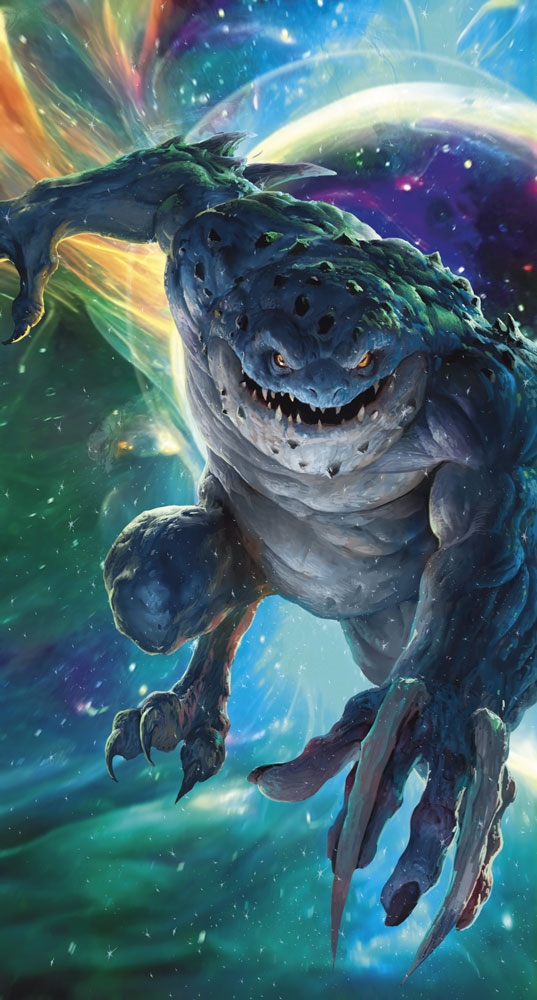
Every Slaad is of the Chaotic alignment, abhorring rules and restrictions, and all but the Death Slaad are Chaotic Neutral. And while this seems to fit with their origins, these chaos-loving frog demon creatures follow an inherent inborn order that tells you how they should be used in your adventures.
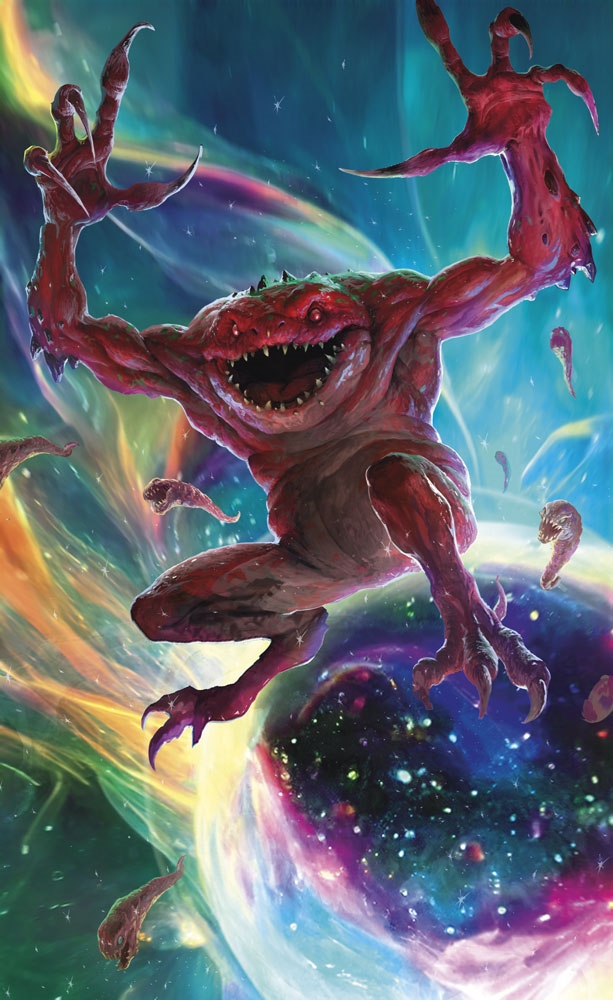
At the bottom of the order are the Red and Blue Slaadi. They’re the footsoldiers of this terrible species, and one of their primary goals is that of transformation – making more Slaadi.
A character struck by a Red Slaad may find themselves injected with a Slaad Egg during combat. Unbeknownst to them, a Slaad Tadpole is gestating inside them. And, much like in the popular Alien franchise, when the tadpole is ready to come out, it will burst out of its host and kill it. Depending on who the host was, the tadpole will then evolve into a Blue or Green Slaad.
The Blue Slaadi work in concert with the Red, making this pairing the most likely for your Players to encounter. Their curse is a little more horrible than that of the Red – it’s possible that the target of their claws will transform into a Red Slaad or, if they had enough arcane talent, a Green.
The horror that comes with the Red and Blue Slaadi is this sense of inevitable transformation. The target weakens over time, unaware of what is happening to it, and turns into the vessel for something horrible, if not the horrible thing itself. It’s possible to use the Remove Curse spell to halt the transformation, but your Players would have to know that the person is cursed. A fast-paced race to find a cure before their comrade dies could be a great adventure seed, as long as you give them the clues to find out what happened to them.
Maybe the Party member starts to act a little off. Memories of certain events don’t line up properly. Their priorities shift, taking them away from the person they used to be and slowly morphing them into the monster they are becoming. The question is no longer about whether they are infected, but rather about when they stop being the person they were.
With the Green Slaad, we are no longer interested in transformations, but rather it acts as the controller of the Blues and Reds, often at the behest of more powerful entities like the Grey or Death Slaadi. These creatures can wield magic either on their own or with their Chaos Staff and are smarter than their lower-level brethren.
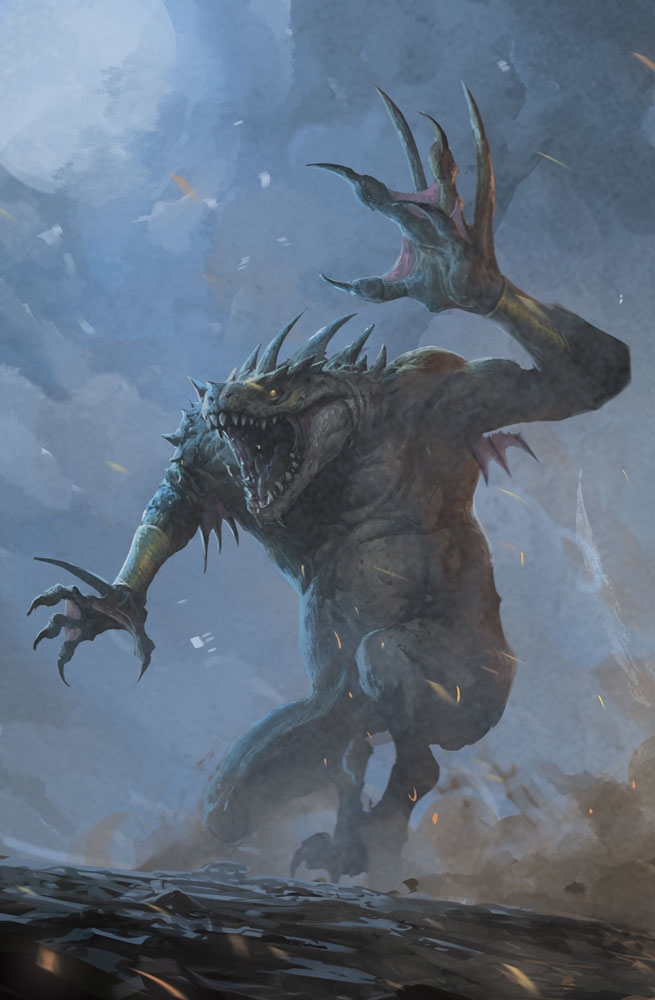
If a Green is very lucky, it may be transformed by powerful magics into a Gray Slaad. Like the Greens, it can use magic, but has access to more powerful spells. They are the more forward-thinking Slaadi, perhaps spearheading missions into the Material Plane on their own, directing Green, Red and Blue to do their terrible bidding.
The final form, bestowed by a Slaad Lord, is the Death Slaad. These are the most terrible and intelligent, capable of casting higher-level spells such as Cloudkill (at level 8) and Plane Shift. If there is a Slaad most capable of creating complex, destructive missions, it is this one, enlisting all those beneath them.
Whereas Red and Blue introduced the horror of becoming something terrible, the Green, Gray, and Death Slaadi are able to Shape-Shift as a bonus action. This means they could be anyone. That smiling shopkeeper who’s been selling them prime magic items? A Green Slaad doling out cursed blades they found in Pandemonium. The loyal palace guard, always on their post? A Grey Slaad making plans to unmake the monarchy from the inside out. The archivist your Party trusts with its secrets? A Death Slaad feeding them just as much information as they need to stay off-track.
Anyone, anywhere could be a Slaad, waiting to rope your Players into their nefarious plots. Maybe not quite as horrifying as not knowing who you are, but it should have your Players jumping at shadows and rolling Insight Checks as often as possible. For a DM interested in intrigue and how information and misinformation shapes a mission, Slaadi are excellent choices as villains. You can keep your players guessing and paranoid, uncertain not only about each other, but about themselves.
And this is where good Safety Tools are important. Body Horror may not be up everyone’s alley, and you as a DM should make your Players aware in Session 0 that it’s a possibility for their characters to be taken away from them by terrible means in this game. If your Players aren’t cool with that, see if you can find a way to work around it, or, if it’s just not possible, save your Horrifying Slaad Adventure for your next David Cronenberg Fan Club D&D game.
And these adventures can get very weird, as Planar adventures often are. Imagine Limbo leaking out into the Material Plane. Nothing is stable, everything is changing in new and horrifying ways. Cause and effect no longer have any relationship to each other. And crawling through that ever-changing mess are these strange, colorful, froglike creatures that want nothing more than to make more of themselves. With the color progression, you even have a kind of natural escalation to your campaign, introducing stronger and more terrible Slaadi as the infestation from Limbo gets harder and harder to hold back.
As chaotic as the Slaadi are, there is still order to be found. Not just in the hierarchy of color-coded chaos frogs, but in the existence of Slaad Lords and control gems that allow for not only the creation of Slaadi, but their control as well. Want your Players to stop sleeping entirely? Hand them the control gem for a Gray Slaad and tell them that it will obey your Player’s orders and see what happens there. What does it mean for a creature born in chaos to be trapped by the will of another?
I ran a game where this happened, and the Slaad my players had control over consistently told them, calmly and in great detail, about they ways it would murder them all when it was free.
If you’re running an adventure that plays with concepts of identity and reality, the Slaadi are your best go-to monsters. They get more and more terrible as the adventure goes on, and reveals to the Players a part of the Multiverse that not only does not care about them, but which rejects them entirely as people. They are vessels to be overwritten so that the power of Limbo may be unleashed upon this world.
Slaadi threaten more than your players’ lives – they threaten their sense of self. The person you were ceases to exist, replaced by embodied chaos wearing your skin. And the worst part? Your companions might not know until it’s too late. And by the time they do know, the only solution might be to destroy you themselves.
In a world of dragons and demons, Slaadi remind us that some horrors don’t destroy you. They become you.


Pingback: The Aboleth’s Gift: Secrets, Slime, and Self-Destruction | Encounter Every Enemy
Pingback: Monster 100: Every Monster Matters | Encounter Every Enemy