In every conflict, there comes a time where the only choice left is force.
You tried to be diplomatic, but they didn’t want to talk. You tried to be tricky, but they were ready for you. You tried to wait them out, but they were more patient.
And so you close your eyes, sigh deeply, and say, “Fine. Send in the Goristro.”
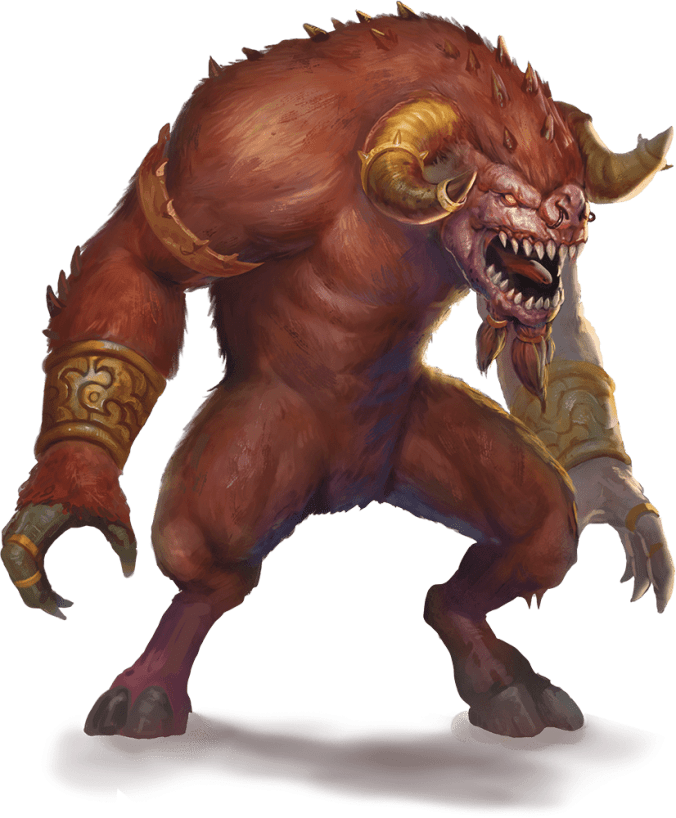
The Goristro’s description in the Monster Manual states, “Goristros are giant demons capable of bringing cities to ruin,” and that should tell you everything you need to know about how to use one of these demons in your game. They’re not clever, they’re not tricky – they destroy everything in their path. In fact, they’re so dangerous to the world around them that they have the Siege Monster trait: they do double damage to buildings and structures when they run into them.
That doesn’t mean they’re letting living creatures off lightly, either. They’re highly mobile behemoths, and a good use of their Brutal Gore and Slam attacks could probably reduce even the toughest of Player Characters to dangerously low HP in a single turn. They’ve got up to 437 HP and an AC of 19 and they’re not going down to anything less than your party’s absolutely hardest of hits.
So what does it mean to have something this terrible in your game?
It means that something has gone terribly wrong, that’s what it means.
Goristros aren’t demons that make plans. Other, smarter beings do that for them, so if a Goristro has appeared, it means it is being used by someone else, as any good Arcana check will tell your Players. While the immediate question is certainly, “How do we stop this thing?”, the next should be “Who sent it?”
The most obvious answer is that it was sent by other, smarter Demons. If you’re playing an adventure where the Abyss has opened up, Demon Lords are certainly going to unleash Goristros against the mortal plane. After all, creatures like The Demogorgon or Baphomet aren’t interested in gold or kingdoms – they want destruction, pure and simple, and a Goristro will do that job for them.
This could be a wonderful fight for your players to prepare for. They know the armies of the Abyss are coming to this kingdom. They have very little time to not only convince the rulers that an attack is imminent, but to help them get ready to face a creature that could probably get through their walls with little trouble while their petty human soldiers and cavalry are scattered under its thundering hooves. This could really reward clever thinking and relationship-building for your Players, calling on all the people and resources they may have built up during the campaign to come up with a workable plan.
And for you, as the DM, you get the joy of not worrying about how they’re going to stop it. You’re just pointing the Goristro at the walls and letting it go. It’s up to your Players to think of something interesting and creative enough to shut that down, and there are few moments in running D&D more entertaining than watching your Players figure out how to completely ruin the monster you’re trying to kill them with.
If you don’t want to gift your Players with planning time, perhaps the Goristro is the result of a summoning gone wrong. A Wizard, perhaps angry that his local Wizarding Union has turned down his application to join, has a few drinks and decides that he’ll show them – he’ll show them ALL! And he doesn’t mean to summon something so terrible. He just wants to show them what a mistake they made, not to turn the city into rubble.
Alas, anger and bruised pride can lead to very poor decisions, and what comes out of that summoning circle is a living WMD, a creature that no mortal wizard should have control over.
But does your Wizard have control over it? The answer to that question will determine the whole adventure.
Let’s say they do – their force of will is strong enough that the Goristro doesn’t instantly kill them and start destroying everything it sees. What does your Wizard do with this? Are they really so angry that they let it annihilate their tormentors, or do they come to your Players with a truly terrible problem: I have this city-destroying creature on a very thin leash, and I don’t know what to do about it.
Of course, if the Wizard’s will wavers at all, the Goristro can turn them into thin red paste and then do whatever it wants.
But what does a free Goristro want?
They have an Intelligence of 6, putting them on par with such a mental luminary as Grog from Critical Role, so these demons are not mindless. What does it mean to be a living weapon with just enough awareness to know that you’re being used for the purposes of other creatures, creatures that you could probably destroy if you wanted to? What if you suddenly had no masters, no one pointing and saying, “Break that.”
You could give your Players this moment: a massive creature, just standing there, breathing like a bellows. Not moving. Not destroying. Just standing. A weapon without a wielder.
Maybe the Goristro just destroys. That’s what it knows, after all, so why wouldn’t it? Maybe it tries to find its way back to the Abyss, rampaging towards the closest rift to its home plane, heedless of anything in its way. Maybe it just stands there, waiting for a threat to respond to. Your players aren’t going to save it – these creatures are Chaotic Evil, after all. They’re just deciding where this walking disaster lands next.
But if they are clever and careful and prepared, they may well find an opportunity in this moment to redirect its terrible energies elsewhere, and maybe even keep it from killing them and everyone else it sees.
A Goristro can make for a spectacular battle at your table. Throw armies at it, put walls in front of it, and it’ll just plow right through them. And your Party will probably take it down eventually. That is the nature of D&D, of course, but they should only do so at great cost.
And once it is defeated, its body dissolving into ichor as it reconstitutes itself far away in the Abyss, your players should be left wondering: Who sent it?
Because as bad as the Goristro was, whoever decided that this creature was the solution to their problem?
That’s the real monster.
 Encounter Every Enemy