We’ve talked about Elk before – majestic, silent, possibly a signal to your players of what has gone wrong with the world.
So why do we need a Giant Elk? What does this creature do that our run-of-the-mill Elk cannot?
The biggest difference between this and the regular Elk is that, while the Elk is a Beast, the Giant Elk is a Celestial. It is a spiritual being cloaked in fur and antlers, and that makes it a whole different creature for you to use in your game.
Where the Elk were vital residents of the forest, the Giant Elk can be the spirit of that forest. This is the creature that comes to your Party’s campfire late at night, emerging from the shadows into the firelight and speaking to them in the language of gods and angels to tell your Party that it has a problem. Either for them or with them, whichever is more interesting.
This is a wise and intelligent creature, and that means it can reason and judge, make requests and grant boons. It is not a creature to be hunted, but rather one to be negotiated with. Depending on your setting, it could be a kind of diplomat or a noble or even a king.
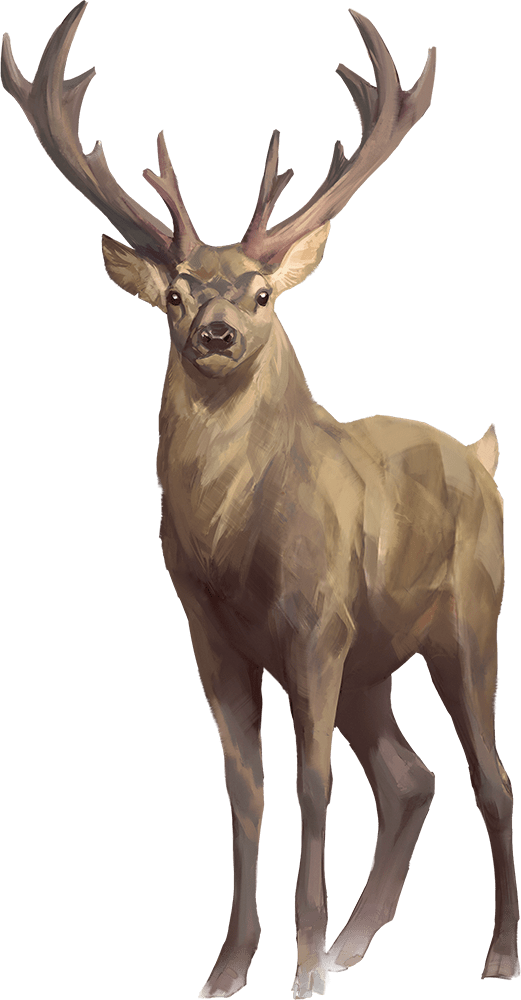
The latter could make for a very interesting adventure. Imagine a Giant Elk that rules over a forest. Not through laws or edicts or armies, but simply because the forest itself acknowledges their rule. Now we find hunters coming home empty-handed. Farmers and ranchers who want to expand their land are thwarted. Passage through the forest is stopped by felled trees and tangled branches, and the human beings who relied on the forest are suddenly in a state of disarray.
And they want your Party to fix the problem.
Undoubtedly they’ll tell tales of a Great Elk Spirit that roams the woods, and will probably suggest that your Party either banish it or kill it. Maybe someone can even lend your Party their grandfather’s longbow, said to have been enchanted long ago by a great warrior-wizard so it never misses its mark.
Other villagers will beg them not to kill it. Yes, it’s disrupting their lives, but what are their lives against a spirit of nature? Perhaps making peace with the Elk King will bring true prosperity to them. Being in cooperation with nature surely is better than being in competition with it.
When your Party does eventually meet the Elk King, they will be meeting a great celestial creature that watches them with a gaze that is far more intelligent than a simple beast. It won’t threaten or cajole or try to bribe your players into doing the right thing. It will tell them what the right thing to do is, and then – calmly and confidently – expect that it will be done.
What happens when they realize that the reason the Giant Elk has been given dominion over the forest is that it has earned it? It has been there longer than anyone remembers, and the forest bends to its presence, if not its will. The Giant Elk doesn’t command the birds and the beasts or threaten the wolves. The stream bends around its resting places. Trees grow where they are needed, fall where they are not, and where the Giant Elk passes, the other residents of the forest give way.
The Giant Elk has authority, but not ownership, and that is something that a lot of D&D adventures rarely address.
You could play up a sharp contrast to that with examples of human authority, whose authority is inevitably based on ownership and possessions. If you own something, then you are given leave to do what you want with it, regardless of whether what you do is useful or correct or moral.
That kind of leader would look at a forest and think, “If I can control that, then I own it. And if I own it, I can do what I want with it.” A tree or a brook or a sunny grove is of no value to such a person because if left alone, it generates no money and allows no leverage over others. A warehouse full of lumber or a productive water wheel or a winter cabin are things that can bring gold and influence, and those are the things that person works for.
You can build a campaign around these incompatible understandings of what it means to have authority, and put your Players in a position where they have to decide which version most aligns with their own moral vision. The human leader can pay more, certainly. Having that kind of person in your party’s debt can allow them to call in favors later, perhaps when they are most in need.
What can the Elk King provide other than the gratitude of the Forest and all who reside in it? Perhaps it, too, can provide resources and allies, but instead of gold or a stronghold or armies, it’s food or a place to shelter or the creatures of the woods themselves.
If you want to make things a little more complex, give your Human a reasonable motivation for wanting to encroach on the Giant Elk’s territory. Perhaps it’s the ruling council of a village that’s had a hard couple of years. Their cropland isn’t producing, their homes are in need of repair. “The Elk has lived here for centuries? That’s great, but my people have to survive the winter in six months.”
As a game system, D&D values power as one of its core engines. Players level up, becoming more powerful. They face enemies of increasing power. The ambition of a Player is to exert power over this shared world, becoming someone with far more weight over history than they are in real life.
The Giant Elk’s power comes not from domination but from recognition. Nobody voted for it. It didn’t conquer anyone. The forest simply recognizes its legitimacy.
And hopefully, that will leave your Players asking themselves what makes someone worthy of power in the first place? Is it something you seize or inherit or purchase? Or is it something that has to be earned, day after day, until the world has no choice but to recognize it?
Your Players, standing in the presence of a creature around whom the forest itself breathes, a creature who never asked to wield power, will understand power in a way that no dragon or Beholder or master Vampire ever can.


Pingback: Monster 100: Every Monster Matters | Encounter Every Enemy