Why do people seem to love pirates? I mean, historically speaking, Pirates were pretty nasty customers. They were basically sea bandits, exacting violence on people in order to get what they want, but we don’t have multi-million dollar movie franchises and theme parks celebrating bandits, do we? Kids don’t dress up as muggers for Halloween.
So why do we romanticize Pirates? And how can you keep from doing the same in your D&D game?
When you sit down and think about what Pirates represent, there are a lot of really useful angles, and the biggest of these is similar to what we discussed when we talked about The Mirror: Who gets to decide who is or is not a pirate?
If you have a ship captained by a ruthless, huge-bearded man with a pegleg who exacts capricious, joyful violence on captives and crew alike, is he a Pirate? Well, that depends. Is he working within the bounds of the law? Is he an agent of a government? Well, then, no. He’s not a pirate. He’s a terrible person, but not a pirate.
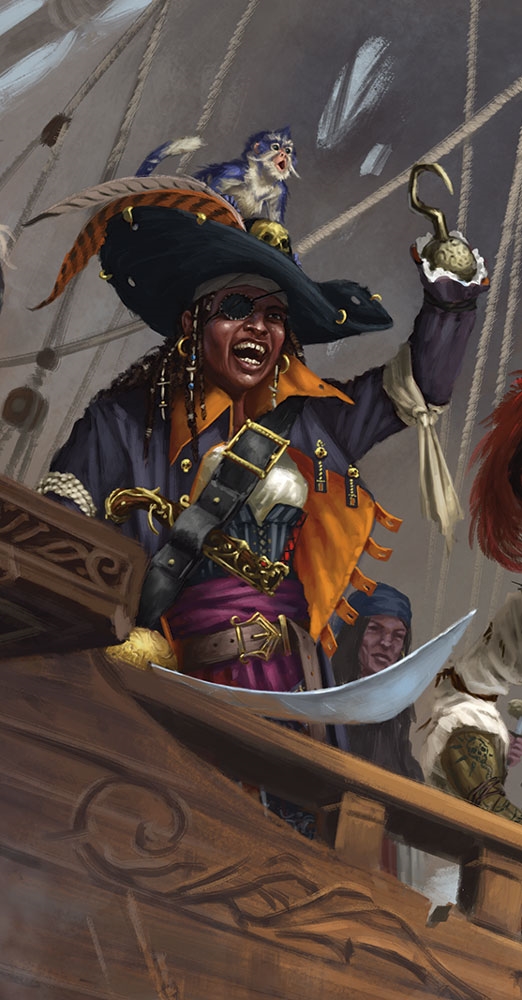
But what about the clean-cut vigilante sailor, whose crew is trying to stop a government from overreaching on the seas? They attack and cripple ships, but do their best to leave the crews alive. They never steal more than they need, and have a very narrow mission focus.
Sound like great people, but they’re acting in opposition to Government, so they’re Pirates now.
If you think about it, most governments are not against violence. They just tolerate it when it’s useful to them. Many militaries have done truly atrocious things in the name of their countries. And people like mercenaries or privateers blur those categories, acting as official actors of violence in return for pay.
And that becomes an angle you can play with: What happens when the legality of behavior comes not from the behavior itself, but from the label applied to it? Adventurers in D&D are usually given free rein to do what they want because they’re Adventurers. Plunder a tomb, steal a valuable diamond, fight Dragons in the city center – that’s all fine because they’re Adventurers.
But what if they weren’t?
What if they find themselves in need of a ship to get to their destination, and the clock is ticking. They can sign up for permits, sure, and make sure they are familiar with the local rules and customs surrounding seafaring in this land.
Or, and stay with me here, they can become Pirates themselves because doing it by the book was too inconvenient?
That, to me, hooks into one of the reasons why Pirates are one of the few entries in the Manual that is actually aspirational. No one dreams of being a Gelatinous Cube, but everyone dreams of telling a local bureaucrat exactly where he can shove his rulebook, and Pirates are exactly the type to do it. The more institutional pressure you put on your Players, the more likely they are to steal a ship and Yo-ho-ho their way out of town.
Another thing to remember about Pirates is that they are economic engines as well as terrors of the seas. They disrupt the food chain and change the way people on coasts do business. So you can finally have your classic Seven Samurai adventure, but with Pirates and a poor, defenseless seaside village. They’re too small to rely on the local militia or the Monarch’s forces, so they hire your Players as defenders.
Now your Players are part of an economy, deciding a very important question: whom does this violence benefit? Are they taking from the pleasure yachts of wealthy nobility, or is wealth extorted from humble island villages? Does treasure go to supporting the families of the Pirates you sail with, or enriching a merciless Pirate King who hasn’t actually been to sea in decades? The official systems that would make these decisions are gone, and your Players become part of the new order, deciding what role violence – both physical and economic – should play in the world.
But that kind of reveals why people become lawless pirates in the first place. They do it because they no longer believe the existing systems can protect them. If you can’t count on the law or the courts to protect you, then why not become a Pirate? Why not sail around with your buddies and raid government ships in order to live the life you think is right?
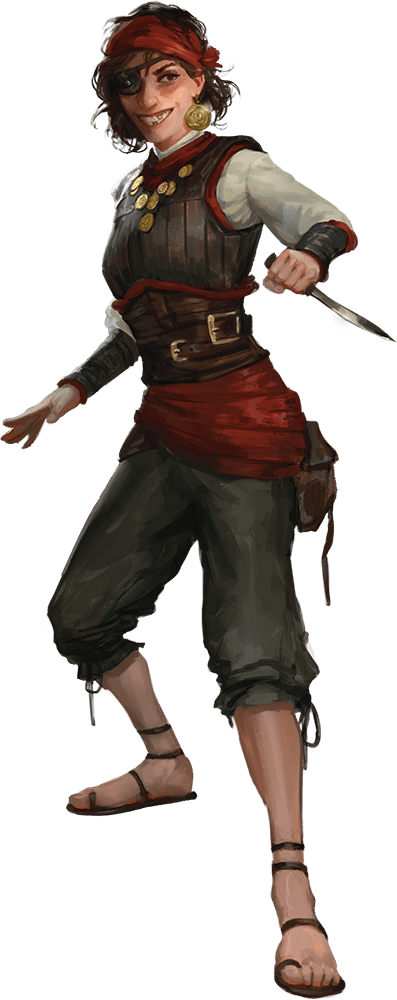
Suddenly your Pirates aren’t just crazy guys with cutlasses – they’re people operating outside the realm of legitimacy because they recognize that legitimate power no longer serves them.
And once you have that idea on the table, all new ideas open up for you.
Now you have things like Pirate Societies, where the sailors govern themselves. It’s actually fairly in line with how real-world Pirates behaved, running their ships and their fleet with far more of a democratic approach than we might expect. Not because they were enlightened idealists, but because shipboard tyranny can get you killed. If you do it right, your Players might find that a Pirate vessel is actually freer, fairer, and more of a meritocracy than whatever landbound kingdom they left before.
And we’ve seen this before – remember Kobolds? Those little dragonlings that assume life is trying to kill them, and prepare accordingly? With Pirates, you have people who assume that the laws and systems that rule the world are not operating in their favor. As dissimilar as they seem, both Kobolds and Pirates are survival cultures formed by exclusion.
Therefore, they choose to operate outside of those systems, if not in direct opposition to them. How that opposition affects your Players, of course, is up to them. Are they willing to look into the inequities that allow Pirates to exist, or are they going to stand up for Law and Order, regardless of how it is applied?
The Monster Manual offers several levels of Pirates for you to fight, from the humble CR 1 Pirate all the way up to a formidable CR 12 Pirate Admiral. But fighting the pirates doesn’t have to be the choice you put in front of your Players.
Fighting pirates is easy. Understanding why they exist is harder. If your players take the easy route, that’s fine – they’re adventurers, so they have free rein most don’t, and piracy looks really seductive when legitimacy feels kind of hollow.
But if they look deeper, they might realize something uncomfortable: the systems that made them adventurers are the same systems that made others pirates.
The difference isn’t moral. It’s just luck.


Pingback: Pteranodons: When the Sky Steals Your Stuff | Encounter Every Enemy
Pingback: Dragon Turtles: The Landlords of the Deep | Encounter Every Enemy
Pingback: Archelon: The Gentle Giants Nobody Hates | Encounter Every Enemy
Pingback: Monster 100: Every Monster Matters | Encounter Every Enemy
Pingback: Bronze Dragons: Nobody Saves the World Alone | Encounter Every Enemy