It’s nice sometimes to have a really reliable jump scare when your Players are already on their toes.
They’re walking through an underground crypt – or an ancient cave or an abandoned temple – where dust hangs heavy in air that smells like it hasn’t moved in centuries. Maybe there’s water running down the walls in tiny rivulets or strange scurrying things that flee the torchlight.
They come across a half-opened door, swelled by moisture. Convinced there must be something inside, they slowly push the door open, holding their torch out ahead of them for light, when….
BATS!
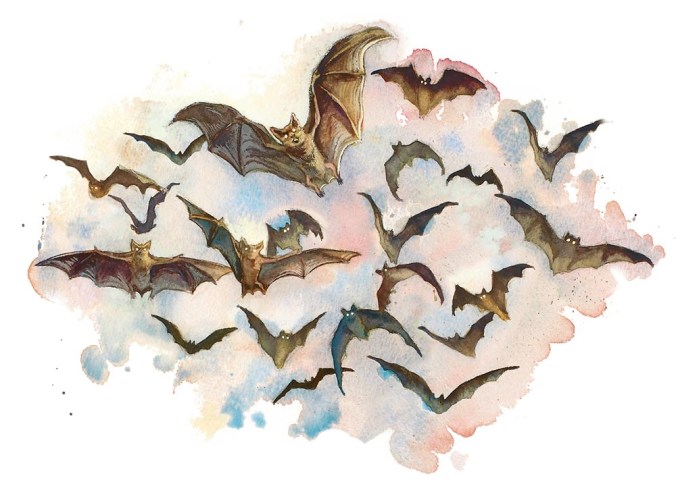
All the bats, and they come flying from every corner of the room, flapping and squeaking, surrounding them and freaking everybody out for a hot minute. The adrenaline is flowing, everyone has their hands on their weapons….
Then you all have a good laugh before the Shambling Mound in the corner unfolds itself and tries to eat them alive.
Swarms of Bats, like most Swarms in D&D, are not terribly interesting as combat options. At best, they’re nuisances, determined to annoy your players into wasting their resources with tiny beasts instead of facing the actual threat. The most interesting thing they can do is occupy a player’s space, but unless you want to homebrew a rule where missing the swarm means a Player accidentally bludgeons their teammate, this causes less chaos than you think it does.
The best thing to do with Swarms is to think about the function that they play in a dungeon, and I think the best analogy we might use with the Swarm of Bats is this: they are the dungeon’s nervous system.
They’re the first thing in the dungeon to react to your Players’ intrusion, snapping to life like a reflex action or a touched nerve. What they should now understand is that the dungeon knows they’re there. That Owlbear nesting a few floors down, those Skeletons that’ve been resting in the torture room, all the things that call the dungeon their home are now aware that there are intruders, and they will be ready.
Speaking in meta-D&D terms, dungeons are static places. Nothing really happens until your Players get there. The Mummy will always be in its tomb, the Ochre Jelly will always be stuck to the ceiling – dungeons exist in a kind of stasis until your players arrive to disrupt it. The bats, who by their nature are creatures of thresholds, will be the first to notice that something is wrong. Strange new things have entered the dungeon, disrupting the equilibrium, and the bats react accordingly.
Therefore, they can act as a signal to your Players: this place is untouched by the outside world. This doesn’t mean that there’s nothing there, of course. Just that the things that are there are laying in wait, and because the Players have set a chain of events in motion, they will not be waiting patiently.
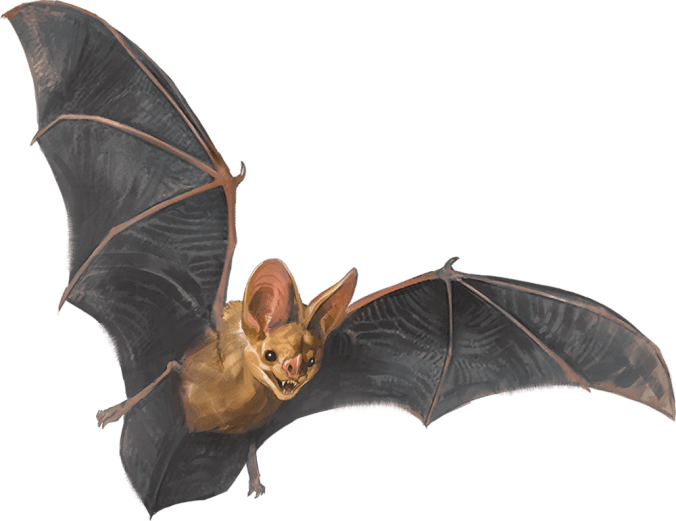
In that sense, the Swarm of Bats can represent something very primal. They are the gateway between the Civilized World and the Unknown. You can put Swarms of Bats anywhere you need the Party to know that they are moving from a place of safety to one where they may be in danger. Abandoned churches, ancient caves, deep forests that haven’t known the step of a humanoid in millennia. All these places are where the adventure happens, and the Swarm of Bats is a signal that the adventure is about to begin.
There are other things you can do with a Swarm of Bats that may require you as a DM to put your thumb on the scales a little bit. For example, having hundreds of tiny creatures flying erratically towards you down a hallway in the real world would be undeniably terrifying. It would be a moment of blind panic as you try to get them away, see where they’re coming from, and maybe keep them from biting you.
Unfortunately, their official stat block doesn’t really address the panic factor, but that doesn’t mean you can’t.
You could decide that any space occupied by a Swarm of Bats is Heavily Obscured. This will make combat much more difficult for Players whose skills rely on sight, such as spellcasters, and can also make it much harder for your martial characters to hit what they’re aiming at. If you’re feeling really mean, you could have the characters succeed on a Perception Check at the beginning of their turn – say, DC 12 – or they have to move in a random direction when they chose to move at all.
Now the Swarm of Bats is an actual problem of existing in a space, rather than dozens of flying furballs diving and swooping around them the whole time.
You could even give the Bats a disease to carry. The Dungeon Master’s Guide has a few on hand, such as you would get from the legacy version of the Diseased Giant Rat: a continual loss of 1d6 health every 24 hours until the disease is cured. Or until they die.
It’s unfortunate that the Monster Manual doesn’t give Swarms of Bats more to do, mechanically speaking, but all that means is that you have freedom to decide what they mean in your game.
However they encounter them, by the time your players see the bats, it’s already too late. The dungeon already knows. Traps are armed. Monsters are alert.
The Swarm of Bats aren’t a threat to your players in a combat sense. They’re a signal that the real threat is waiting in the darkness beyond.


Pingback: Bat: What We Fear, What We Become | Encounter Every Enemy
Pingback: Giant Bat: Remember to Look Up | Encounter Every Enemy