They make their lairs in the most desolate places, haunting territories of sadness and despair. With their songs, they lure the unwary to their deaths, twisting their minds and their desires until it’s too late. Where once was an adventurer there is now only a carcass, a fresh meal for these winged creatures – half woman, half bird, with hate in their hearts and a song on their lips.
Harpies are creatures that come straight out of the mythological foundations of our own world. Depending on the writer, they were either fair maidens who heralded the winds or, more often, hideous creatures with stinking flesh and putrid breath that carried people off to their doom. The Harpies in the Monster Manual definitely follow in the latter tradition. They are cunning scavengers with a haunting song that lures creatures in until they can lash out at them with claws or a club. It’s an easy save for most middle-to-high level parties, but if someone should fall under her spell, it can greatly disrupt a Party’s plans. Even more so if there are multiple Harpies in play, which there absolutely should be.
It would be a mistake, though to simply use Harpies as a combat encounter. Like so many of the monsters in the Manual – especially those that have survived in actual Earthly mythology – the Harpy can be a very symbolic creature, representing fundamental emotions and needs that can serve as the foundation for a whole campaign.
In this case: Desire.
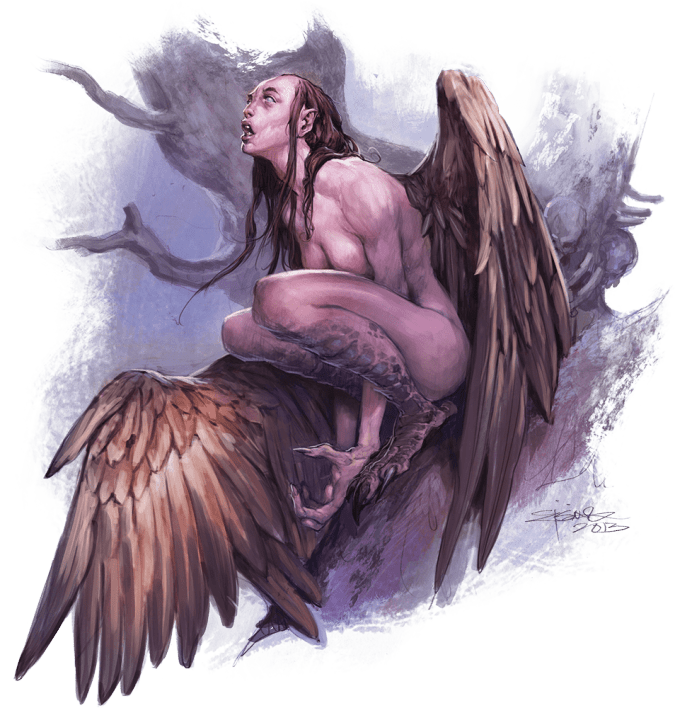
Harpies are creatures of desire, first and foremost. They desire creatures to serve them as prey, or to toy with before being devoured. In mythology, they would steal food, often spoiling it so that others couldn’t have any. And their song, of course, generates desire in all those who hear it. Legend has it that their song is as beautiful as they are hideous, and sounds different to each person who hears it.
The desire that they create is so strong that it causes those who hear it to surrender their very agency. Unlike Dragons, who demand obedience, or Devils, who coerce it, the Harpy simply takes over the mind of its victim, removing the possibility of wanting anything but to move closer to her.
So we might ask ourselves an important question: If the Harpy is such a hideous, hateful creature, why does her song work? What does her song contain that could cause even the most hardened Adventurer to put down their sword or their spells and walk to their doom?
This gives you a chance to reach into your Players’ characters are really pull from their innermost hearts. Your Rogue might hear forgiveness in the Harpy’s song, the chance to be absolved of a terrible error of judgement, perhaps the one that set them on the path of crime. Your Bard might hear the call of fame, of an adoring crowd that wants nothing more than to hear them play just one more song or recite one more poem. Your Fighter might hear a song of rest, calling them to put down their weapon and armor and finally stop the fight that has driven them for so very long.
Now it’s not as simple as “save versus charm.” Now your Players are trying to resist the ache inside their heart that they most want healed, and then try to understand why they should even try to fight against it.
We can also link this power to their nature as scavengers. With war tearing a kingdom apart, the Harpies come in its aftermath. Not just to feast on the dead, though they’re happy to do that. They also come because they know that the survivors of war are exhausted. Afraid. Weak. The Harpy’s song then becomes a temptation to stop resisting, to stop having to be strong enough to endure terrible things.
And that is where your Players come in. Now they’re not just coming in to eliminate monsters – they’re saving people from exploitation. The citizens of these small, war-torn towns live with a strange fear of the Harpies. They fear being taken, certainly, but at the same time, that song promises rest and peace, something they may not have known for years.
What if, after slaying the Harpies, your Players are not hailed as heroes? Perhaps they are greeted with resentment at destroying even the illusion of a restful life. People have always wanted what is dangerous for them, even when they know it’s dangerous – what damage might be done by taking the Song from them?
If there are no great wars in your campaign, and you want to grant the Harpies a little grace, you could have them manufacture crises. They haunt lonely roads and old ruins, perhaps plant false signal fires and rumors of sanctuary for the weary. They draw in solitary travelers and desperate people, promising hope and salvation, only to meet them with betrayal and death.
All of this is really circling around a very important, and very human, question: Why do people willingly go to their own destruction?
Despair is a powerful driver, of course. To lose hope in not only the world but yourself can lead people down a dark path, believing that oblivion offers them a solution to their pain.
Others seek purpose, chasing a way to prove to the universe that they deserve to be here, even if it ends in them not being here anymore.
Still others pursue love, that need for another person to choose you for who you are. People have destroyed themselves for love since we started telling stories around the campfires, and they’re not likely to stop any time soon.
The Harpy’s song is powerful because it speaks truth. The Rogue DID betray someone and still carries that wound. The Fighter IS exhausted from endless combat. The song doesn’t create false desires – it amplifies the real ones already breaking them apart. That’s why it works. That’s why people walk to their deaths.
Their victims are not foolish or weak. They do so because the song touches something true that even they might not have known.


Pingback: Kuo-Toa: What You Believe In Believes In You | Encounter Every Enemy
Pingback: Lamia: One Reasonable Decision at a Time | Encounter Every Enemy