A little while ago, as loyal readers will know, we talked about Swarms of Bats and how they can be used as a signal in dungeons: here’s a threshold, and the realm past that threshold already knows you’re here.
Today, however, we’re going to talk about the singular Bat. The adorable, CR 0, 1 HP Bat.
There are a few good reasons for the Bat to be in the Monster Manual, sharing space with such luminaries as the Tarrasque and Tiamat. Despite its small size and lack of combat potential, having a Bat in our arsenal can be both mechanically useful and symbolically interesting.
The two most likely reasons why you need the Bat’s stat block are for Familiars or Druids.
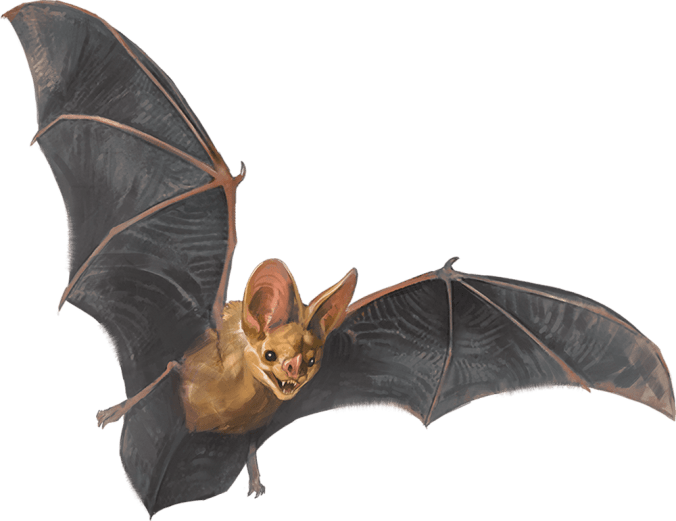
As a Familiar, the Bat is a top choice. It’s tiny, it can fly, and it has 60 feet of Blindsight, meaning that no matter how dark it gets, your Bat Familiar can scope out a room and get back to you with whatever you need to know. Plus, if you really want to freak someone out, you can have your Bat swoop at their face and maybe get Advantage on that Intimidation check.
For Druids, a Bat is a great Wild Shape option, for most of the same reasons. Being able to get in and out of small places while being very inconspicuous is a great thing to be able to do, though Druids only get to do it once they hit Level 8. A clever Druid, then, will use their Bat form to stay hidden, and then drop into combat by surprise and unload a Polymorph on the enemy that thought it knew what it was battling.
Other than those two situations, you probably won’t be needing a Bat’s stat block for very much. Unless, of course, you do something truly cruel, like give the Bat your Party’s MacGuffin and then have it fly into a cave to snuggle in with its Bat friends.
Like so many of the Beasts we’ve done here, what the Bat can do is far less interesting than what the Bat means. And the first thing that comes to my mind isn’t D&D at all.
It’s Batman.
For such small creatures that pose no real threat to humans, it’s remarkable that one of the most famous comic book superheroes of all time was fashioned around a Bat. He could have chosen a creature that is actually dangerous, like a wolf or a lion or an eagle. But Batman understands why Bats freak people out: it is a creature that is at home where we are most afraid. Where we stumble, it flies with ease.
Bruce Wayne could have been anything. He chose to become one of the few animals that we have spent thousands of years instinctively distrusting.
But it’s not really the Bat that we fear. Again – Bats are largely harmless to humans. What we fear is that uncertainty and darkness, the way it perceives a world that we can’t even begin to understand. Where humans enter a cave and have to be cautious and prepared, the bat just thinks, I’m home.
And maybe that’s what the Bat can mean for your world. It can mean that the dark places, the strange and alien places are home to something that finds comfort where your Party finds fear.
One way you could explore this is to think about the places people normally fear to go. In cities, it might be the “bad part of town,” which usually means where the poorer citizens, the immigrants, the ill-served live. Since many Adventurers are hired by people with money, you could seed this idea early on – that there are places in the city where it’s dangerous to go, where only thieves and brigands can live, and it would be foolish to travel there, especially at night.
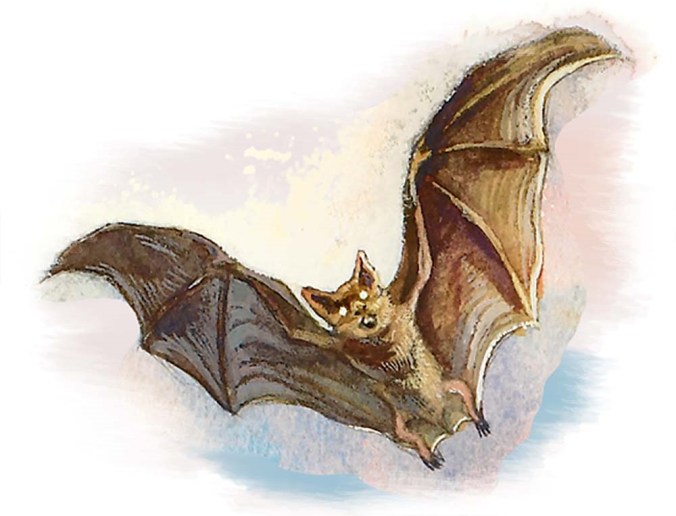
But what happens when your Players inevitably have to go there? They find a society that is governed by rules they don’t understand, which the residents navigate with ease, but which baffle outsiders. These aren’t bad people, you see. They’ve just had to live underground for so long that they experience the world differently.
And that’s where you can seed in your Bats. Maybe the main tavern they go to is called the Bat Cave (because, if you’re like me, you can’t help yourself.) Since this part of the city is generally ignored by the powers that be, they have their own guards – the Bat Men (I am so sorry) who mark themselves with a Bat insignia as a mark of pride and civic duty.
You might also use the Bat as a symbol for high-adventuring academics. Imagine a Wizarding society where there’s a small group of spellcasters who are determined to explore the fringes of magic. They want to know just how far you can Polymorph something before it breaks, or how Planar Binding can be used in new and terrible ways.
The label themselves with the Bat because, as they see it, they are navigating in the dark. But where other stumble, they shall fly. And, for the purposes of your Campaign, where they fly, they bring chaos.
Finally, the Monk’s Warrior of the Open Hand or Warrior of the Street subclasses would be an excellent way to finally give in to the urge we’ve all been sitting on and make a vigilante for your Big D&D City. They would be a figure of legend – rarely seen, often spoken-about, willing to bring justice to the alleyway muggers just as much as the high-society organized criminals. Perhaps your Party has been hired to apprehend this lone warrior so that the people of influence are no longer plagued by their brand of justice. Or, alternatively, you’re somehow dragged into their plans, becoming a part of how they exert power over their part of the city.
A bat is really just a flying mammal. As a symbol, though – worn on a chest, tattooed on a guard’s arm, adopted by those who work in darkness – it means something. It means “I am at home here where you are afraid.” It becomes a symbol for those who know how to navigate worlds that other people fear.
Your players will fear bats less once they realize bats aren’t the enemy. The darkness is.
And darkness doesn’t have to be an enemy at all.
 Encounter Every Enemy
Pingback: Giant Bat: Remember to Look Up | Encounter Every Enemy