We’ve talked before about the existential horror of Awakened Plants—how terrible it must be to go from just calmly photosynthesizing to being a fully self-aware, sapient being. Today we’re going to talk about their less-complicated cousins, the Blights.
These are plants that have some autonomy, but not the same capacity for thought. They just have evil in their wooden hearts and are ready to take that evil out on your Party.
The Monster Manual offers you a nice variety of Blights to fill your Hag’s garden or evil Druid’s woods. Depending on your Party’s level, you can throw any of these at them and really ruin their walk in nature. In fact, the progression of Blights are a framework on which you can build an entire campaign.
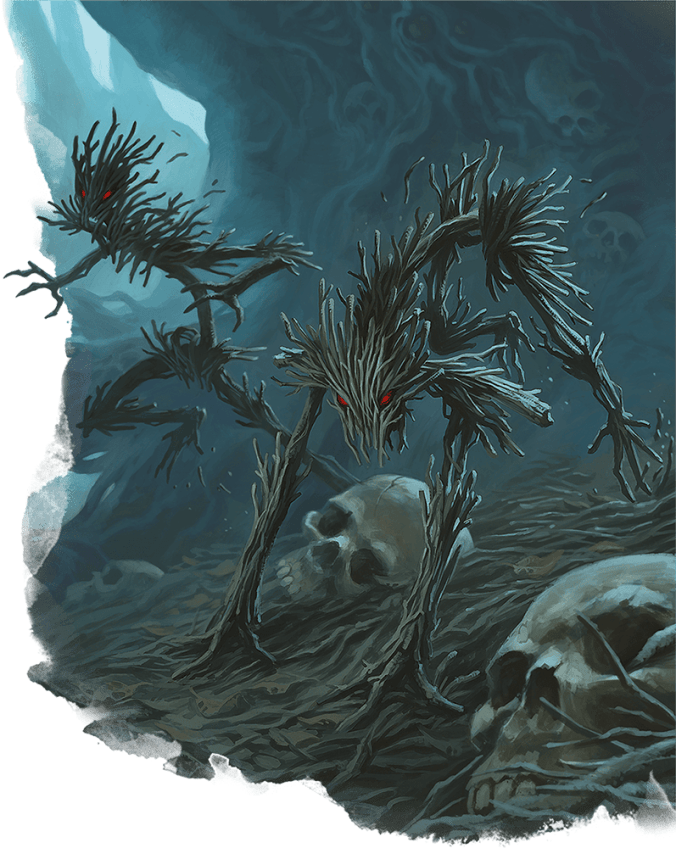
For your low-level Party, Twig Blights are great little guys to put in their way. They have only about 7 hit points and go up like kindling when they’re hit with fire, but if they surround a character they can cause some real problems—they have Pack Tactics, so having more than one of them around, say, your Wizard will probably result in your Player needing to break out that backup character.
Twig Blights look like little bundles of kindling, and hide well anywhere you have scrub brush or piles of wood. This may be on the outskirts of a little village your Party is passing through. For the last few nights, people have talked about hearing strange rustling in the brush near the woods. Not the rustling of animals or woodland creatures. Little clicks and clacks and snaps that don’t sound like anything else.
And then people start turning up dead. Remember: Commoners are not hard to kill, and a small pack of Twig Blights can easily take down a lone person just out gathering wood for the winter. Their body is found the next day, slashed by tiny claws that don’t look like any predator they’re prepared to hunt. But with your Party’s help, perhaps this little village can find some peace and security. And your Party might be able to make their first allies in the campaign you have planned for them.
Needle Blights are a little stronger than their twiggy siblings, and definitely weirder. According to the Manual, they “have vaguely bipedal forms, with gaunt, misshapen limbs. Whether standing unnaturally still or lurching with their awkward gaits, these blights can’t pass as either normal plants or woodland travelers.” So whereas the Twig Blights are good at hiding, these guys aren’t fooling anyone. They start lurching out of the dark woods and come right at your Players.
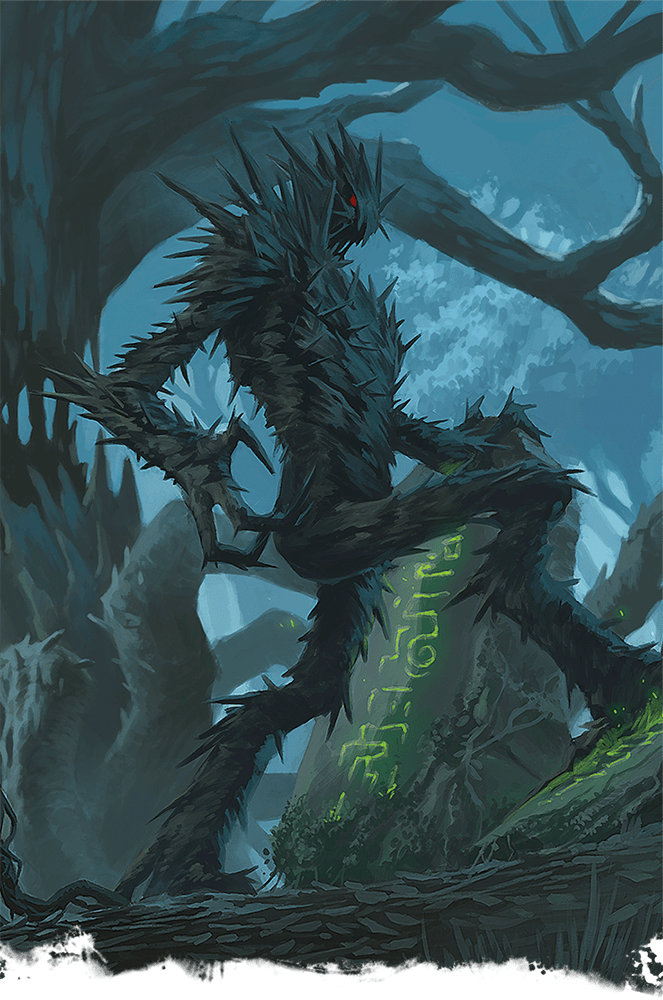
These would be excellent guardian creatures for your twisted villain of nature. Despite their strange gait, they walk as quickly as most other monsters, meaning they can give chase when they see your Players approaching that strange hut in the middle of the woods where that weird old wizard happens to live. What’s more, they can fling their needles up to 30 feet, potentially able to take down a Level 1 character in one shot.
You can certainly use these with higher levels as well. As your Players approach the Green Dragon’s lair, for example, the Needle Blights could be a first line of defense. They’re certainly not going to kill a Party that is looking to take down a dragon, but they would help to slow them down and make them waste some resources just to get through them.
Moving up the ladder, we can bring Vine Blights into the adventure. What I think is easiest to overlook with these creatures is that they are able to speak. They’re not all that bright, but they can carry a message from their terrible masters. So one night, as your Players are camped out and planning the trip for tomorrow, this strange, vine-wrapped figure comes walking slowly out of the darkness. It cocks its head and rasps a warning: These are the lands of Granny Swamplurker and you are not welcome.
Now the problem has changed from one of environment to one of intention.
They’re also the only Blight with the ability to cast a spell—Entangle—keeping your Players restrained in place so that other Blights can more easily get off their attacks. They might also wrap their vines around a Player, pulling them in tight so they can squeeze and crush every turn. The Vine Blights make great controller monsters to make it harder for your Players to get to their real objective, deeper in the woods.
And that objective may well be a Tree Blight. These are a step up from the other Blights, as they’re great, twisted trees that hate pretty much everyone and everything around them. Unexpectedly, they can move a lot faster than you expect a tree to move, and their attacks hit pretty hard. Even better, if you can catch a Player with the tree’s Grasping Root, you can then get in an extra attack when the tree opens its woody maw and gnashes at them.
These are the Blights that a group of evil Druids might use to guard their twisted grove against intruders such as your Party. They patrol the forest, looking for anyone who might approach and they will happily take out anything that moves wrong. This includes, as the Manual specifies for what must be specific reasons, other, similar plant creatures such as Awakened Trees or Treants. So if your Party thought they were going to sneak past by enlisting some other woody help, they can think again.
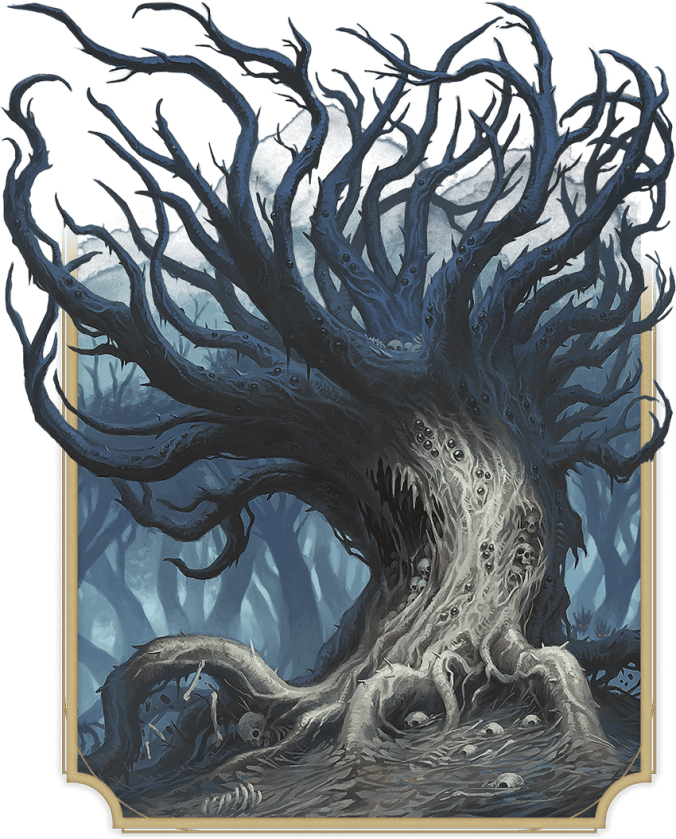
Finally, the true Big Bad of the Blight family is the Gulthias Blight. These are twisted trees that are said to have grown from the stake that killed a vampire, and they divide all other creatures into two categories: servants or fertilizer.
This is the Blight that the serious evil Druids worship, the one they bring their blood sacrifices to. It’s the Blight that the Hags manage to work with, to deal with their victims when things finally go south. This is the Blight that twists an entire forest around it, turning something beautiful into something malevolent. The story that starts with the dead villager finds its end here, especially since the Gulthias Blight is able to create smaller, lesser Blights once a day. If it’s been doing that for a while, it can spread its malice far and wide before it is eventually confronted by your Players.
And when the time comes to fight this twisted tree, it won’t be easy. It can move up to 50 feet per round, lash out from near and far, and drain the life right out of a creature it has captured. What’s more, it will almost certainly be surrounded by lesser Blights. Or fanatic Cultists. Or evil Druids. As long as this Blight is a source of power and influence in the forest, there are those who will fight on its behalf.
Most of the fairy stories and monster movies that we love tend to ignore the incredible horror potential of plants. In our world, if you get hurt by a plant, you probably deserved it by tramping through brush you shouldn’t have been in or by being careless with your chainsaw.
We don’t expect plants to move. Or attack. Or hate.
If there is anything that unifies all the Blights, I think that’s it. They hate us. Why the Blights hate us is up to you: poisoned soil, a vanished grove, centuries of axes and fire. Maybe they just despise all meat life for reasons only they understand. But your Players don’t need the full history before they fight one. They just need to understand that somewhere in these twisted roots, something remembers exactly what was done to make it this way. And it’s not interested in forgiving.
And afterwards, when the Gulthias Tree is ash and the woods are finally quiet, a villager will go to their winter firewood pile like they have done for years… and hesitate. Because they know now that the woods aren’t as indifferent as they once thought, and that if pressed, that hate can come back with a vengeance.


Pingback: Dryads: The Guardians of the Green | Encounter Every Enemy