It can be tough to be overshadowed.
There are times when, no matter how hard you try, someone bigger, better, stronger than you manages to soak up the spotlight and leave you in the shadows, wondering what all this hard work was for. And you know that if people just took a moment to give you a look, give you a chance, you’d show them something truly special.
I’m talking, of course, about the Allosaurus.
Wait. What did you think I was talking about?
Anyway, the Allosaurus is a great dinosaur. And if the Tyrannosaurus Rex didn’t exist, we might be telling ourselves stories about this guy instead. He may be smaller and have a worse PR rep, but if you need a good dinosaur for your campaign, and you don’t want to blow all your surprises on a T. rex, then an Allosaurus is a great idea.
The biggest difference between this dinosaur and T. rex is that while Rex was a solitary hunter, if not a scavenger, that relied on brute force and proximity to take down its prey, the Allosaurus (it is believed) was a pack hunter. It didn’t have the sheer muscle of its very distant, but much more famous, cousin. And so where the T. rex simply needed to be in the area of its meal, the Allosaurus needed more strategy.
This is reflected in a particularly nasty aspect of Allosaurus’ stat block: if it can get a 30-foot run at your Player and slash at them with its claws, it can knock your Player down and get a free Bite—at advantage, mind you—potentially doing more than 20 points of damage in one action.
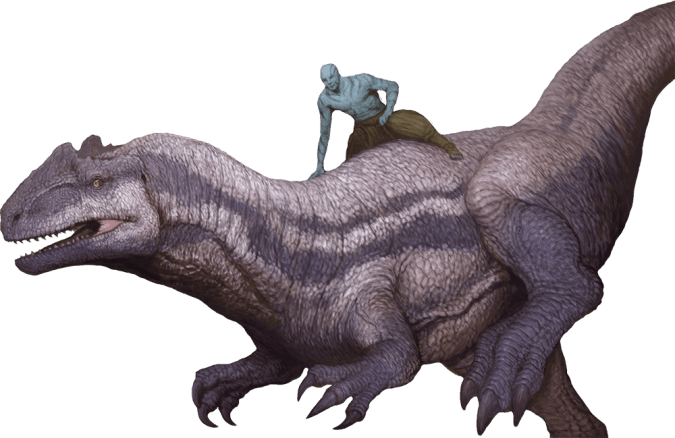
So when you’re setting up an Allosaurus encounter, mobility is your friend. Make sure your Players find it hard to get out of the line of sight of this creature so that it—and its friends—have a clear shot at whichever one of them has made it the angriest. It’ll force your Players to think about positioning and the way the battlefield is set up and how they might use the terrain to their advantage, something which I know I have trouble with.
If you have clever or tactical-minded Players, they might notice that the Allosaurus likes to use half of its movement to back up before charging, and will start to put things in its way. A stand of bushes or a fallen log, perhaps. Or they might draw it into a convoluted gulch that doesn’t let it get a running start.
There are certainly plenty of circumstances where your Party might encounter the Allosaurus. They could be wandering through the deep jungles of Chult (or a Chult-adjacent locale), looking for the lost temple that will either make them rich or steal their souls. The local guides have warned them against being complacent in the wilderness. And, of course, they ignore those warnings.
There’s a crack of wood ahead of them. Then another behind. Maybe one more off to the left over there, with the sun streaming in and getting in their eyes.
And without any other warning, three big, bullet-headed dinosaurs come charging in to knock everyone over and chew out their guts. Not because they hate your Party, of course, or even think about them at all. Your Party is in their territory. They are prey. That’s all.
If you want, you can play with the idea of the Allosaurus as the “also-ran” apex predator. Let’s say there is a Noble in their city who, as Nobles do, wants to have an exotic beast for their menagerie. Something the other Nobles don’t have, so they can lord it over everybody at their soirees or salons or wherever rich people go to make other rich people jealous.
So they give your Players a mission: go find me this creature of legend. Bring it to me alive and unharmed, and I will make you all wildly rich.
From the description it will sound very much like a T. rex—maybe fooling your actual Players around the table as much as it fools their characters. If your Players are clever enough to do some research first, they might realize that the Noble is sending them out for something wholly different, and have to decide if there’s any way they can pull the wool over this person’s eyes so they can get away with the money.
On the other hand, they might not know the difference at all. So you send them off to a faraway lost island, set up these Allosaurus fights, make them figure out how to capture one, keep it alive, and deliver it back to the Noble.
Only to find out that they should have done their research because this is not the monster they were paid to find. That overdressed Noble looks up at it and says, “I thought it would be bigger.”
And then, of course, it escapes its confinement and starts charging through the streets of your city, discovering that well-planned, straight-line streets and avenues are just perfect for a creature like it. Despite being millions of years removed from civilization, the layout of a great city plays to the Allosaurus’ strengths, something that even the most forward-thinking city planners probably wouldn’t have thought of.
If you want to put the Allosaurus on more allegorical footing—and why wouldn’t you—it might allow you to explore the difference between power and opportunity.
The Tyrannosaurus Rex is a study in power. It doesn’t need to strategize or think its way through a conflict. All it has to do is be there, tearing through everything in reach. It has power and doesn’t give a damn about anything else.
The Allosaurus can’t impose itself on the world the way T. rex can. It needs to work the angles, figure out the distances, and position itself for success. If the Allosaurus tries to fight like a T. rex, it will lose, and likely not walk away from that fight.
Give your Party an enemy that thinks it can’t be beaten, one that simply exerts power on the world around it. A ruler of a great kingdom. A Blue Dragon that has conquered a continent. A Gulthias Tree that rules a forest. Let your Players learn lessons from the Allosaurus, from being outmaneuvered by a seemingly lesser monster, so that they know the difference between being powerful and being effective.
And then they can show the rest of the world what happens when they’re underestimated.

