Your Players have discovered, in the middle of a vast desert, a massive abandoned temple complex. Huge sandstone blocks in a ziggurat that seems to climb to the heavens. And in the middle of this temple, basking in the sun, a great, Brass Dragon waits for adventurers to come into its lonely lair.
“Oh! Company! I’m so glad you’re here. Now, sit down, because I have a lot to catch you up on….”
Every class of Dragon has its Thing: Bronze Dragons are fighters of injustice, Green Dragons are sly manipulators, and so on. It’s a convenient way of helping the Dungeon Master decide which Dragon is best for their campaign, either thematically or mechanically.
The Brass Dragons are the chatty ones.
They’re the Dragons who would probably invite your Players into its lair for something to eat and end up spending the entire day using Major Image as the equivalent of showing them the slideshow of their vacation photos. They would look at your Barbarian and perhaps say, “You remind me of Voxiana of the Dry Sands—are you related by any chance? She was an amazing fighter, great with a warhammer. In fact, I remember when she came to me one time and I said, ‘Voxiana,’ I said…”

Gossip-mongers, information brokers and all around extroverts, Brass Dragons have an important role to play in any campaign they’re in. And while they are cute when they’re young, the older they get the more they gain a central role in your world—and a certain sense of tragedy.
Brass Dragon Wyrmlings are basically like that over-excited niece or nephew who just can’t wait to meet everyone at the family reunion. They’re happy to approach anyone who looks even remotely approachable and strike up a strange, very fixated conversation with them, perhaps tagging along uninvited on whatever quest they happen to be on. And for your Players, that could be either a source of good humor or incredibly irritating.
Imagine this: your Players are exploring the wilds, and they’re approached by a bounding, brass-scaled wyrmling the size of a large dog. “Hi! My name is Mu’undi” What are your names? Boy, that sword looks shiny – can I hold it? Where are you going? Can I come?” All in Draconic, of course, because—Rules As Written—wyrmlings don’t know Common yet.
Even so, who could say no to that?
It could be a lot of fun to have Mu’undi in your adventure, especially if you have a Party of characters who are relentlessly Grimdark and who would absolutely never want to associate with a creature that is essentially a fire-breathing, sleep-inducing golden retriever. For the DM, it could be a good way to spur a hesitant Party or one that often gets paralyzed by planning into action. Sure, they could talk for an hour about the best way to open that door, but guess what? Little Mu’undi has already done it and is yelling, “Hey! Come look at this! I didn’t know bones could walk!” from down the hall.
Odds are pretty good that the wyrmling will nominate themself as the Team Mascot within three sessions, and if you’ve done your job right, your Players will have no choice but to give in. And while Campaign time usually doesn’t last for years and years, when it does come time to say goodbye to their new friend, they’ll know they have an ally in what will one day become a very powerful Dragon. One who will likely remember them for centuries to come.
As they grow and become Young Brass Dragons, they get more serious. Instead of tagging along with whoever seems most interesting, they begin to go on their own travels, exploring the world and building their networks of friends and allies. These Dragons are the ultimate in “I know a guy” personality. No matter where they go, they know someone, or know someone who knows someone, who can get information.
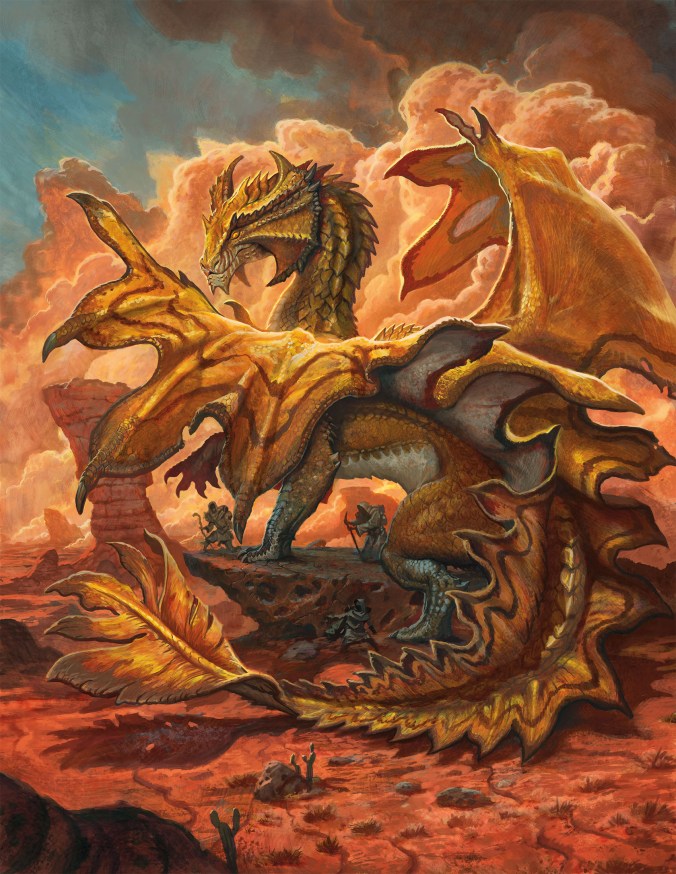
Mu’undi is now a traveler, and when your Players meet him, he’s no longer the peppy little bundle of enthusiastic energy that he once was. Now he’s determined to go to new places and help bring people together. He might be the one who is helping a Bronze Dragon gather their troops for an important mission to defend an ancient kingdom. The Bronze needs heroes, of course, and Mu’undi knows where all those heroes live, what they are best at, and, for some reason, their favorite variety of soup.
In a darker campaign, a young Brass Dragon could be a wartime courier, bringing messages from one army to another, or finding lost informants and bringing them home. They’re the Communications Corps in this conflict, and their presence is not only an important way to communicate, but a morale boost all by itself.
Your Players are bogged down in a conflict, perhaps cornered by enemy forces in a blasted landscape. Hope is not yet lost, but it’s looking at the map and making confused noises. Suddenly, a flash of red-gold scales, and this Dragon comes to ground in front of them. “Hektor! Vansara! Leffen! You all look terrible. I can’t wait to catch up, but first I have this message for you….”
Your Players may be in a tough spot, but now they know they’re not alone. And that’s worth a lot.
The Adult Brass Dragon is probably less excited about being on the front lines of adventure and more about being the information broker in their region. They’ve spent decades collecting people and building networks of informants. They have an excellent memory for what they have heard and fight fiercely for the truth. More importantly, this is the point at which they learn the Shapechange spell, allowing you to sneak a Brass Dragon into your campaign under the guise of a perfectly ordinary person.
So this time your Players meet a stout, middle-aged man named Mu’undi. He knows everyone, and somehow always seems to have that extra bit of information that can guide them to the next stage of their adventure. However, he’s grown now. He doesn’t give information away for free. Your Players will need to tell him something that he doesn’t know, and that might be a lot harder than they expect. Simply getting the information to continue their quest may be a quest in itself.
In fact, this might be a good place to pair your Brass Dragon with a Guardian Naga. As keepers of secrets and histories, the Naga would be an excellent place to put that knowledge that the Dragon doesn’t have. Mu’undi may even tag along with you in humanoid form, helping you navigate your way through the jungles (which he finds far too humid and oppressive) and killing time by telling your Players stories about all the people he knows.
Once you put the Brass Dragon and the Guardian Naga in the same room, you should probably move on to a montage, unless you’re one of those DMs who loves to talk to themselves for an entire session. Regardless, you will have done two important things: You’ve advanced the adventure, of course, and your Party has now introduced the Brass Dragon to someone who knows all the forgotten things about the world. And that will definitely put them in the Dragon’s good books for a long time.
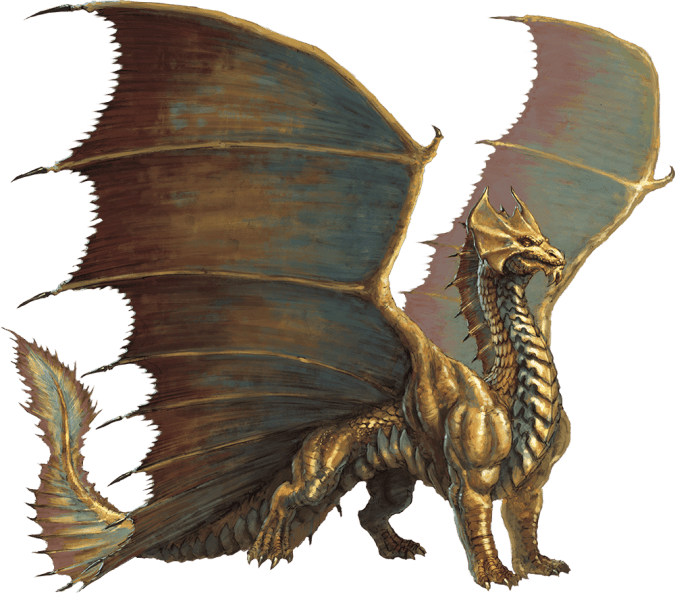
Finally, as an Ancient Brass Dragon, Mu’undi sits at the center of an information network that spans not just nations, but worlds. Be careful, though: having an Ancient Brass Dragon in your campaign means that, in practical terms, Mu’undi is a one-stop-shop for your Players to get the contacts and information they need, and they will likely default to him when they need something. “Sure, we could crawl through the Cursed Castle of the Bog Lich to find the lair of Tezempelex the Grey. Or…. we could go talk to Mu’undi. He’ll have snacks.”
And that’s a fair problem. This Dragon knows everyone and can probably track down whatever information your Party is looking for. So you need to make sure that he’s always at least one step away from knowing what they need to know. He might not know where that lair is, but he knows someone who knows someone who might. From their desert lair, they see the connections between people, between nations, and between eras. They are collectors of people and their stories, first and foremost.
Which brings us to the quiet tragedy of the Brass Dragons. Why are they the chatty ones, the ones who make friends at the drop of a hat?
Perhaps it is because they know they’ll outlive all these kings and artists and adventurers. Dragons live far longer than most, after all, and the Brass Dragons know that. They know that one day, their friends will be gone.
But they are determined to ensure that they will never be forgotten. Not in the sense that history may remember someone, but in the way a friend would. The quirks, the little things that would never show up in the Chronicles of the Great. Who told good jokes, who loved someone they weren’t supposed to, who always brought honey cakes when they visited.
The Brass Dragons aren’t chatty because they like the sound of their own voice or because they need to fill the silence. They’re chatty because someone has to remember the people that history won’t.
“You never mentioned—is Voxiana of the Dry Sands related to you?”
“Yes. She was my grandmother. We… we never met.”
“Oh. Well. Sit down, young lady.”
“But we have to stop the Bog Lich from—”
“Doronac has been a lich for a thousand years. He can wait another day. So. Your grandmother was one hell of a card player….”

