Your Party continues their wandering through the desert. They’ve chatted with the Brass Dragon and undone the schemes of the Blue Dragon. They feel good about how they’re doing so far—confident, prepared, ready for anything.
And then, in the sky in the distance, they spot a small, black dot just circling. It’s joined by another. And then more. Gently riding the updrafts as they circle something down in the sand, waiting patiently for the inevitable.
Without knowing what this could mean, your Party heads towards the birds, swords in hand, spells ready to go. And when they get there, what do they find? My impulse is to say it’s their favorite NPC, exhausted, dehydrated, unable to move. And their last words before they pass out are, “I… I found you.”
And then the Vultures land.
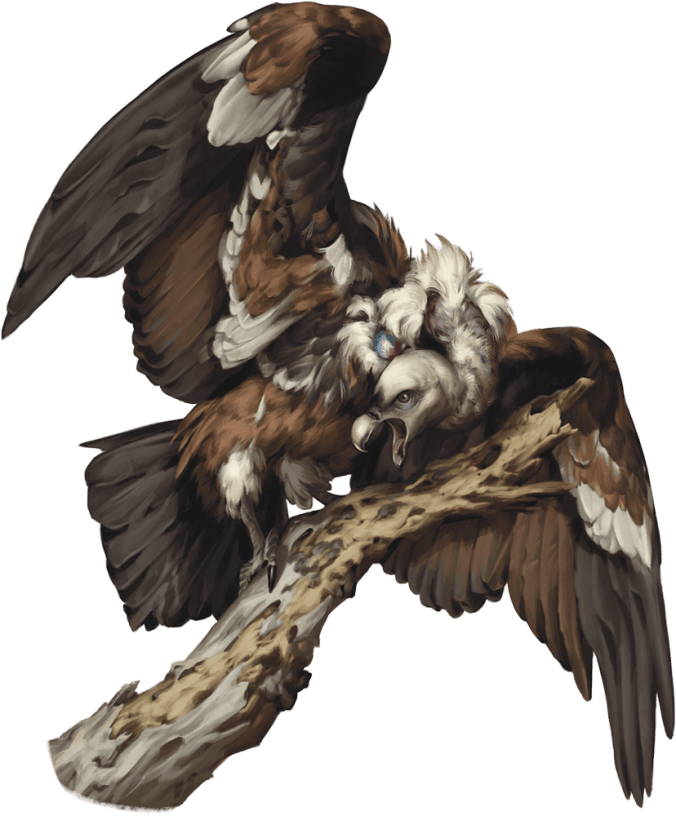
In pretty much any adventure, whether it’s D&D or a movie or a TV show, Vultures aren’t an encounter. They’re CR 0 creatures who, at best, get to use Pack Tactics to maybe shave 2 HP off your Players at a time. No one ever really fights Vultures, because that’s not what Vultures are for.
Vultures, in most stories, are a signal. They tell us, “Something bad happened here.” Someone failed to find food and water. Someone was ambushed and murdered by bandits. Someone found themselves on the wrong end of a Giant Scorpion nest. Whatever happened, their part in this story is almost over. But not before they make sure your Players know where to go next.
It feels like a bit of a cheat, really. This role that Vultures play has been so ingrained in our popular culture by years and years of storytelling that it would be almost impossible for your Players not to investigate. It’s a giant signal that basically says, “The story is this way, people!” And unless your Players are the kind who deliberately ignore your adventure hooks—because they are the True Monsters—you can almost guarantee they’ll make their way to where the Vultures are.
And when they’re there, you can give them what they need for the next stage of their Adventure (except, maybe, food and water):
- The aforementioned Beloved NPC, desperate to find the Party
- A map to the Hidden Temple of King Phanarus the Gold
- The signet ring of the Royal Family, kept hidden against usurpers and meant for the exiled princess
- A spellbook, full of cursed magic that was meant to be lost in the desert
- An explorer with a copy of Volo’s Field Guide to Vultures who, alas, found what they were looking for
The possibilities are endless, and comforting. In a weird way, because it gives the DM a very reliable place to hang their adventure hooks.
Vultures don’t just have to act as beacons to the next stage of the Adventure, though. They can be players in their own right, participants in the world that most people stay away from out of revulsion or fear.
Ecologically speaking, Vultures are the world’s undertakers. They ensure that the deceased are taken care of and returned to the world. Battles, plagues, monsters—anything that creates death will almost certainly attract Vultures to them.
And if your Adventurers are like most Adventurers, they leave death behind them on a very regular basis. Whether it’s Goblins or Bugbears or Gnolls or anything else, I have yet to run a group of Players that makes sure to bury the bodies that they have just put down. Loot them? Absolutely. See that they’re properly interred in the earth? Never.
Every time they have a fight and deal with some bad guys, the Vultures come to take care of what remains.
But perhaps these Vultures begin to anticipate your Party. They know you’re good for a meal, so… as your Players are sneaking up on a Kobold nest, one of your Players notices the Vultures up in the trees and, for a moment, wonders, Are those the same birds?
Soon, the Vultures aren’t following your Players—they’re leading them from one slaughter to another. Showing them where the easy pickings are. Where your Players can provide them with fresh and delicious meals.
If you have a Druid in your Party, they might feel curious enough to cast Speak With Animals to learn a little more. After all, these are the witnesses that no one ever really thinks to question. They see the whole thing, but they remain part of the background, creatures that most people choose to ignore.
With the battle finished, bodies everywhere, your Druid asks, “So… did we get everyone?”
No. Soft men ran.
“Where did they go?”
The Vulture nods towards the distant woods.
“How many?”
Enough food.
How long do you think it will take for your Players to realize that, whatever quest they think they’re on, their real quest is to make sure this band of Vultures is well-fed? On top of that, what happens when your Players discover that the Vultures don’t judge the dead. A dead Goblin and a dead Paladin are both food, and if one member of your Party should fall, well… they’ll fill vulture bellies just as well as anyone else.
Finally, as we have discussed here before, sometimes a beast in your D&D adventure can do more than just show up as part of your worldbuilding. Sometimes they can be inspirational, carrying more meaning than purpose.
There are rumors of a masked and robed person who has been seen on the edges of battles, turning up at the sites of muggings and murders, anywhere that death comes unexpectedly. Witnesses say that this person appears in ragged black robes and a long, beaked mask, and they have named them The Vulture. With the wave of a hand and an arcane word, the murdered dead rise to follow the Vulture into the shadows, where they all inevitably vanish.
Your Party’s new quest: find this necromancer and stop them from interfering with the dead.
So, what is the Vulture’s mission? Well, that’s entirely up to you. Maybe The Vulture is building the classic Undead Army, gathering corpses to overrun the kingdom and raise a Necropolis over which they can reign.
Maybe they are working on a Flesh Golem, an obscene violation of the boundaries between life and death. They need the bodies to find components—a femur here, a set of toes there, maybe a nice head of hair—so they can build their perfect being in their little loft apartment near the university.
Or perhaps they are merciful in their dark magic. They are not trying to violate the dead, but rather to respect them. They see these violent deaths as unjust, and their mission as one of kindness. The undead that they raise are brought to an orchard of trees and flowers, where they are commanded to lay down and rest in a place of beauty and peace.
The fact that these dead people had families who might want to mourn them themselves never really enters The Vulture’s mind. They’re doing a kindness to the world, and will be very upset if they are told otherwise.
Now your Party has a decision to make. How does one deal with misdirected kindness, with a mercy that also happens to be a crime? Like their animal counterpart, The Vulture is playing a role in the cycle of life and death that disgusts and disturbs the living, but this is the greatest mercy that they know.
Your Players are bringers of death in almost any D&D adventure. This is part of what you sign up for when you decide to play D&D instead of, say, Kids on Bikes. And when the fighting is over and the bodies are looted, your Players immediately stop thinking about the creatures they just killed.
But the Vultures know that when the Adventure is over, dinner begins. The only question left is whether your Players figure it out before the birds start calling them by name.

