Goblins! The staple of D&D adventures, especially at the lower levels. If you need a threat along a road, somebody to cause trouble in a small farming community, or minions for your Players to kill by the dozens, Goblins are your go-to monsters. They’re small, they’re kind of nasty, and ubiquitous to the game ever since its inception.
But what does that ubiquity mean for us as we play the game? If you think about it, there are a lot of really interesting implications that come up when you think about Goblins in D&D.
Goblins teach your Players who matters.
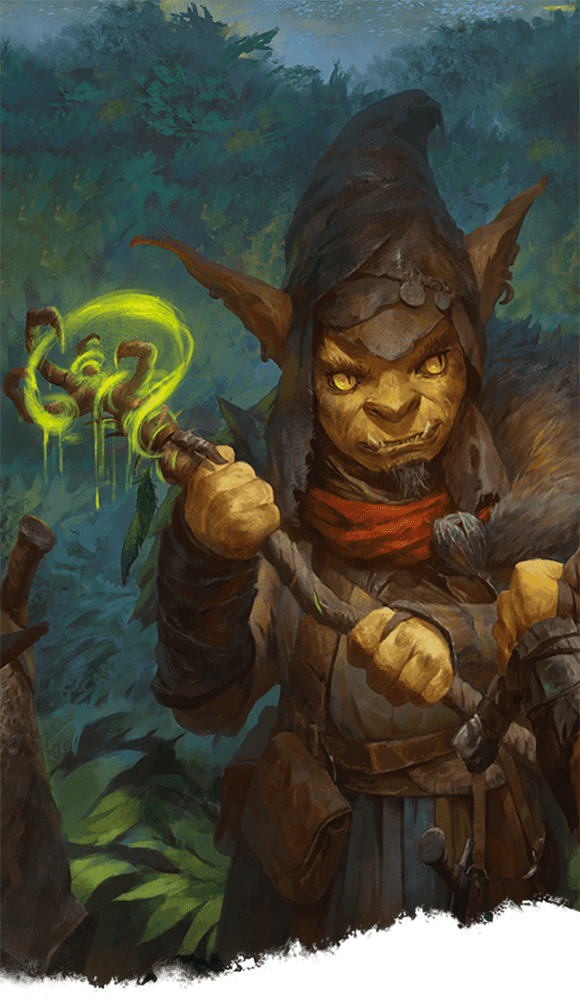
“Hail and well-met, Adventurers! Goblins have been harassing our town recently, and the burgomaster has placed a bounty of 50 gold for every Goblin ear you bring us!”
That’s it. Goblins are a target now. And it would be easy enough to leave it at that, letting your Players scythe through Goblin dens to make their money. But – and this is important – Goblins are thinking beings. They have an Intelligence of 10, which is equivalent to Commoners in the game.
Now if the burgomaster had said, “Go to the next village and kill everyone. 50 gold per ear,” your Players would probably balk at that. There are mothers and fathers over there. Old people, teachers, farmers, all just trying to make their lives work. And sure, maybe some of them were harassing the town, but certainly not all of them.
But make it Goblins, and suddenly it’s all about rolling initiative and calculating hit points.
Because D&D has traditionally made it very easy for players to behave as though Goblin lives don’t matter. You could even add details to their camp that suggest a broader life than just being “monsters” – some little stuffy dolls in beds, freshly-washed cookpots, a pile of clothes to be mended – but chances are that your Players won’t find them until they’ve killed everyone, and once they do they’ll likely think you’re just trying to tug on their non-existent heartstrings.
For you as a DM, though, you should think about that when you plan your adventure. Maybe yes, the Goblins are harassing the town. But what’s driving them to do it? What are they missing that these towns can provide? Is there a peaceful solution to all of this?
There doesn’t have to be, of course. Some tables thrive on moral complexity and others thrive on murder. You do what is best for your table. But just be aware that this aspect of Goblin life can exist if you want it to.
Goblins are everywhere.
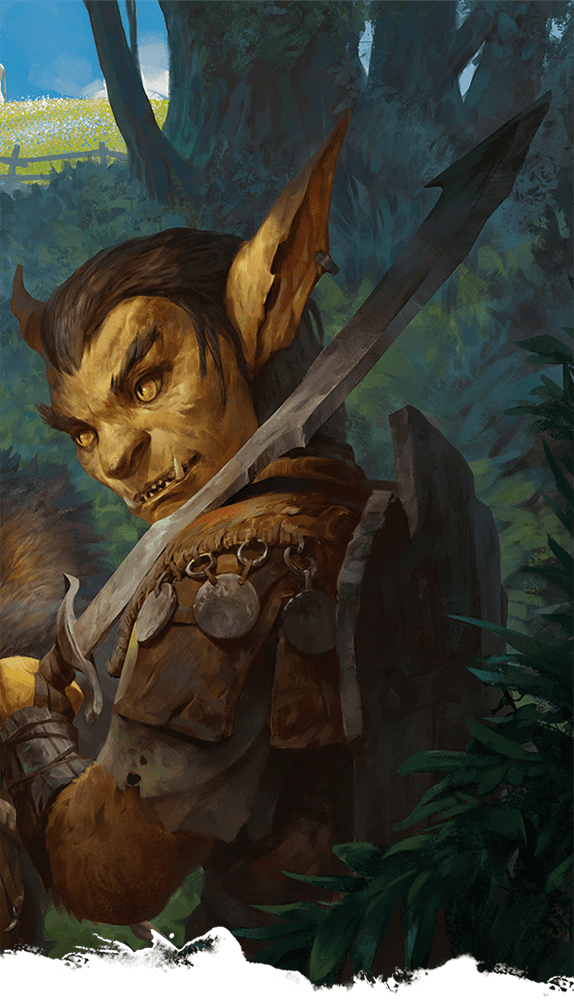
Think about it. They’re in abandoned mines, old caves, ruined temples. They can be crawling through the sewers of a city, behind the walls of an old fortress, under a bridge or deep in the forest. There is nowhere where Goblins can’t live.
And that’s because Goblins are survivors. Maybe not each individual Goblin, perhaps, but Goblins as a species are able to thrive no matter how many adventuring parties are sent out to kill them.
Kingdoms fall, countries fade from the map, and the Goblins are still there, looking around and asking, “Is anybody using this?” And let’s be honest—if a pack of Goblins has been occupying Baron Vasternaz’ ancestral castle for the last four hundred years, then who’s really invading whom when your Party comes to take it back? Goblins persist in a world that wants them dead, and if that isn’t strength, then I don’t know what is.
Now they’re not pathetic victims or just disposable villains. They’re creative, inventive creatures in a world that’s ready to kill them at a moment’s notice, and their response is a pair of middle fingers and screaming at you to Bring It On. They know for a fact that Goblinkind is going to be mucking up the works of civilization forever. If they can take out a few low-level fighters on the way, then all the better.
“Goblin” isn’t enough.
Your Players are coming down the road to their next destination when suddenly, three Goblins step out of the underbrush ahead of them. Your Players are probably already reaching for their character sheets when you have one of them say, “Adventurers! Thank Maglubiyet you’re here – the bridge is being held by Gnolls who are killing everyone and looting their corpses!”
Now your Players have to make a decision. Are these Goblins earnest? Are they really worried about not being able to cross the bridge? Or are they in league with the Gnolls, perhaps trying to lay the groundwork for whatever those vicious hyena demons are prepared to do. And your Players, even if they have never played D&D before, are probably going to assume that these Goblins are up to no good, no matter that they are weaponless and their body language tells anyone with even middling passive insight that they’re worried.
With any luck, you’ve now taught your players a lesson about making assumptions when they’re in your world. If they learn the lesson, they should be a little less quick to react, a little more critical about what they’re told when High Lord Manabachter tells them that they have to clear out these awful creatures in the woods. They may learn to step lightly and ask questions.
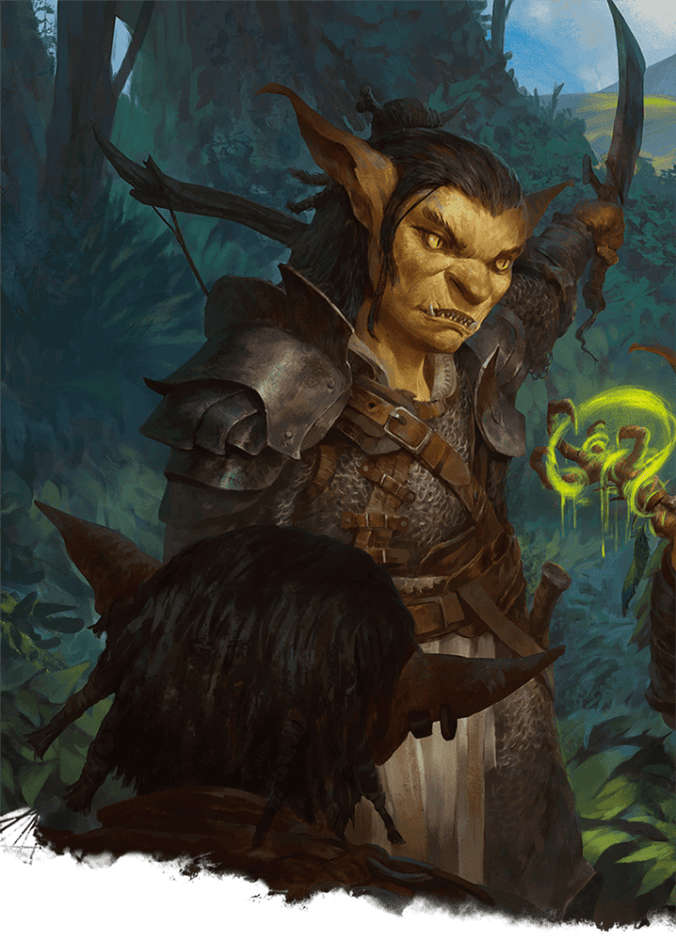
Which is when you put three more Goblins on the road who are absolutely going to rob them and kill them. Maybe in that order.
If it does come down to combat, though – which it almost certainly will – you do have more options in the 2024 Manual. You’ve got your Minions, which are fragile and annoying, but hard to catch and good with a dagger. These are the wild, screaming lunatics who run up behind your Players, stab them, and then Disengages so they can get away. I could see using a whole bunch of these guys, all cackling and laughing, even as they’re turned to paste by your Barbarian.
Then the Warrior, which has pretty much the same stats as the Minion, but with more HP and a bow. They’re more serious, more ready for the longer fight. Probably incredibly protective of the Minions and will probably fly into a rage when your Players kill them.
The Boss is more interesting, however, with the completely unscrupulous ability to swap places with a nearby ally as a reaction in order to avoid damage. I really want to run one of these as the loudmouth smack-talker who’s terrified of getting hit.
Finally, you have a Goblin Hexer, who might actually be a real problem for your Party. They can cast some deliberately annoying spells, such as Grease and Faerie Fire, and force a re-roll on an attack if they need to. These casters stand back from the main fight, probably monologuing as they cast and assuming they could never be hit. Right up until your Ranger puts an arrow through their eye.
However you use them, as the Dungeon Master, you’re in a very powerful position. Goblins will keep showing up, in your game and in every other DM’s game, for as long as D&D exists. But it was never really about them. The most important thing is what your table decides counts as a person worth pausing for. And what doesn’t.


Pingback: Flight, Fury, and Fangs: Adventuring With Wyverns | Encounter Every Enemy
Pingback: Blood and Bother: Deploying Stirges with Style | Encounter Every Enemy
Pingback: Druids: The Ones Who Speak for All | Encounter Every Enemy
Pingback: Arch-Hags: The Villain Who Already Won | Encounter Every Enemy
Pingback: Monster #50: The Mirror | Encounter Every Enemy
Pingback: The Commoner: The Most Important Stat Block in the Book | Encounter Every Enemy
Pingback: Danger Without Malice: Ankylosaurus | Encounter Every Enemy
Pingback: Muscle and Hunger: Giant Lizards in Your World | Encounter Every Enemy
Pingback: Giant Bat: Remember to Look Up | Encounter Every Enemy
Pingback: Toughs: The Argument at the End of a Fist | Encounter Every Enemy