Your Players are deep underground, perhaps seeking out the Lost Cavern of Alianka the Darkwitch in order to bring her the news that her sister has perished. The caves are dark and deep, as caves tend to be, and this particular one opens up into a vast cavern, with a ceiling so high that none of your Players’ precious darkvision can see to the top.
And then: the flapping of wings. Not a thousand tiny wings like a Swarm of Bats. Not a single, barely audible pair of wings like the Bat.
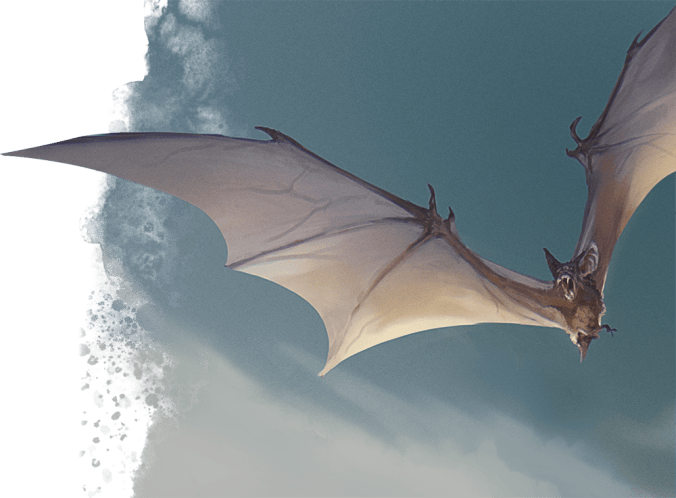
No, this is the sound of sails snapping in the wind. Heavy, leathery wings that can belong only to the Giant Bat.
As with many of the Giant beasts we’ve seen, these don’t have a very complicated stat block. They can fly pretty fast, they have a nice bite attack, and they’ve got Blindsight out to 120 feet. They’re strong enough to pick up a regular-sized humanoid, and pretty dexterous. So if you really wanted to, you could have a fight in the caverns where a bunch of these large creatures come flying down from the ceiling and try to pick up your Players and drop them from a great height. I’m sure they’d love that.
But combat isn’t where these kinds of creatures shine. If you want to introduce Giant Bats to your world, you need to make them mean something to your world. And that means bigger plans for them than just hiding in a darkened cave until some clumsy Adventurers show up.
The easiest way to do this is to give your Giant Bats some purpose in the world, and one purpose could be as mounts. Yes, they’re big enough that creatures – especially small ones – can ride on their backs. So if you’ve been wondering how you might spice up that Goblin encampment you’ve built up outside the city, why not give them Giant Bats?
Goblins are usually a low-level threat in D&D, to the point where they usually populate introductory adventures. But if suddenly they’re riding in on Giant Bats through the night, dripping incendiary bombs from above and swooping away? Now your Goblins are a problem, and the Giant Bats are a huge part of it.
Rather than task your Players with simply killing all the Goblins, perhaps they might be asked to look into where those mounts are coming from. After all, if they can carry those little guys, they might be able to carry some of your smaller humanoids as well. They need to track down the source of the Giant Bats. Perhaps they will need to observe and make a few good Animal Handling rolls to see if they can learn anything about training them. Figure out a way to transport them to their patrons who want to use the bats to their own advantage.
And then kill all the Goblins.
Much like some of the other mounts we’ve talked about, you will almost certainly get your Players asking if they can have one. That could be a whole quest in itself – to find someone who can teach your Player what they need to know about riding a Giant Bat. Because riding a horse or a Dire Wolf or some other ground-based mount is one thing. On this mount, your Player is not only flying, but the Giant Bat is navigating by echolocation (or Blindsight, if we want to stick to the stat block). That’s great for flying in complete darkness, but your Player had better have nerves of steel in the process. Falling to their death might be just a few saving throws away. After all, the Bats know exactly where all the stalactites are, and it might not care how close it gets.
If you want your Bat Mounts to be more part of the world, think about how they could be put to good use by the people who live there. They would be excellent overnight messengers, carrying important missives through the dark from one settlement to another. Maybe a Dwarf kingdom keeps a stable of Giant Bats to act as mine rescue mounts, carrying injured Dwarves out after a mishap in the deepest corners of the world.
A couple of the bats come back, bearing the injured. Then one comes back bloodied, with no miner. Then the rest don’t come back at all. Now your Players have a mission: find out what happened to the Bats.
And the miners, probably. But the Bats are hard to come by and expensive to train, so definitely the Bats.
In addition to interacting with the lives of the people in your world, having these creatures around gives your world three dimensions, which can be very helpful with Players who routinely forget to look up. They might be hiking through the woods when suddenly something hits the ground. A boot. Then a backpack. Then a very annoyed Halfling who is now miles away from his surveying expedition and would really appreciate a hand getting back to his comrades safely.
Or perhaps your Party is walking along a ravine when hundreds, if not thousands of Giant Bats come rushing up out of its depths. It’s the middle of the day, so what’s happening down there to drive them out? What could be big enough and hungry enough to eat these creatures, and how much XP does it grant?
You could even have your Players sitting around their campfire after a long day of adventuring, ready to set watches and go to sleep, when a Giant Bat comes careening out of the sky. It’s injured and exhausted and covered in claw marks. After the initial confusion settles, your Players realize that maybe looking up would be a good idea, just in time to see the Wyvern barreling down on them to retrieve its dropped meal.
Like so many of the Beasts we talk about here, Giant Bats give you ways to enrich your world. Most of your world exists at eye level – roads, doors, conversations at a tavern table. Giant Bats remind your Players that danger, rescue, and opportunity don’t respect that limit. Sometimes the only warning you get is a Halfling falling out of a clear sky. The trick is teaching your table to look up before it’s too late.

